21 minutes ago
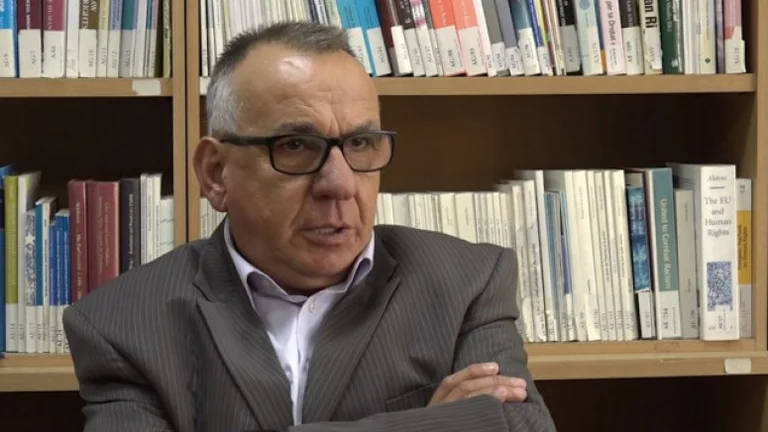
Enver Hasani: The current stock of Association creates a special regime such as The Hague, undermines 2008 independence
Periskopi(3 years ago)
(3 years ago)The former head of the Constitutional Court, Enver Hasani, has spoken about the question of the draft status state of the Serb majority municipalities proposed by the European Union. He in an interview with Blic newspaper has said that if this kind of association is done is out of Kosovo's constitutional order, and therefore he has mentioned it one by one [...]
He in an interview for the Blic newspaper has said that if this kind of association is done, it is out of the constitutional order of Kosovo, and for that, he has mentioned one by one the reasons why Kosovo is so threatened by such an association, while talking about the introduction of Resolution 1244 in that draft.
“The statue creates a special regime, similar to what we have in The Hague, on all issues related to the Serb community, beginning with representation of their political will, executive policies, police, court, report with other states, Serbian church, cultural and historical heritage on Kosovo territory. This is a law regime that is left alone (“sef-contained legal regime”).”, Hasani says.
Total interview:
What are the main shortcomings of the draft-status that have already been made public?
Hasani: There's a couple of eyes. The first and most important one is that this draft contains the end of the head of the clause that are pure constitutional matter and, as such, represents a new Kosovo constitution, a material constitution of Kosovo, which is being created entirely outside the constitutional system created with the Constitution of Kosovo that is in force from June 15th 2008. The second defect is the abusive use of constitutional provisions and other legal and legal instruments in order to establish a political-territorial autonomy that undermines the unitary character of the state of Kosovo. What is called association is, in fact, the implementation mechanism of Serbian autonomy and within it has the content of the Serb Community, from the very beginning (it is not originally allowed to enter into it to be established), the competencies (tribently state and from public law) and to the way of selecting disputes about the interpretation and implementation of the Statut (arbitration as a new instance of constitutional trial; in some places even called tribunal). Finally, the statue creates a special regime, similar to what we have in The Hague, on all issues related to the Serb community, first from representation of their political will, executive policies, police, trial, report with other states, church, cultural and historical Serb heritage on Kosovo territory. This is a law regime that is left alone (“self-contained legal regime”).
It mentions laws for state administration, framework conventions for minority and local self-government in Europe, the law for intercommunal and other co-operation, with the goal of creating the municipality of Serbian municipalities, not for future implementation. None of these legal and legal instruments are important for community application, for such legal entity does not exist and is not authorized to establish it. They talk about the autonomy and entities of local self-government, of national minorities, which neither of which are recognised in the Kosovo Constitution. Above all, none of them are documents that can be implemented directly, because they have no self-fulfillable standards, as required with the Constitution of Kosovo and with the whole European constitutions. To be such, they must be accompanied by implementing legislation, which cannot have the rank of a statute but of constitution and of law. Neither is the European Convention for Human Rights self-compliable: it applies because the Constitution of Kosovo has said that the Strasbourg Court practices should be implemented; this is what all public authorities in Kosovo do, while the very provisions of the Convention for Human Rights have been embedded in the legal texts and the Kosovo Constitution itself. In other words, the quote in the Preambulla of Stattu and then inside its text the use of local and international legal texts only takes place until the founding of Serbian autonomy, not to be implemented in the future because they cannot be applied to a non-resident judicial entity. Citing the concrete article of the Constitution of Kosovo by Chapter III is also abusive because there is no logic in the statute to confirm a constitutional provision; the same applies to the provisions for use of official languages, because it has been introduced with the Constitution of 2008; the same veil for the establishment of the Constitutional Court, which is done by law, never by statute. If they want such competence, then let them legalize the task, not the statute to impose an invasive competence. No difference is there with arbitration: it is formed because it is known that after the establishment, the Constitutional Court has no longer any work, because the amendment in the Status of Autonomia is valued, not according to the 2015 Act, but according to that Constitutional Court's conviction allowing the founding of Serbian autonomy. Therefore, disputes between central power and Serbian autonomy choose arbitration, not the Constitutional Court.
What is significant about the fact that UN Resolution 1244 finds in Preambula, along with other legal documents?
Hasani: Its introduction is the direct consequence of implementation of the Ohrid Annex pledge, under which Kosovo has responded without prejudice to its status from Serbia to take over international obligations. This has direct consequences for Kosovo citizenship and marks the new phase in the process of breaking up the UN Adviser's think on Kosovo and, as a result, of independence declared on February 17th 2008. When the Status is approved, it is submitted to the UN and is introduced into Security Council procedures as an integral part of its documentation concerning Serbian sovereignty and territorial integrity, which it inherits with this resolution and remains there forever. This is similar to the Ohrid Annex, which is an integral part of Kosovo's documents for the process of EU accession and any other European structure, including the Council of Europe.
That has far worse consequences than that. First of all, the five EU nations that do not recognise Kosovo will never do so as long as the Law-based Status Resolution 1244 is in force. This resolution is known to have figured a time in the Ahtisaari Plan and the Kosovo Constitution. This has been done because with the Declaration of Independence we have taken unilateral pledge, but not for general implementation of Resolution, but for obligations that have been generated by its implementation until the country's independence was declared. After independence it has had no power over us and the countries that have known us. Second, any foreign investment in the future in parts of Serbian autonomy is decided according to it and the competence of this is held by the Assembly of Aconomia. You know the Washington Agreement is still in effect if you didn't know. There are Kosovo pledges to Weyman, they will be realised in this way as I am saying, through direct agreements with the institutions of Serbian autonomy. Finally, it opens up the possibility in the near future to restore the number of Serbian soldiers for the preservation of churches and other Serbian historical sites. That sounds like a utopia today, but much of it has seemed, and today we are seeing it with our own eyes. The Serbian Church has the same status as in Serbia, this has been acknowledged by Mr. Kurti with the Ohrid Annex. The introduction of Resolution 1244, I repeat, is nothing but the breaking of this vow.
What is the Constitutional Court's role in this: Can it prevent the formation of association?
Hasani: The Constitutional Court certainly does not prohibit the formation of Serbian autonomy because it is not its job. It has procedural competence for consideration, and as far as credit is concerned, it has the main terms off. There hasn't been drafts to date. The court has had a trial in 2015 over what the Serb majority Communist Association Act should look like. This bias has been removed from the statue, and the Court no longer has to deal with it. If taken, then it lowers this draft because, overall, it is opposed to its orders from the 2015 Act of Judgment and the 2013 Agreement, which as a reference point has had the existing association of municipalities in Kosovo. It is not true that the Ahtisaari Plan speaks of the kind of association that is now being formed. In the text of the Ahtisaari Plan, it is a normal association such as Kosovo's. Serbs in Vienna have been defeated because even then they've tried to do what they're doing today, as Mark Waller admits in his book, which today advises Mr. Kurti. Mrs. Catherine Ashton says in her latest book that the Serbian idea has been the establishment of the Serb municipal community, while Albanians have insisted on association under the Ahtisaari Plan, which is not entity by public law.
How was it to be done?
Hasani: The 2015 Act has had to be taken into account and processed, back to the Statut and released by draft in front of local friends and Serbs; that draft then serve as the basis for dialogue, open and transparent. This has been completely hidden as it has been done: no one has a mandate or a right to create a new constitution of Kosovo, without following any constitutional procedure and outside public eyes. This has high prices for the country, but also for those who today feel they have political legitimacy for it.
A text such as the current draft, which is fully archaic because there are revolutionary provisions operating outside the existing constitutional system, can make the latest students of any law school in our country without spending any money on that job.
Is there time to correct something?
Hasani: No. Things have gone away, Anexi Ohrid cannot be undone, it is there, and more every day will be drawn back from a piece of Kosovo independence that was declared on February 17th 2008. Remember that Taiwan, which today is not sovereign and independent, once has over 90 recognitions, today has only a few and that of Western countries. I expect the process of recognition to take on even more drastic proportions, as countries that have intended to recognise us will be greatly discouraged when they see what Kosovo has done in Ohrid and the UN-based Status on Serbian autonomy 1244.
How is it that Serbian education and health as a network in Kosovo function as private institutions?
Hasani: Very simple. Serbia is a sovereign and independent state, in its constitution Kosovo has as autonomy. A sovereign and independent state does not allow another public authority to be placed under the auspices of another public authority, which it considers to be inferior to its constitution and laws. That is why all that network on Kosovo's territory acts similarly, and that is also according to Resolution 1244, which only rules out Serbian sovereignty in Kosovo but does not erase it as a whole. That Serbian sovereignty is extinct only in proportion to the countries that have recognised us, for others it exists and is respected. In fact, there are many states that have recognised us at a given historical moment and that think the same as the five EU countries that have not recognised us, but still do not show it. So February, Resolution 1244 is the reason Serbia uses private institutions in Kosovo for its network of education and public health.
Why are you saying there's going to be de facto recognition?
Hasani: They're stories that no relationship has with recognition. Every recognition of the state in international law is subject to being state (<x0). The recognition of Kosovo by Serbia, de facto or de jure, conflicts with Resolution 1244: No logic is to say that Serbia will recognise Kosovo, but in Ohrid you have acknowledged that our report with it is without prejudice on status, plus in Drift-Stattu you have sworn this fact as the constitutional provision. Serbia consistently denies the state of Kosovo, Kosovo's legal title of being a state and strongly opposes. That opposition is respected by many EU countries and abroad, and always excludes any recognition of Kosovo on its part. These things know law students who have passed the exam on international law without any difficulty.