a day ago
Albanian economy in quarantine, losses could exceed 25m euros per day
Periskopi(6 years ago)
(6 years ago)Albanian society's short-term self-management, the closure of bars, restaurants, factories and other businesses, as drastic measures for preventing corruption from spreading, is producing effects on the economy as well. The most affected sectors are transportation, underseas of the accommodation sector, restaurant bars, shoemaking, call center. The situation of uncertainty has also been created in [...]
Albanian society's short-term self-management, the closure of bars, restaurants, factories and other businesses, as drastic measures for preventing corruption from spreading, is producing effects on the economy as well. The most affected sectors are transportation, underseas of the accommodation sector, restaurant bars, shoemaking, call center. Situate uncertainty has also been created in the Facebook industry, in large and retail trade, excluding the trade in food items, as well as travel agencies. All businesses average 50m euros a day. A 50% drop in their sales (in the days of suspension has been and higher) would cause lack of daily income of at least 25m euros.
From Dorin Azo
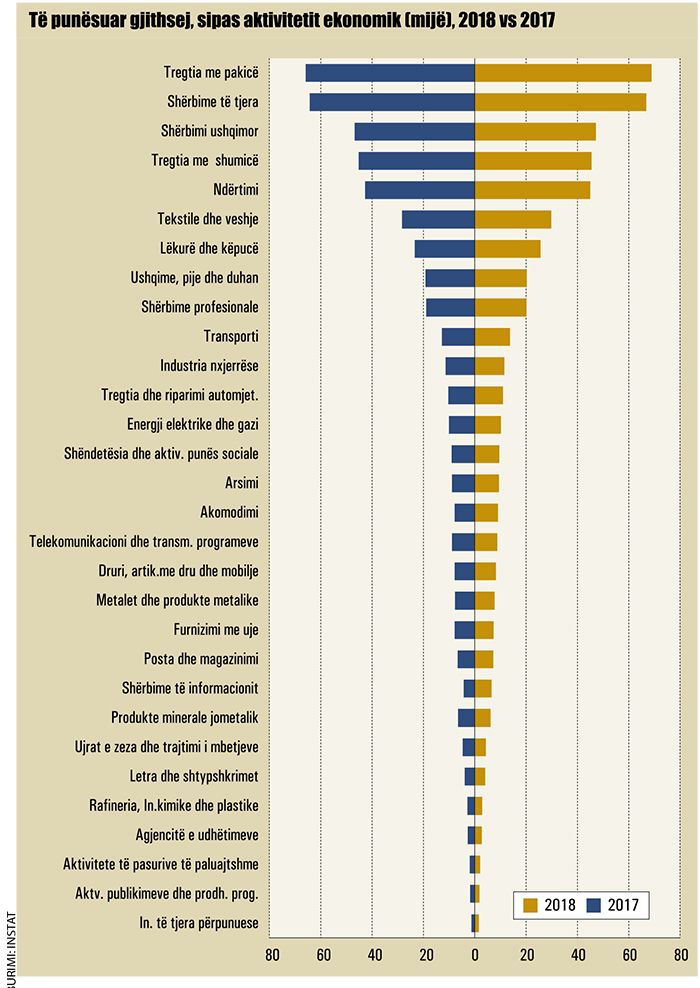
Albanian businesses had an income of some 22 trillion dollars (about 18 billion euros) for 2018, according to INTAT official data. On average, the daily circulation of 107 thousand subjects operating in the country -- in the field of trade, services, transport, industry, construction, energy, telecommunications and others -- is about 50m euros. (44% of these revenues are provided by majority and retail trade activities, 12% from construction, 8.5% from services, about 3% from access to food services, etc.
But the economy has entered an unexplored territory because of the paralysis of almost all activities
Instead, with a view to curbing the spread of the coronary, which is not known how long it will last. Many businesses have been closed (especially bars and restaurants), others are working with minimal capacity, consumers have curbed consumption, in addition to necessary purchases. Export companies, after being hit by Italy (our trade partner) already have problems with continuing production due to the worker's failure.
Most businesses report a decrease in activity by 70%, or temporary closure. Although it is too soon to become a balance, if we consider a 50% reduction of economic activity in the country, it would bring in the lack of at least 25m euros per day.
Sectors most affected
The suffering branches and the biggest loss are transport, the accommodation sector that includes bars, restaurants, locals; Textiles, skin and shoes, travel agencies, wholesale trade and retail.
The airlines, which carried out direct flights with Italy, will be affected in revenue missed in their monthly financial mirrors, with about 18m to 20m euros. “The figure is considerable and more likely that the effect will be carried over a period of more than 1-year time”, Etleva Hoxha, company manager Albawings for “Monitor” said.
In total, monthly revenues of the transport sector, according to INSTAT figures, are 28m euros. Including the closure of the internal and inter-urban transport sector, ferry movement and 20m euros in air transport, losses for the transport sector are estimated at around 25m euros. It should be mentioned that according to the Transport Association, only because of the failure to recover tickets to the marginalized layers of losses is $3m a month.
Election situations and uncertainty include travel agencies. In total, 950 travel agencies operate in the country, where 350 of them are in Tirana. Agencies have been introduced to <x0 war> ” with airline companies, as all citizens require ticket cancellations, dates forwards, or reimbursements. “
Citizens with fear have reduced 80% of their movements and no more tickets are expected. No one takes the initiative to escape, excludes extreme cases, when one seeks to travel to a destination that he needs for work. Ticket bookings and trips have almost been suspended. That's a tendency, because of the situation created by the coronary. Economic activity in travel agencies is almost paralyzed, and with the announcement of the first cases of coronavirus in the country, cutting tickets has reached minimum”, one of the country's travel agencies' representatives for “Monitor” says.
Travel agencies circulate around 21m euros per month, according to INSTAT, but their tour is duped, as for more than three years after the new requirements of accounting standards, they also report the value of the ticket, while they previously stated only the margin they filed.
Effect on Bars and Restaurants
Bars and restaurants are Albanians' favorite activity, along with trade. In the country, according to INSTAT, there are a total of 18 thousand bars and restaurants, being among the first in the world for the high number of coffee bars per resident.
For several days, all restaurants in major cities are closed. The losses are considered to be around 70% for the sector, according to accountant Armand Mala. He explains to “Monitor” that the consequences of closing bars, restaurants, pubs will be both macro and micro levels.
Unfortunately, in the case of coronary, health damage goes alongside the economic damage, which is generally being caused. The Turkish's first heads were discoquets, pubs and nightclubs, which justly gave an order to block them immediately as the first cases emerged. Further, the order was harsh, closing the bars of restaurants. The consequences are both micro and macro level. At micro level, all these businesses will have losses, we are all aware of the high fixed expenses these businesses have. High hairs, very fast investment amortification (we remember that the main Lounges in the capital completely change the interval on average every 3-4 years), other contractual expenses are just some of the monthly entries”, Mala says.
Mr. Mala recommends that to cope with this situation, loss must be distributed. The representative of the accountants' offices says this situation will also affect Bruto's domestic production. “Workers need to sacrifice something, not expect to be paid, since they are in a work contract. The landlords should not put pressure on this period, demanding respect for the payment deadlines.
O SHEE also not put pressure on making payments on time, tax and tax offices should urgently issue the warrants, extending declarations and payments, only in this form businesses will not bear this burden alone. At macro level, the panorama is clearer, with the ban on this kropetew once there's a brog at the GDP in our country, says Mala.

Shoe and Faso Industries
According to INSTAT data, the skin and shoe production industry generates 18m euros in revenue per month for the economy. Experts in the industry say the losses are estimated to reach about 60 to 70%, or about 13m euros a month.
Donika Mici, representative of the shoe manufacturing company “Donianna”, told “Monitor” that, currently, when the situation appears deteriorating in the country, and in terms of the world's declaration of pandemic, shoe manufacturing plants can be closed. Mrs. Mici explains that after the deterioration of the situation in Italy, she immediately asked employees who had physical contact with citizens in this country, as well as those who did not feel well physically or in a state of anxiety not to appear at work. “Under the government's command, from Friday through Monday, factories have been closed.
From Monday it will also begin strengthening safeguard clauses, according to instructions given by state institutions. After taking the measures in my hand, the factories will close. That's because it's not safe to come to the factory, where many of them come with buses, which are crowded, or they may be in contact with sick people. So this whole situation and the way the virus spreads creates uncertainty, what I prefer is that employees send home, rather than keep at the factory. I am very drastic in this regard, as I am most interested in the health and life of employees”, Mici says.
The representative of the company “Donianna” says the effects were felt at the first steps of the virus spreading in Italy. “Bleries have banned, many states will be isolated, which will lead to their failure to produce, because they have no sale. No one gets on the street taking orders, nobody goes out on the street to sell. It's a global crisis and before economic activity, my employees and I prefer to live. At first, we do not know how life will turn out, and we are not interested in the continuation of our work.
This is the third world war, destroying the economy and the health of people. I predict that everything will start from zero, as after World War II. What bothers me most right now is getting out of this fight without the highest number of victims. This situation is expected to last until June in Italy, which will affect our country as well. So this six-month-old is going to be catastrophic”, Mrs. Mici says.
The textile and shoe sector is not as important to the annual circulation as to employees, who are generally low class. In total, according to INSTAT, there are officially about 55 thousand employees in the textile and shoe industry, but the number is higher and due to indirect employment (many domestics, for example, sewing shoe pages or other services).
Caller-Center businesses risk going bankrupt
Because mass gatherings should be avoided in this transitional period, currency - call businesses are at risk of bankruptcy. Agron Shehiaj, a centreer call pioneer in Albania, has claimed that the sector's businesses are at risk of going bankrupt because of the situation. He said the damage is incalculable, claiming there will be an inevitable series of losers. Shehaaj himself has chosen for companies where he is a shareholder to implement his work from home, as everyone's life is more important.
Italy, the main source of call centrist work with Albania, is already in quarantine, while in Albania, the virus is in the first days of its spread. Health authorities in the country have recommended avoiding large gatherings, with suggestions such as family gatherings, weddings, and funerals. The business of call center and fason is the first to be dissolved in an even more agricultural situation.
As the Italian government has taken steps to compensate for the losses to businesses from this situation, Albania has no such financial potential. Albanian public spending is insufficient to cover neither basic hospital needs to cope with the flows, but to compensate businesses and the population in quarantine is not at all.
During the past year, 659 businesses were operating as a centrist call. The sector recognised a rapid expansion where, of 382 companies operating in 2011, their numbers jumped to 848 in 2015, where the highest number in the country was recorded. Along with the increase in number, the sector's employment burden in the economy increased, becoming the savior of many young people, who were able to secure salaries above the market average in Albania.
According to data belonging to the first 6-month of 2019, 22,266 individuals worked on the call center, out of the 25 thousand employees the entire sector employed in 2015-2016, marking an 11% drop. Viewed at percentage points, the decline has been greater in businesses, which for the same period closed at a faster pace than the number of employees.
Market actors explain that part of the closed call center were small centres with few employees. The decline of the call center sector was prompted by the austerity measures the Italian government took for call center activities outside the Italian state, applying heavy fines for their violations.
Other Sectors Touched
This increased trend or cure of the crisis, due to the coronary pandemic, has forced all domestic economic factors and actors to step down on the ground and analyze carefully and not without concern what the internal and global situation associated with the Albanian economy means.
Dramatic events with neighbouring Italy and the economic interdependence we have with this neighbouring state or other countries like Greece (where the first victims were scored there) or beyond to China, have introduced our economy as well. And while the Central Banks of powerful world governments like that of the US, Great Britain, or even the European Central Bank are injecting enormous amounts of money into the market to ease the effect of the crisis, we will expect the central banking institution's upcoming collection to learn whether there will be effective and concrete measures of involvement of this central financial institution to facilitate the Albanian economy.
A real concern that has followed all major economies affected by the deadly virus is the ability of the state system itself, or even banking, to guarantee normal liquidity in an extraordinary situation similar to the war with an invisible enemy. That means concern over time payments without the chaos of pensions, salaries, compensation of timely birth permits by the Social Insurance Institute, or atonement for limited capacity payments.
Similarly, insurance companies and insurance companies will be questioned, and in matters of time, it may be to discuss whether insurance companies will extend insurance payment terms indiscriminately, if they have to do with vehicles, with homes, etc., in an unusual and unforeseen situation in the duration of the ban on movement and government work due to coronary.
Even if the current phase of economic and social quarantine is overcome, no one can guarantee that if we take the current phase of our economy, that for its specificity there are hundreds or even thousands of workers together, none of them will be affected with coronary, that the same labor force would not be self-accumulated and that it would be solid and free of problems for itself and the company to refu in production with the same efficiency as before.
All of this if there are no cutbacks of orders from Italy or Greece and so on. Major, serious questions that will require answers from both financial institutions and fiscal, tax, state and other institutions.