4 minutes ago
President, Chairman and Manager
Periskopi(a month ago)
(a month ago)It says: Baton Haxhiu
Amman makes me president, but leave me head and take me to the government. Meanwhile, Kosovo expected an option that did not come and no one entered the elections to defeat Albin Kurti
After every election there is a brief moment of silence when politics is forced to look at itself in the mirror. That is when propaganda ceases, militants ' applause fades, and numbers remain the only witnesses to the truth. In Kosovo, this moment is being avoided with an unusual energy. Instead of reflecting, we are hearing reasoning. Instead of an analysis, we're hearing self - comfort. And instead of asking why the opposition didn't win, we're hearing explanations of why Albin Kurti lost a few thousand votes.
This is the greatest paradox of these choices.
Vetevendosje lost votes. That's true. After six years of power, following successive institutional crises, following repeated elections, after clashes with Western allies and after a government that in many areas did not produce the promised results, its collapse was expected. But the same truth is that the opposition did not get those votes.
And that is where the major political problem of Kosovo begins.
Because when the ruling party falls and the opposition doesn't rise, then we don't just have government consumption. We have an alternative crisis.
Instead of listening to the question of how it is possible that a consumed government still remains the dominant political force, we heard statements essentially celebrating the fact that Albin Kurti did not win as much as expected.
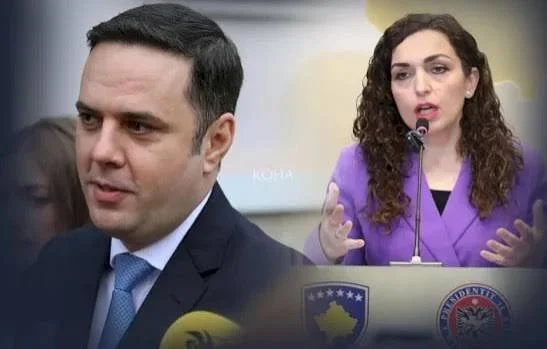
Vjosa Osmani came up with the conviction that its outcome is sufficient argument for a new presidential mandate. Lumir Abdixhiku came up with the conviction that four election losses could turn into success if there is a statistical increase among them. While the PDK is trying to present its stability as victory, even though it failed to become the options that citizens expected.
If you read the election night statements carefully, the impression arises that everyone was talking about their personal problem rather than Kosovo's political problem.
Vjosa Osmani was not speaking as a participant in a parliamentary contest. She was speaking as a candidate for president. If only the elections had been a referendum on him and not a race to rule the country. In essence, she was telling the political system that there is no more reason not to be elected president.
But that's exactly the question to be asked.
If the elections were a referendum on its presidency, then why did they not turn into a political majority? If the outcome is a topic for the presidency, then there should also be arguments to explain why this political capital did not produce a ruling alternative.
Lumir Abdixhiku, meanwhile, chose an even more strange argument. He said he had only one month.
Just a month! How can someone say this sentence and stay alive politically?
If only he had been elected president four weeks ago, and he's been acting like he hadn't been mayor for years and hadn't led the party in four election processes, and hadn't taken over the promise to get him back. LDK in power.
There is a great difference in politics between explanation and reasoning. Explaining requires responsibility. Reason requires justification. And Loomi's statement was closer to justification than reflection.
Because nobody's judging him for a month's campaign. He is being tried for an entire cycle of leadership.
He's being tried for four losses.
It is being tried on four occasions when Kosovo citizens decided that its alternative was no more convincing than the power being criticised daily.
And here comes the biggest problem of modern LDK.
She's starting to confuse the form with the content.
It has begun to believe that procedural correction is a substitute for political energy. That moderate language is a substitute for vision. That relative growth is a substitute for victory.
But a big party doesn't exist to improve. It exists to win.
A large party does not enter the elections to prove it has grown. Come in to prove I can rule.
And when four consecutive losses turn into arguments for continuation, then the problem is no longer electoral. It's cultural.
The same question should be asked by the PDK.
Because she is also living in a comfortable policy zone. Strong enough not to fall. Weak enough not to win.
Bedri Hamza is a good man. He's a serious manager. It's a respectable figure.
But politics is not a courtesy contest. Politics requires energy, conflict of ideas, vision and ability to create majority.
And if after all of Vetevendosje crisis, after all of the consumption of power and all of the fatigue of the public, The PDK still fails to become the first force, then should start thinking about what any serious party thinks after such a cycle.
For the next generation.
This is no call against Bedri Hamza.
It's a call for PDK.
Because big parties don't fail when they lose elections. They fail to believe that loss is normal.
And today there is a common danger for Vjosa, Lumir and Bedriu.
The three are speaking as if Kosovo's main problem is the decline of Albin Kurti.
While the real problem is their inability to replace it.
That is why the outcome of these elections is more brutal than it seems.
Because it's not just about the boundaries of Vetevendosje.
It also speaks of the boundaries of its opponents.
And until the opposition has the courage to accept that truth, Albin Kurti will continue to win even when it loses votes.
Because ultimately, power is not sustained only by the power of the one who rules.
It is also kept from the weakness of those who claim to be willing to replace it.
In the end, perhaps the problem is not only that the opposition did not win. The problem is that everyone entered these elections with another goal than Kosovo expected.
Vjosa Osmani entered to produce the argument of her second presidential mandate. She read the result as a ladder to the presidency, not as an attempt to build a new political majority.
Lumir Obadiah entered to save himself. After four consecutive losses, he was no longer seeking victory. He was looking for the reasoning. And when a leader starts asking for excuses instead of victories, he's actually beginning to accept defeat as a normal state.
As Bedri Hamza entered as a good manager enters the office Monday morning. With seriousness, with correctness and the sense of duty. But politics is not administration. It's not a financial report. It's not a consistent balance. Politics is energy, conflict of ideas, inspiration and ability to make people believe tomorrow might be different from today.
And maybe that's why Albin Kurti keeps winning even when he loses his vote.
Because his opposers did not enter this election to defeat him.
One entered to become president.
The other entered to survive as LDK chairman.
The third entered into the task.
And no one entered to win Kosovo.
This is the real secret of these choices. And maybe their tragedy. Because a consumed government may lose its vote, but it never leaves power until it faces one seeking victory more than salvation.