3 days ago
Generave Socialism Z
Periskopi(a month ago)
(a month ago)Analysis by: The Economist
Various times inspire different sets of left-wing ideas. After World War II, especially in Europe, socialism was strengthened by heavy industry, with powerful unions. It was not intended to abolish capitalism, but to manage it, statehood public services and to re-distract large-scale revenues.
After the 2007 financial crisis, “concialists, as The Economist called them, argued that the post-war European model had created extremely remote leaders from ordinary workers and extremely self-discreet in the face of climate change. Their solution was to put employees on company boards, create labor-owned co-operatives and subsidize green technologies, with the aim of creating a more stable, fair and ecological capitalism.
Now the latest wave of socialism is expanding. It is partly fed by anger for the humanitarian crisis caused by Israel's war in Gaza. But for many voters, Gaza is already representing something greater: the feeling that their governments spend attention and money on other issues, while neglecting the problems of their citizens in the country.
They look for the XXI version of the right “agreement”, which offered to Americans Theodore Roosevelt in 1904.
Today, this means dealing with a damaged system that enrichs powerful interests. According to this argument, the modern economy damages anyone who is not on Forbes ' list. GDP is higher than ever, but rents are too high, lunch costs $28 and it's hard to get a good job.
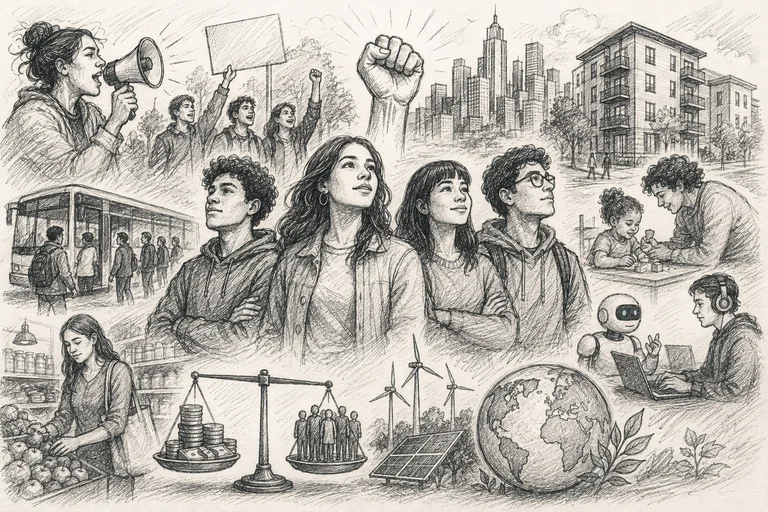
Young Socialists want the state to determine the prices of many goods and services, especially of basic needs such as food and rent. Where money is needed, they will be provided, almost exclusively, taxing the richest. This is a political form that does not appeal to notions of common good, like previous waves of socialism, but people's close personal interest: “lower the rent! Put the bill down! Give me free buses! Protect my workplace! ”
The solutions are naive and often uncompliable. But the message is so simple and attractive that this Geneva Socialism Z is gaining supporters throughout the democratic world.
Zoharan Mamdani, New York's new Socialist Chairman, is one of them. Katie Wilson, another figure of the left, leads Seattle City. Radical left-left candidates such as Graham Platner in Maine and Abdul El-Sayed in Michigan hope to become senators in the Muslim elections in November.
In Wisconsin, another figure on the left, Francesca Hong, is moving up the polls for governorship. The betting markets rank Alexandria Ocasio-Cortez, the socialist Congressman from New York, the second after Gavin Newsom as the most likely candidate for president in 2028.
In Canada, Avi Lewis, the husband of Naomi Klein, the prominent author of the radical left, recently became leader of the New Democratic Party, the third largest party in the country. In Britain, the Green Party, led by Zack Polanski, is gaining ground. In Germany, the leftist party Die Linke has been reaching the highest levels of support for years. In France, Jean-Luc Mélenchon, a veteran figure on the left, is looking towards next year's presidential race.
- Mamdan wants to freeze rents for subventioned apartments in New York, open municipal-owned grocery stores that sell basic low-priced products and offer free care to children by the age of five.
Die Linke, in the last regional elections, promised to lift all tariffs from being sent to university. Mr. Polanski's greens would put control over the rents and make free buses for the young; Australian greeners would like to do all public transportation for free. “Think of Costco, but managed as a public service”, says Mr. Lewis about his plan to create public food stores throughout Canada.
Voters rejected the billion socialism. In 2019, Jeremy Corbyn, a representative of the baby-boomer generation, worshiped by many British youths, led the Labusist Party to its weaker outcome since 1935. Bernie Saunders, the most famous American face of that movement, lost the race for presidential democrat running in 2016 and 2020. In France, Mélenchon failed to enter the presidential runoff. Socialists had to seek a new approach. The economy after the pandemic offered them the opportunity.
In the 2020s, an unprecedented gap has developed between the economy on paper and the economy experienced by humans. Although the rich world enjoys low unemployment, record real family income, and strong stock markets, people have rarely been so pessimistic.
Since 2022, American consumers' trust has been near the lowest historical levels. During the pandemic, 20% of Europeans thought that the cost of living or housing was one of the two biggest problems facing their country. Now that's what 36% think, as concerns about climate change, crime, unemployment and migration fade. James Meadway, a socialist thinker, sums up leftist confidence like this: “Economic growth has been cut off from improving living standards. ”
Greed is good when it's mine
People blame both businesses and the state for their situation. A 2024 survey by Navigator, a research company, found that three out of five Americans thought the “laxmia of corporations” was a major cause of inflation.
That may be why corporations seem more greedy than humans themselves. The percentage of Britons who want the government to extend taxes and spend more” on public services has dropped significantly, while the percentage of those who think income tax is “unfair” or “very unfair” has doubled since 2019. The percentage of Americans who believe that federal income tax is “very high” is near the highest level of the last two decades. In France, the percentage of those who trust the central government for the use of public funds fell from 33% in 2023 to 22% in 2025.
People are increasingly blaming technology, especially artificial intelligence. They fear that giant data centres will increase electricity prices and that the IA empowered by these server farms will be taken to work. More than 60% of Americans, British and Canadians say IA products and services make “nervoise”, compared to a global average of about 50%. A recent survey among American youth found that 59% thought the IA was “a threat to their professional prospects”.
And if you think today's economy is a fraud, the Geneva Socialists Z warn: Wait for tomorrow's economy run by the IA. A small number of tycoons will gain unprecedented power and wealth at the expense of all others. At a recent university ceremony, students booed Eric Schmidt, the former executive director of Google, whenever he mentioned those two damn letters.
What do people want to do about it?
Voters, on paper, are less socialist than a few years ago. After a 5% peak in 20182021, the percentage of Americans who described themselves as extremely liberal “” has dropped to 3.4%. However, this is not because people have become the rightist, but because they have lost interest in ideologies. A survey by Harvard University Policy Institute found that, among American youths, support for both capitalism and socialism declined significantly between 2020 and 2025.
Instead of ideology, people want someone to raise their income and lower their costs. According to General Social Survey, a long-term survey, never since 1975 so many Americans have asked for action by the government to improve the living standard” of the poor. They want someone to stop the IA from ruining society.
A group of influential socialist academics gives intellectual basis to these ideas. Isabel Weber's work by the University of Massachusetts Amherst suggests that the power of businesses to set prices means that the modern economy serves directors and shareholders better than ordinary people. In a study last year, Weber and her colleagues analysed companies' communications with investors and concluded that many firms benefited from inflation from “being protected or even increased profits”.
Many economists stress that wage hikes -- rather than the abuse of prices -- have sparked a large portion of inflation recently. However, the ideas of Mrs. Weber, along with concepts connected with the K-shaped “economy, where the rich win and everyone else lose, have gained popularity.
Others go further, suggesting that economic growth cannot give people what they really need. Jason Hickel (anthropologist) and Kohei Saito (filozof), among other things, argue that GDP growth is socially devastating, forcing people to work hard, just to make a living. Saito's book, “Slow Down: The Degrowth Manifesto” became a major success in Japan, selling more than 500 thousand copies.
These ideas are unclear, but they are fashionable among European politicians; in 2023, Ursula von der Leyen, president of the European Commission, participated in a “conference beyond economic growth” in the European Parliament.
In response to these political and intellectual developments, the Geneva Socialist politicians Z are experimenting with a new message. First, they are giving up the language “woke”, arguing that, in a world of unprecedented anger for the economy and with contempt for ideology, these topics seem less urgent.
No more talk of structural “racism” or DBP (diversity, equality and inclusion). “Climate crisis”, the biggest collective problem, gets relatively little attention, even Mr. Polanski's Turkey. The Democrats have stopped talking about a “New Green Agreement”. Mr. Platner even promises to lift federal taxes on oil, something unimaginable for the Socialists of the previous generation focused on climate. Even the traditional “tax and spending”, the foundation of classical socialism, has been set aside.
Geneva Socialism Z focuses on making life more affordable and workplaces safer, especially in the face of artificial intelligence. Supporters favour almost every policy offering immediate relief, instead of long-term investments with uncertain benefits.
Some want free public transportation. Most support rent control. Almost everyone promises free child care. Until a narrow loss in a preliminary election on June 2nd, Tom Steyer campaigned for governor of California with the idea of a <x0 mic bank financing for the IA era”, promising well-earned jobs and benefits for workers affected by artificial intelligence”.
Mr. Lewis would stop building data centres in Canada and oppose “any attempts to replace public employees with chatbots”.
The largest intellectual division among the Generatine Socialists Z and their predecessors relates to the question of who will pay for all these benefits and protection. The previous Socialists imagined widespread tax hikes. In the late 2010s, Bernie Sanders proposed an additional 4% on income of over $29,000 a year (so for the vast majority of American families).
While the new Socialists, when proposing tax hikes, focus almost exclusively on the rich. Mr. Polanski proposes an annual tax of 1% on property of over 10 million pounds and 2% on property above 1 billion pounds (Britani has only about 100 billion.) Mr. Mamdan is putting an additional annual tax on some luxury properties. Washington's state is adopting a “billion-commerium summit” of 9.9% on revenues of over $1m.
According to this logic, additional money will come from making government more efficient. Verdant, the organisation of James Meadway close to the Green, has proposed a “DOGE of the left”, named in the brief attempt of Elon Musk to eliminate unnecessary federal spending during Donald Trump's presidency. On May 28th, Mr. Mamdani promised the creation of COGE (Commission on Government Efficicicency ) Commission for Government Efficiency for his city.
Most of these ideas are strange. Rent control does not make housing more affordable; it displaces investments in the sector, limiting the offer and increasing rents in the long run. Efforts to Stop The IA will make investments and jobs move elsewhere. Efficiency savings look great on paper, but they're hard to implement in practice, just ask Elon Musk. And such great support in the taxation of the pluralcrats is dangerous: there's just not so many of them and they can leave (as some from California have done in anticipation of new taxes on billionaires).
Free Lunch Is Not Just for the naive
However, many non-socialists are embracing policies that would make Mr. Mamdani proud. Centre Labusists are experimenting with price restrictions for food. The centre's Democrats have proposed tax cuts for anyone outside the highest percentage of winners. Even Republicans MAGA are keen to support suspension of building data centres.
Whether the more Geneva Socialists Z will win elections or not, Geneva Socialism Z is not disappearing.