18 hours ago
The moral revolution was enjoyed with white gloves
Periskopi(25 days ago)
(25 days ago)It says: Baton Haxhiu
In our daily lives, classics have always been easy to recognize. He came at night, broke the door, took the money, and left. Society despised him because his act was brutal and evident.
But Kosovo produced another figure, much more dangerous and much more intelligent. Eat white gloves. A person who does not enter the ark with force but enters into a public conscience.
I steal, not by hiding my face, but by exposing his morale as an honest certificate. And the citizen of this country and the public is convinced that this man is morally clean and has begun to forgive him for almost anything else.
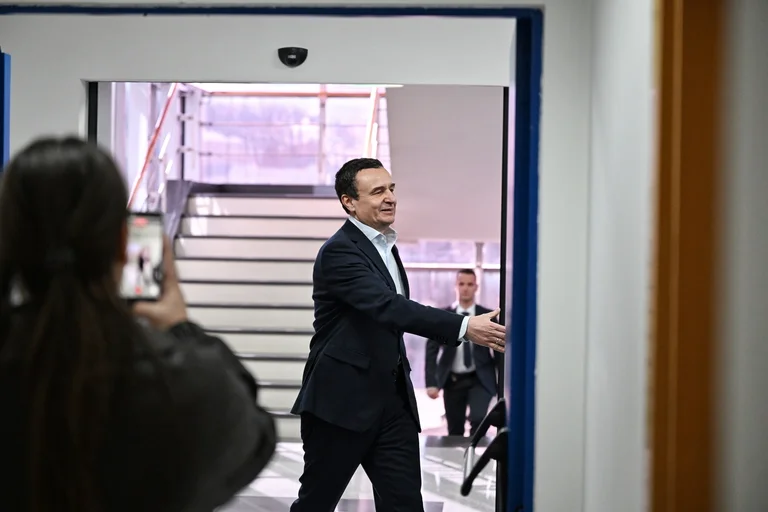
This is when corruption ceases to be only a matter of money and becomes the psychological phenomenon of Albin Kurti.
An example of newspaper stories in America of years of financial crisis: Bernard Madoff didn't rob people with guns. He used his reputation to rob them and quietly, finally selling them credibility with a face that seemed fair and moral. The victims gave money, not out of fear, but out of conviction that they faced the righteous man. And that was what made his deception almost perfect. He did not sell just profit. It was moral security.
In politics, this form becomes even more dangerous because not only is private money used there but the State is used.
And this is where Kosovo's big problem with Albin Kurt begins.
Albin Kurti is not a classic thief that Albanian society has learned to hate. Nor is he the banal politician who displays his luxury in a vulgar manner. On the contrary. It has built the figure of ascetic man, almost poor, with 16 euros in wealth statements, a permanent moral language, and an ethical revolution in his mouth. And that's where his strength lies. He does not want the public to admire power. He wants the public to forgive power in the name of morality.
That's why most of his interviews are not interviews with real governance. It does not stop long in the economy, in failures, in the way the budget is used, in the contradictions of power. He constantly builds a moral dramatology where the main character is thief, shame, and guilt. He has realised that in Kosovo people get tired of the truth because truth is complex and requires responsibility, while the guilty is emotionally easy. Society does not always require explanation. Looking for an address to anger.
So “put your imaginary” into its disk. It doesn't matter who it is. No matter how much you prove yourself. As long as confession creates emotion. And so is the greatest political deformity: the thief becomes a confession, and the truth remains etched.
This logic explains virtually any contradiction of his power. It may come out and say it wants consensual president, proposed by the opposition and acceptable to citizens, while at the same time states that the president must be “firefighter”, a figure that does not know how to get on a plane and that does not deal with foreign policy. The first word produces the illusion of pluralism. The second word reveals fear of any figure that could create independent legitimacy.
And that fear became evident at the moment that Vjosa Osmani won international profile through her commitments at the Peace Board in Switzerland. There the presidency stopped being institutional decorating and began to be perceived as the next political gravity centre. For a power based on public confession control, this is unacceptable. Therefore, the future president must be a figure without international ambitions, without a strong profile, without the possibility of building political capital outside the prime minister's orbit.
At this point, manipulation no longer looks like a classic lie. He looks normal. And this is the most sophisticated form of power. When the public no longer sees the line between morality and propaganda.
This is also seen in the way the State is used. For three parties elections, hundreds of millions of euros in social aid are distributed, while at the same time, policies that produce direct electoral effect are financed. The aircraft for the diaspora are presented as patriotic and sentimental gesture, while the money is the tax of the poorest citizens in Europe. And the public is required to see this, not as political use of the budget, but as a moral act.
This is where the whole myth of the clear “lider collapses”. Because power is not measured by personal savings. It's about the relationship you create with public money. A man may have 16 euros in accounts and yet behave as if hundreds of millions of euros of budgets are continuing his personal and moral project.
This is the moral revolution of the thieves with white gloves. He does not use morality as a restriction on power. I use it as a license to expand it. And the most dangerous moment for a democracy is when a leader starts to believe that he alone has the right to use the state according to his own will.
That's where real degradation begins.
Because the state is no longer treated as citizen property, but as a continuation of the leader's conscience. And the more he is convinced of his moral cleanness, the less he feels the limit between power and himself.
In the end, this is no longer history of classical corruption. It's a story about a society that's at risk of being deceived, not by brutal thieves, but by a man who comes with a quiet face, morale in his mouth and white gloves in his hands. / Periscope/