18 minutes ago
UN alarms: Albania at 2100 to have fewer residents than Pristina
Periskopi(6 years ago)
(6 years ago)The United Nations organisation (OKB), in its projections for the Albanian population, has revised the expectations of how many people will remain in one country by 2100. The significant devaluation has come in a year (2019 versus 2018) and has been promoted as the decline in fertility rate, [...]
The significant devaluation has come in a year (2019 versus 2018) and has been prompted by both the decline in fertility rates and the high trend of immigration.
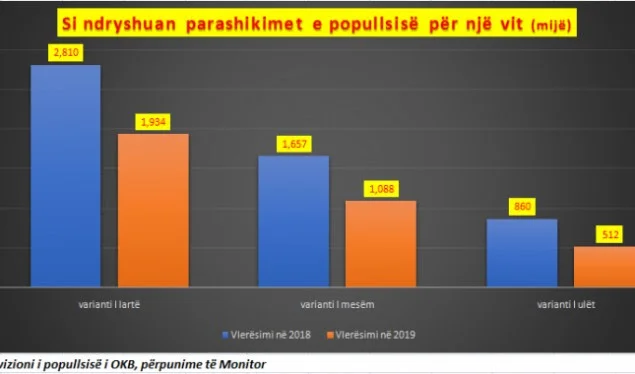
In predictions published in 2018, the country's population in 2100 was expected to remain at about 2.8 million people, a slight decline from the current level of 2.87 million. But, just a year later, in 2019, expectations have dropped significantly for the optimistic version. In all cases, even in the optimistic version, if zero immigration is obtained and normal performance of fertility rates -- in 2100, Albania is not expected to have more than 1.9 million people, or 31% less than the earlier year's forecast.
In the medium version, Albania is not expected to have more than 1 million inhabitants, of 1.6 million people who were forecast in 2018 for the scenario, with a reduction of about 34%.
The highest revision was made for the lower (highest rate of migration and low fertility), according to which, in Albania in 2100, more than 512 thousand people are expected to remain in Albania. Previously, the expectations for 860 thousand people were reduced by 40%.
Reasons
The decline of fertility (the gross birth rate) and the resumption of the immigration cycle are expected to shrink the population in the coming decades.
INSTAT's latest data showed that women living in Albania year after year are giving up on their mothership, drastically reducing the number of babies brought to life. In 2018 this phenomenon was further highlighted when the average number of children born to a woman marked a historical record. The fertility index was only 1.37 children for a woman of 1,48 children in 2017 and 1.73 children per woman in 2014, according to INSTAT data.
The rapid decline in birth rates has brought Albania under the replacement rate, which estimates 2.1 children per woman. Albania also has the birth rate well below its global fertility index, which in 2017 was 2.4 children per woman according to World Bank data. Albanian women are born nearly 50 percent less children than the global average.
Between January 2014 and January 2018, Albania's population has been reduced by an average of 0.16 % a year. As a result of these developments, reports of addiction have increased in age and have been reduced to younger ones. Dependence reports account by comparing the number of people (0-14 youth and/or older 65+) with the working age population.
As of 2015, Albania is experiencing a new increase in migration phenomenon. Only asylum applications have reached about 200 thousand in the past five years, according to official data from Eurostat, while there are many others who leave on work contracts or who simply leave and never come back. Population removal is becoming a problem for enterprises, who complain they are not finding specialized workforce. In a recent poll, the Albanian SME Institute “SME Albania” found that about 61% of the companies have had employees removed for immigration reasons during 2019.
The population's decline, particularly the removal of working-age populations, is expected to produce serious effects in the future, both in pension scheme, with the creation of a fragile layer without proper care, and in the decline of entrepreneurial productivity, with an effect on the tendency of their salaries, their tax investments, and the long-term consequences of slowing the country's economy. ( TCh/