a few seconds ago
KASK chief surprised how the number of voters in the CEC is higher than the number of residents

Periskopi(7 years ago)
(7 years ago)On the CEC voter list, the number of eligible voters is greater than the number of people in Kosovo, this issue is surprising even the head of the Kosovo Statistics Agency, Isa Krasniqi. Krasniqi in an interview for Kosova Prees, says that according to the assessment of the population's number [...]
Krasniqi in an interview for Kosova Prees, says that according to the assessment of the population of 2018, Kosovo has a population of 1 million and 795 thousand people, and if the contingent of potential voters, which is roughly 1 million and 800 thousand voters, it turns out there are more voters than the resident population in the Republic of Kosovo.
Although it has targeted the number of diaspora, according to him, there is a greater number of voter lists compared to the residential population in the Republic of Kosovo by 31 December 2018.
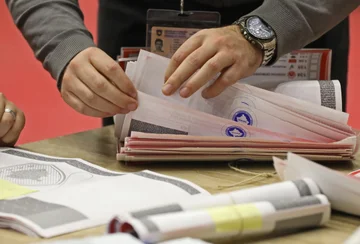
While the number of registered voters was 1 million and 888 thousand and 59 with a voter turnout of 779 thousand and 729 voters, or 41.3%, according to CEC data.
“The body of people is residential or bodies of potential voters when it removes the group between the ages of 0 and 18, then it is a number of 1 million and 272 thousand and 226 potential voters. But you know that on the Central Election Commission's list, anyone who has a vote rights is counted by the non-resident population that is located anywhere in the world, living outside the Republic of Kosovo. The non-resident population has a very small turnout in the election that is in some way neglected, and if the percentage of voter turnout can be 39 per cent, the real percentage if we rely on the contracting of the residential population turns out to be slightly over 55 per cent”, Krasniqi says.
Alarming for AKS chief chief Isa Krasniqi is the decline in the population in Kosovo.
Krasniqi says the number of residents is steadily declining on the basis of the decline of fertility, mortality and population migration.
He says that for this trend of decline, all Kosovo institutions have been alarmed, because if this decline continues, in the coming decades Kosovo can have less than 1 million inhabitants.
In comparison to 2017, we have a decrease of approximately 2,000 in the Republic of Kosovo. So, we have a population dropping. But the fertility contingent has a decline, and we've stressed that it's an alarm for the Republic of Kosovo, because the decline in fertility greatly impacts other policies, especially in the economic and social aspect that has an essential impact. This is important to take into account even political for the longer term. Then, if we have population migration abroad and increased mortality, because the congent of old age comes up and that then reduces the”, he says.
In the rest of the interview, Krasniqi also talks on other topics such as foreign trade, trade reports, GDP, unemployment rates and product prices. /I. Shaban/