23 minutes ago
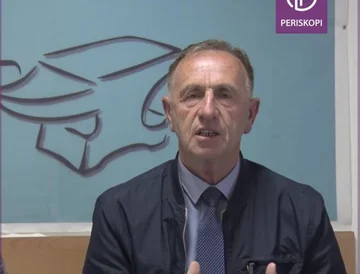
Albin Kurti no word of national union, criticises governments for holding the meeting in Mitrovica

Periskopi(8 years ago)
(8 years ago)Vetevendosje leader Albin Kurti has said Monday's meeting between the Kosovo government and that of Albania would be good to be held in Mitrovica. Criticising the current level of co-operation between the two governments and adding that more frequent accountability should be for signed agreements than adding them [...]
Criticising the current level of co-operation between the two governments and adding that there must be more frequent accountability for signed agreements than the addition of those that are not implemented, Kurti has said that “in this period when talking about partitioning Kosovo, the two Albanian governments would have done well to hold the meeting in Mitrovica, which should be united rather than in Pec, given over 8,200 hectares of Montenegro.
Otherwise, according to him, economic and military co-operation between the two countries should be priority.
According to Kurti, the high trade deficit for each of the states shows that territory is used mainly for the flow of international capital, instead of being used to accumulate national capital.
“Secila by our governments crippled the respective budgets instead of thinking of harmonised investments in the field of energy, agriculture and other necessary spaces. While co-ordinating the two governments for Albanians outside the borders of our two states is invisible”, he has said.
According to the Vetevendosje Movement, the level of economic co-operation and common co-ordination of economic policies between Albania and Kosovo are more distant than co-operation and organisation among nations within the European Union.
The “governments of Albania and Kosovo are signing agreements, but without associated with their implementation. Meanwhile, our problems remain similar and require common solutions”, a Vetevendosje announcement said.
All of this was said in a standup for this party held today. At table “National Economic Integration” was talked about increasing co-operation and harmonising economic policies between the two states towards economic union.
In the field of education, MEP Arberie Nagavci said that in both states there is a lack of skilled quarts in critical thinking and analistic reflection, lack of awareness of the importance of professional education, and lack of co-ordination for school curriculums and also for professional teaching skills. It proposed several steps for the common solution of these problems, including the removal of quotas and the unification of criteria for our citizens for university studies in both states and the harmonisation of professional practices. In addition, it proposed joining a single institution of the Academy of Sciences, Albanological Institutions, Institutes for Professional Formation of Teachings, accrediting Ages, and the formation of an institution for assessment and monitoring of education and the formation of a think tank for academic and scientific research.
For the current level of economic co-operation between the two countries, Edison Yakurti from the Committee for Finance in this party indicated that it is in the phase of a fossil integration, as the two countries have managed to sign only for preferential treatment and free trade between them, but remain far from the stages of intensive integration such as customs union, common market and monetary and banking union.
According to him, imports-exports between the two countries, even though they have increased in recent years, remain modest. Through its data analysis, Yacurti explained how there are many trade barriers between the two countries because, according to him, governments have always implemented reforms according to the motto “each to himself”.
“is the interest of oligopoles and monopolies with short ties to respective governments, which are not interested in the economic union between Kosovo and Albania. However, the potential for trade exchange is great thanks to the slight differences between us as society”, the VV report said.
For the necessary steps towards economic integration, Jakurti proposed: the removal of non-tariff barriers through the unification of standards and institutions for local products, the unification of statistics institutes, business registers and the customs union with further aim of unifying central banks.