a day ago
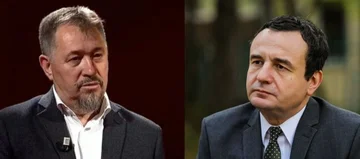
Ninula for Baton Haxhiu

Periskopi(9 years ago)
(9 years ago)With what did I push Baton so hard to protect Ramush Haradinaj? What has forced former editor of the Time Ditore to reason not only on the infamous commander of the KLA, but also on all his countrymen who in Kosovo committed terrible crimes against Serbs, the Roma minority, and [...]
What was it that has forced the former editor of the Time Ditore to reason not only on the infamous commander of the KLA, but also on all of his countrymen in Kosovo who committed terrible crimes against Serbs, Roma minorities and others, as well as on the non-combat “Albanians?
How is it possible that a European intellectual and seemingly liberal and reasonable from the first “letra for Lylanne”, after just a few months of dialogue, which did not fit in, is to be converted into an archetic resident of Kosovo, with full understanding of the crimes of those whose “gix is heated by revenge”?
I only know Baton from reputation in our common Yugoslav homeland, and this apology of crimes is not fitting in that memory. Do you also protect criminals when you converse with their countrymen or each Belgraden co - talker is an enemy before whom you defend his countrymen whatever they have done? Is Belgrade “Lick red@x1> for Pristina, so Baton seems that everything is allowed with Belgrade, that in this dialogue all intellectual and moral considerations disappear? Not enough respect for minimum checking facts?
What can push any person, left more journalism, to reason crimes on vulnerable people, and respectively, the local <x0-seconds of revenge against neighbours”, as Baton cares? I can't understand. But if for Baton, I'm “Licke Red”, if by my words it's so blinded by rage that it starts to house criminals, let's start with the words of his daily colleague and countrymen from Pristina.
I'm ashamed to read “Ambassador and other heretic notes” by Veton Surroi, which “Veran Matiqi's Samizdat” has recently published it in the Serbian language. On page 34 of this book, I did not immediately discern the name of Dragoslav Basescu. I have forgotten Pristina University professor, who six months after the departure of the Serbian army and police from Kosovo and six months after the expulsion of most Serbs from Kosovo, had lynched the crowd, which celebrated the Albanian “flag day. What was this victim of “of the domestic acts of revenge against neighbours” against his fellow citizens? How do you know all at once that it's Serbian when you saw it in “jugo” old with her 78-year-old wife and mother? Did he write to his forehead that they were Serbs? Did they not enjoy the red flag? Basp has been a “hardcore” in America, born in Prizren, at least four decades lived in the capital of Kosovo and Metohija, and it was one of those “neighbours who believed they didn't need to leave for Serbia because they had done no harm to anyone. As Veton says, on that November 28th, Basescu surely hoped that “ascem had happened what had happened, that it was killed who had been killed, that houses that had been burned and that things would somehow have come to their own place”.
He paid for that mistake with his life. It was just beginning. The troops of the three Serbs the crowd had pulled them out of the car. Nor did Basiq's address to the attackers in the language of their American rescuers, with the emphasis he had received at the University of Berkeley, California. The three were beaten, dragged bloody for 40 feet [4 m], while Dragoslav was put in his mouth, which even exploded in his mouth. It's not known if he was already dead when he was hit with two bullets in his chest. The beaten mother-in-law, who had never taken a bullet to her chest, survived in two days. She too has been put into her mouth, so her grandson, who had come from Belgrade to see her, was unable to recognize her on the deathbed. “How is it possible that several hundred, some even thousands of Albanians say, on the first day of the flag expected in freedom, in a gross link to kill one man and beat up two women's alivours?” This is a rhetorical question by Veton Surroi, who is not satisfied with the answer of Albanian society in Kosovo that blood feud is the reason.
It seems that between June 14th and December 31st 1999, 1149 people have been killed in Kosovo, which reportedly has killed six people (Baton probably meant six neighbours every day). One would usually be Roma, marked by the color of the skin and the hall in which she lived, the other Albanian, “co-worker”, or simply political opponent, while the others would be Serbian villagers, old ladies, households. The vet claims even retired cops. He cannot believe that all of these murders were committed in “effect”, nor does he understand why there would be more hatred in Kosovo than anywhere in history by then. Because “Great Britain (in 1919, 1920, 1945, and 1946) did not kill German passersby, members of the people who had killed hundreds and hundreds of thousands of British citizens. Not even in Poland, in any year after victory, after winning “Solidarity” did not kill Russian-speaking passersby, the language of the conqueror. Not even in Sarajevo, in 1995, a month or any month after the signing of the Dayton Accord and the establishment of peace, no citizen, passing by the case, identified as Serb, a member of the people who kept this city in exile for three full years, with this case killing, by artillery or snipers, the Sarajevo civilians”.
In other words, Veton claims that Dragoslav Basic was killed because such daily behaviour became the collective rate. I think about killing members of minority communities or political opponents these were no longer individual acts, but a pattern of behavior that repeats, that became the collective rate, accepted by a part of society”.
Compared to the words of this witness of events in Kosovo after the bombing, Batoni's expression “the local revenge against neighbours” sounds like euphemism, doesn't it? Especially when it goes on to say that these “the local revenge of neighbours” could be expected and that it could be understood. In what respect is this kind of expectation and understanding of cultural crimes of impunity and tolerance in the murder of Serbs? Baton's colleague Veton puts special emphasis on the fact that right after UNMIK, mission chief Bernard Kouchner, the Albanian side, ahead of all demands, even prior to the requirement for the exact definition of the number of Albanian victims, had applied for the skills of the Beopetrol gas station, and that the concession for gas pumps would have to be granted to a businessman, who would then build a hotel in which meetings of the party of the KLA leader, and who would soon become her deputy.
As much as blood feuding, with Albanians traditionally links the century-old codex for failing to attack children and elders, not at the time of armed conflicts. What has happened in Kosovo after the departure of the military and police, how has the last moral taboo dropped, so that the killing of Serbian elderly has nearly become an everydayity? Several months after NATO's arrival in Kosovo, which Albanians remember as “clitrim” and Serbs as mass persecution and persecution in Kosovo's capital, Ljubljana Vujoviq, seventy-eight-year-old, was found drowned in the bathtub of her apartment, until Zorka Zizpi, seventy-four-year-old, was found with slit throats. The veto is saying, the rate of collective acceptance of crimes has been created in Kosovo. Foreigners such as Paddy Ashdown washed their hands and claimed that Hashim Thaci was able to prevent crimes only if he wished, while Veton Surroi, thinks that mass deportation occurred just because “somebody” had made the decision that Serbs should be expelled from Kosovo. While power in Kosovo at the time, as now, was held by Hashim Thaci.
In the end, here's what the American prosecutor and ambassador, known for Kosovars as the man who has written The Hague's indictment against Milosevic, which undoubtedly qualifies him as a friend: “In view of the things they've been through in this conflict, nothing but makes sense of pursuing the intention of innocent individuals... this presents an important attack on a part of the civil population, directed against all Serbs who have remained in Kosovo, and many of whom have been old and other minorities, as well as ethnic minorities, and... CK take over power monopoly. In the end, this has happened only for the benefit of individuals assigned to the NLA chairmanship, who used the elements of this organisation to commit violence with the aim of gaining political power and personal wealth, not for any other broader reason. Hence, they individually must take responsibility for their wrongdoing”.
From the context, it is probably clear that the quote stems from the pledodia for the establishment of the Special Court for Kosovo, which was a epilog of his three-year research regarding the claims of Senator Dick Marty's report. It is understandable to prejudge that with “iddive in the leadership of the KLA” has also been referring to commanders with the Smajli and Serpent nicknames, as it is reasonable to prejudge that nicknames have won even before the NATO bombings and that they had not become greedy ethnic cleaning only after they had helped NATO bombers expelled Serbs.
But why am I talking about this with Baton when he's not hanging around? Not why the Prior refuses to dominate the moral rule with which he allegedly dresses in conversation with me. Of course I refuse it, but I'm surprised at something else, with his attempt to expose me, along with millions of Serbs, to be held responsible collectively for Serbian war crimes in Kosovo. Even for crimes I do not deny, nor do I humiliate them. I don't even caress them.
Baton's thinking is a few years of light after every modern understanding of justice, and I think my conversationator knows it as well as I do. There are lawyers who think that placing individual criminal responsibility for the most serious crimes under international law represents one of the greatest achievements of the 20th century. I'm not sure about the rankings, but let's stick with theirs. But there can be no doubt about who in the 20th century has promoted collective guilt and made collective penalties for crimes. Batoni certainly knows that the Germans in Serbia have shot a hundred Serbs for a German, with collective punishments pushing the population to stop supporting the anti-fascists. Even in Stalin's gullags, they were collectively punished for individual errors.
Maybe Baton was mispronounced? Sometimes it's hard for me to follow his way of thinking after he's long addressed to me as Lila, and then to me he's talking about third, like Mrs. Smajlovitch, who can't run without sarcasm and ad hominem attacks. However, I would be willing to allow it to attract the claim of collective responsibility if and when it is considered better.
But without measure, this shift of fast approaches from Batoni, from a European thinker to an angel of collective vengeance, bothers me. Where does this big connection to the Kosovo political combat arm come from? It seems I was mistaken when I thought that former editor of the Daystar could not be happy because the bloody KLA commanders still have such great power over his nation's political imagination. Which even today, nearly two decades after the KLA's first terrorist attacks on Serbs and the Yugoslav state in Kosovo, among Albanians in Kosovo is still unimaginably demising the KLA, which also drops the normalisation of political life. Part of this normality would probably also have some kind of inter-Albanian conversation, which is initiated by Veton's “Ambassador”.
In Serbia this kind of conversation was conducted almost without hindrance all the time of Slobodan Milosevic's power, while this time has passed forever.
I know some colleagues in Serbia will tell me, hey, don't pretend, I know very well that Baton Haxhiu has been sentenced by The Hague tribunal because he has discovered the identity of the protected witness who had to testify against Ramush Haradinaj, the commander of the KLA for whom Carla del Ponte says he has avoided The Hague justice just because those who wanted to testify against him had been mysteriously disappearing, dropped or in suspicious circumstances committed to suicide. Was not the proclamation of the name and address of one of the protected witnesses against Haradinaj a clear and loud message to others about what could happen? Does that not lead to a kind of co-ordination in what is likely later with witnesses against Haradinaj?
Baton himself reminded me that he spent a time in The Hague Tribunal's cell at Schevengin: he knows, or should have known, the difference between the act of self-defense and crime against civilians and prisoners of war. And even if you don't know it, you know that ignorance does not mean a release from criminal responsibility or moral responsibility.
I've been reporting from The Hague, and I know this Court is not infallible. At the same time, however, this is the Court in which many others, such as Batoni, their fellow citizens, and their everyday neighbors, were called aggressors (Banton for Serbs, using the word invaders, as opposed to Albanians, whom you see as victims, and with that the commanders with animal nicknames are only victims of numerous acts of revenge under obel). Of course, Batoni has not thought of this first: Before that, even Bosnian Muslims and Croats, who have lived in those territories for centuries, have been patented by them. So I myself have become aggregator in Sarajevo, even though the war found me in Brussels at the location of the foreign policy correspondent for “Oslobore a” [sh.p. Deliverance. Sarajevo. For this neighbor from the street called “Albankska” [sh.p. Albanian], then he who, after the Serbian grenade had damaged the apartment, had entered the apartment, with the keys he had received from my relatives, and through my friends after the war, did not want to return my keys or my apartment. As he entered, we were good neighbors. When I had to return my property, I became a aggressor. I think this unfortunate one was not guilty, only feared the response of the new Bosnian power in Sarajevo, so he decided that my keys to power would be restored, which then again decided to wait until international administrators ordered the return of pre-war property <x0 ..."aggressors”.
Yet, that was the end of it. But in my skin I've learned how easily a man becomes “the grasper” when someone needs this for the purposes of war and power.
This proclamation of neighbors to invaders is the last shelter of the Secesionists. Those who can't stand to have the Serb minority return to fundamental rights usually, like Batoni, complain about how the West has guaranteed non-professed rights too large.
But on whose side was the West, Albanians, or Serbs? Is the West involved in civil war on the side of Serbs, or on the side of Muslims, Croats and Albanians? And that's why I read how the German cave now claims that Kosovo was “the post-war European judicial sin”, the country with which the West now doesn't know what to do, even though according to this week's account, only until 2008 Kosovo has cost the world community 33 billion euros.
I hadn't hidden it or if I could, but Batoni knew it anyway even when we started this dialogue, which I belong to those from the territory of the former Yugoslavia who consider it aggressor to NATO, and in the context that gives that name international rights. I understand that for Baton, nearly all Kosovo Albanians NATO was a savior and did not underestimate the concept of Baton's point of view, nor did it take risks during the bombing. These, however, do not seem to be insurmountable obstacles to our talks. I think of my and Baton's conversation, however, but I don't see this as an insurmountable obstacle in Serbia and NATO or Belgrade, Washington and Brussels talks.
But since we're only talking about aggressors and invaders, would I be interested in what reason would Batoni have violence against Albanians killed just because they were “kolaborationists of the Serbian conqueror”? Does the collective responsibility of the Serb minority affect them, or are they just redeeming merchandise? It's these fake categories. If the scurried Lubica, Zorka with a slit throat, and the petard - mouthed Dragolub are aggressive, then it is easier to reason on the burly violence against them.
I don't think Baton would want to follow his thoughts to such logical conclusions. Compared to collective guilt, the doctrine of individual criminal responsibility, however, presents step forward for civilization.
I propose that even in the course of dialogue, we stick to certain actual standards, no matter how far we stand. Even Western renomeal sources claim that Patko is fiction. I don't know what the number of 20,000 violations is based on, but that sounds like a fresh, newly discovered propaganda. I don't understand the Mystification of the role of Jovica Stanisics, who had no special powers: it was only Milosevic's casnec and all power disappeared at the moment Milosevic took the right to deliver messages. But I would like to hear a little more about Lily's city and the French marshal. What exactly is Lily's curfew? Has he mixed up some historical parallels? To me, the French marshal you mention is only known as the one who considered the Versailles Agreement too easy for the Germans, while he became famous with the exact prediction that this would only be a truce that would last twenty years. When it comes to historic ultimatums, Serbs are the measuring unit: the Austro-Hungarian blackmail, which they rejected in 1914, has remained as a caution that you do not always attack the smaller and weaker than yourself. These days Carl Bilt has compared conditions to Qatar to blackmailing Serbs in 1914. The wrong historical analogys enter into false historical teachings. Somehow this parallel to the Germans seems fragile if we set off by Baton's doctrine of collective responsibility, then Serbs historically would meet the collective role of brave warriors against German invaders, would they not? These doctrines of collective responsibility are dangerous, and the shoe can suddenly appear on the other leg.
And when it comes to Baton's personal attacks on me, he's gonna have to try a little bit. In Milosevic's time, I worked for the opposition media. On October 5th, twice “in the presence of power” I was fired from the chief editor of politics and fired from work in that newspaper: with independent editorial policy, I went through the same with Boris Tadic and Alecsander Vuciqi.
But how do things stand with my fellow Albanian? I do not believe that Ramush Haradinaj or anyone else from the KLA who has declared the name and whereabouts of the protected witness against Haradinaj has entered into retaliation. It could have been said earlier that it helped expel and intimidate the remaining witnesses, even though I believe Baton only did his job. Furthermore, why the moment he touched the commanders with his nicknames, at the Kossev portal I get the answer of the KLA publicist, instead of the former independent journalist of Time Ditore?
Perhaps Baton will later be able to answer what happened to the protected witness who by his work showed him that The Hague can't defend anything about him? Has he testified, accused the KLA commander in The Hague? Or is he missing somewhere? I honestly ask, in the case, I only know what I read on The Hague tribunal's website, from which I have reported at one time; not getting tired at all of how this report of The Hague Prosecutor or Serbian power would like. Neither the name of the witness nor what had happened to him was written in the Court's letters from 2008. Maybe Baton can tell us. He must have been worried.
And I have a little proposal, to try in the future to stick to the rule of a thousand words for paper?
(From Serbian language the text translated Bruno Neziraj)