17 minutes ago
The informal adviser to Trump, pastor Burns: In Kosovo I was a US official, but would convey my remarks to the administration
Periskopi(2 hours ago)
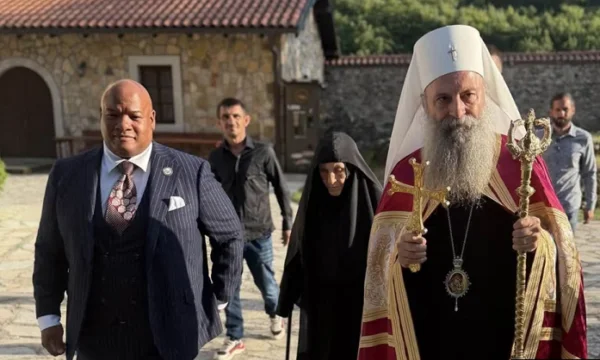
(2 hours ago)Pastor Mark Burns, informal adviser to US President Donald Trump on spiritual matters, tells Radio Free Europe that during his recent visit to Kosovo, it was not in the quality of an official United States representative, negotiator or envoy on the issue of the status of the Serbian Orthodox Church, or any other political issue.
However, he says his remarks about the position of the Serbian Orthodox Church and religious freedoms in the country would be forwarded to the US State Department.
He explains that his visit to Kosovo and to the cultural heritage sites of the Serbian Orthodox Church was not co-ordinated with the American administration.
According to him, his role as spiritual adviser to President Trump is “an independent religious initiative dedicated to promoting peace, protecting religious freedoms and promoting dialogue beyond cultural, political and religious divisions”.
“I have travelled as Christian pastor and founder of the movement --Spiritual Diplomats) --”, he says, adding that this unofficial diplomatic initiative stems from the conviction that “there are places where only politics cannot cure wounds”.
In early July, Burns, accompanied by Serbian Patriarch Porfirije, visited medieval monasteries of the Serbian Orthodox Church in Kosovo HINA Decanin, Peja Patriarch and Gracanica, who are also involved in the WW World Heritage List. NESTO.
The Serbian Orthodox Church announced that during the visit, Burns was introduced to the history of these monasteries.
Burns himself declared that in Kosovo he had not travelled to deepen divisions, but to listen to and support peace, reconciliation and recovery in Kosovo and the Balkans.
He repeats the same stance for Radio Free Europe, saying that during his commitments in Ukraine, Moldova, Serbia, Bosnia and Herzegovina, Kosovo, Israel and other areas affected by conflicts, his message has been unchanged:
“Every human life is sacred, religious freedoms must be protected and lasting peace requires that they be heard whose voices very often remain unmarked”.
In Kosovo, too, I have come to understand better the historical, spiritual and humanitarian concerns of the people I've met with, believing that responsible leadership begins with hearing before talking to”, Burns says.
What was discussed at meetings with leaders of the Serbian Orthodox Church?
The diocese of Raska-Prizren in Kosovo did not elaborate whether the leaders of the Serbian Orthodox Church discussed the position or status of the Serbian Orthodox Church in Kosovo and other issues.
Burns himself says that during his visit to Kosovo, church leaders informed him of their concerns, experiences, and historical prospects.
“As is the custom at meetings with religious leaders worldwide, I received information that was intended to help me better understand their community and the challenges they face. Taking in information should never be confused with the support of any expressed attitude. As spiritual diplomats, my responsibility is to listen carefully, look for the truth, and speak respectfully to all people”, Burns says.
Religious freedoms are mentioned in the Agreement on Normalising Economic Relations between Kosovo and Serbia, better known as the Washington Agreement, signed in September 2020 at the White House, during President Trump's first mandate.
The two sides pledge to respect religious freedoms, including renewed interreligious dialogue, protection of religious sites, and implementation of judicial decisions protecting the Serbian Orthodox Church”, it is said, among other things, in that agreement.
In 2023, Kosovo and Serbia agreed to the Annex and implementation of the previously approved Agreement on the Road to the Normalisation of Relations, which mentions the formalisation of the status of the Serbian Orthodox Church, respectively, that “Kosovo should provide an additional level of protection for objects and the legacy of the Serbian Orthodox Church in Kosovo”.
The Agreement on the Road to Normalisation of Relations has not been signed, but the European Union, which mediates dialogue between Kosovo and Serbia, has stated it is legally binding on both sides.
“
Pastor Burns says what he saw and heard from representatives of the Serbian Orthodox Church in Kosovo, “deserves serious attention”.
“As I have done in other parts of the world, I intend to share my remarks with relevant US State Department officials and other relevant policymakers so that they will be aware of the concerns that have been conveyed to me about religious freedom, the position of religious communities and broader humanitarian issues”, Burns says.
He adds that he intends to use his own public platform “to promote greater awareness of these issues, promote informed dialogue and contribute to peaceful solutions that protect human dignity and the fundamental right of each person to freely express his confidence”.
Dusan Janjic, from the Belgrade-based Forum for Ethnic Relations, tells Radio Free Europe that the visit of pastor Burns to Kosovo represents “a good example of informal diplomacy”.
“Brans came as pastor of the Evangelical Church it is undeniable that he is one of President Trump's spiritual advisers. He did not show up, nor could he come on an official visit, but it is good that he came [to Kosovo]”, says Janjic.
He adds that the status of the Serbian Orthodox Church in Kosovo should be resolved at the church level, without the involvement of authorities in Belgrade or Pristina.
“Kisa cannot be organised along state borders, but along the metropolis that are independent. For modern readers, the Church must receive a status similar to that of universities with guaranteed autonomy or an extraterritorial form”, Janjic says.
But according to him, a possible agreement on the status of the Serbian Orthodox Church in Kosovo can only be reached with the consent of other Christian churches, including the Pope.
The Racka-Prizren Diocese of the Serbian Orthodox Church in Kosovo denied claims last August that negotiations were under way with Kosovo institutions for a key “core agreement”.
Janzic adds that the role of pastor Burns is still unknown, but believes his visit to Kosovo is an important step because “will accelerate the American administration's interest”.
How protected is the Serbian Orthodox Church in Kosovo?
In 2007, former Finnish President Martti Ahtisaari, who was responsible for the Kosovo status issue on behalf of the United Nations, drafted a document known to the public as the Ahtisaari Plan, on which strong guarantees are given to the Serb community.
The plan regulates various issues from culture, language, religion and tradition, to education, health, economic and property issues, to forming Serb majority municipalities through the decentralisation process.
Ahtisaari's plan also protects the Serbian Orthodox Church in Kosovo and its property, and in 2008, based on that document, the Special Protection Areas Law was passed.
This law ensures the protection of Serb Orthodox monasteries, churches and religious sites in Kosovo, as well as protects other cultural and historical sites that are of particular importance to the Serb community.
However, the Serbian Orthodox Church in Kosovo has cut off communication with the current authorities, due to, as it has said, “Nonprofessional and politically stimulating statements by top Kosovo officials”.
The Serbian Orthodox Church in Kosovo was involved in a court dispute for 16 years on the issue of who owns 24 hectares of land and forests near the Decani Monastery.
Then, in 2016, Kosovo's Constitutional Court ruled in favour of the Decani Monastery, but local authorities refused for years to implement the decision, arguing that it legitimised a 1997 decision by former Yugoslav president Slobodan Milosevic, who had donated property to the monasteries.
The decision was implemented only in March 2024, at the request of Kosovo Prime Minister Albin Kurti, following continued international pressure.
Kurti said his attitude towards this decision had not changed, but that implementation was made not to jeopardise Kosovo's membership efforts at the Council of Europe.
The Decani Monastery has another dispute with local authorities in Decani, which is construction of the Decan lavva main road.
Construction efforts on this road are under way through the Protected Zone and have been interrupted several times at the request of the Government of Kosovo or the international community.
Another controversy relates to the Church of Christ Savior at Pristina University campus.
The university claims the facility was illegally built during the 1990s, on university land, at the time of Slobodan Milosevic's regime.
On this issue, the trial process still continues at the Constitutional Court in Pristina. / REL/