6 hours ago
KSF towards Army, but No Military Hospital
Periskopi(a month ago)
(a month ago)As the Kosovo Security Force (FSK) approaches the final phase of transformation into the military with full capacity, a substantial vacuum continues to remain: the absence of a military hospital.
Two years before the conclusion of this process, KSF members are still forced to seek treatment outside military facilities for more serious health cases.
When we need more advanced treatment, we go to public or private hospitals”, a member of the KSF, says Radio Europe Free, under anonymity.
He explains that the first aid and basic services are offered within the barracks, while the Kazerma Medical Centre “Adem Jashari” in Pristina remains the most advanced medical facility within the force.

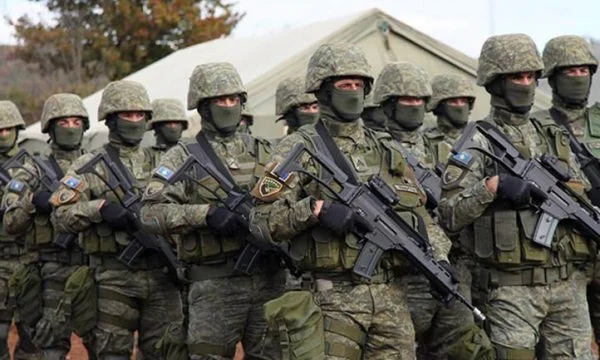
KSF members in the “Adem Jashari” barracks.
For more serious cases, however, options are limited.
The lack of a military hospital is often discussed among us, especially for long-term or heavier cases”, he adds.
Increasing capacity, infrastructure in impasse
The transformation of KSF into the military, launched in 2018, envisions that by 2028, this force will have over 7,500 members, including 5,000 active troops an objective that, according to the Ministry of Defence, has already been achieved.
This transformation includes not only the increasing number of soldiers but also the establishment of new operational capacities, such as weapons, training and participation in international missions.
But, as military capacities grow, support infrastructure appears to not follow the same pace.
Acting Defence Minister Ejup Macedonia briefly tells Radio Free Europe that KSF is developing its medical capacities according to the American medical system model, but does not offer more details.
“The KSF has a medical centre, which has primary medicine delivery capacities and some specialist services”, he says, adding that the centre also has an infrastructure space for hospitalization.
For the former KSF commander, Kadri Kastrati, building a military hospital at this phase of force development is necessary.
The state must advance the medical services, as they have the countries of the region and those European”, he tells Radio Free Europe.
According to him, the Medical Centre in the Kazerman “Adem Jashari” is built precisely with the idea of becoming a military hospital in the future.
Basic infrastructure exists, but there are no investments in personnel and equipment.
This can be realised if there is political will”, Kastrati adds to Radio Free Europe.
Security expert Ismet Ibishi, who has also served as deputy minister of Internal Affairs, says the military hospital is standard of a modern army.
According to him, the presence of medical personnel in military operations is essential not only for treatment but also for increased body safety and morality.
“Even in exercise soldiers can get hurt, and much more in war zones”, he tells Radio Free Europe.
Existing capacity and technical challenges
According to the former director of the KSF Medical Centre, Shkelzen Sylaj, the current facility at Kazerma “Adem Jashari” has space and possibilities for about 60 beds, but remains incomplete with modern equipment and specialised staff.
It cites the need for various devices, such as magnetic resonancency, advanced CT scanners and labs, as well as for organised staff in 24-hour service.
“Hospital System means service 24 hours, and it takes some specialists for each account”, says Sylaj for Radio Free Europe.
He adds that Kosovo has enough medical frameworks from orthopedics, internists, cardiologists to otamologists, but that functioning a military hospital requires high costs and new organisational structure.
Termless promises and lack of transparency
The establishment of such an institution is also mentioned at the highest state level.
In December 2023, then Kosovo President Vjosa Osmani has declared that this project is part of a state programme that envisions health services up to the tercari level for military, police and their families.
However, institutions have not provided concrete details for deadlines or phase of implementation of the project.
Meanwhile, in the 2023 Defense Strategy, this project is not mentioned at all.
Radio Free Europe requested clarification from the President's Office, the Office of the Prime Minister, the Ministry of Defence and the KSF, but until the publication of this article, there was no response.
The KSF also rejected the visiting request at the Kazerman Centre “Adem Jashari”, arguing with planned commitments.
Neither did the Health Ministry provide answers regarding potential capacities for support in the event of the functioning of a military hospital.
And, in a 2024 Defence Ministry annual report, says, in cases of specialised treatment abroad, the KSF co-operates with the medical institution. GAT in Ankara, Turkey.
Need Growing With Missions Abroad
The need for advanced medical capacities has become more urgent even with KSF involvement in international missions.
Recently, some of its members have engaged in a stabilising mission in Gaza, under the United Nations mandate.
A team to verify the situation on the ground has been sent there in late April, however, Radio Free Europe has failed to confirm whether medical personnel have been sent with those forces that add dilemmas on land support.
According to expert Ibishi, the presence of medical teams in military operations abroad significantly strengthens the sense of body security and sustainability.
From my experience that I spent in three wars in Slovenia, Croatia and the last in Kosovo, I as a soldier, in all that experience, have felt much better and safer when we had closer medical personnel”, he says.
Officials Security and Current Treatment
According to Kastrati, the military hospital would also serve for security reasons for the heads of state and high security structures.
Maximum “Security is guaranteed within the” barracks, he says.
Currently, senior officials are treated at the University Clinical Centre in Kosovo (QKUK), which confirms there are no separate departments for them or for KSF members.
All patients are treated in relevant departments, based on their state of health and medical needs”, says the QKUK's response to Radio Free Europe.
It also stresses that additional security measures by Kosovo police may be required on certain occasions.
region ahead of Kosovo
Unlike Kosovo, countries in the region have built real structures of military medicine.
The University Central Military Hospital has been operating in Albania since 1993, which provides specialised services for both military and civilian.
Serbia has one of the largest military hospitals in the region, with extensive infrastructure and organisational capacities.
Meanwhile, the North Macedonia operates the Military Medical Centre, which offers services at several levels.
The Office of the Government of the Republic of Macedonia's spokesman confirms to Radio Free Europe that this centre co-operates with the public health system for more advanced treatment.
With NATO doctrine, where Kosovo aims to membership, military medical support is organised at various levels, each representing a more advanced approach step from first aid to hospital capacity in operating halls. / REL