4 hours ago
Iran opens official tariff system for passing ships to Hormuz Strait
Periskopi(a month ago)
(a month ago)Iran's Supreme National Security Council announced on Monday the opening of an official X account for the Persian Gulf Strait Authority, a body that Tehran says will manage the transit of ships to the Hormuz Strait and collect transit fees, formalising a system that he believed has been in force since March.
Under this mechanism, ships that want to pass through the straits must apply through the official address of PGSA's email, handing in ownership data, security, crew lists, cargo statements and target route.
The transit permit is granted only after the adoption of the authority and payment of the corresponding fee. An official fee has not been published so far. Reports suggest that some ships have paid up to $2m (about $1.7m) for passage, with payments made in the Chinese Juan as well.
The authority functions as an administrative structure in co-ordination with the Islamic Revolutionary Guard Navy (IRGC), which physically controls ship movement on this sea route. I RC is designated as a foreign terrorist organisation by the US and the EU.
The announcement comes after weeks of uncertainty and the risk of navigation in this strategic area. After Tehran declared in March that it would impose payment for safe passage, suspicious operators appeared on the market offering unofficial transit documents in exchange for fees with cryptodollars.
P The GSA appears intended to replace this grey market with a single official channel.
Ebrahim Azazi, chairman of Iran's Parliamentary Committee for National Security and Foreign Policy, said in a television interview that Tehran has prepared a mechanism for traffic management at Hormuz through a certain sea route and that further details will be made public soon.
He wrote on X that only commercial ships co-operating with Iran will benefit from this mechanism and that relevant tariffs will be applied.
Several billboards posted in Tehran's metro system allegedly Iran could generate up to $100 billion annually from Hormuz Strait revenues.
This figure has circulated in Iranian media, along with proposals for mounting even data cables passing through this maritime corridor.
According to W The Hormuz Strait is considered a transit crossing area that guarantees the steady movement of international shipping. Iran has signed this convention, but has not ratified it.
The United States, Gulf and European countries have rejected the legitimacy of such a tariff regime by Iran. They have repeatedly declared that free navigation in this strait should remain without tariffs or additional restrictions.
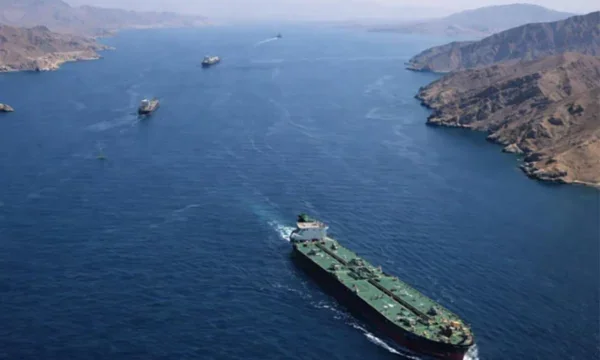
The waterway, some 35 miles [35 km] wide at its narrowest point, transports approximately one fifth of the world's liquid oil and natural gas.
U.S. media report that the number of oil tankers collected near Kharg Island ʹ the Iran's main crude oil export terminal has reached the highest level since the beginning of maritime tensions, suggesting increased pressure on Iranian exports.
Iranian news agency Tasnim reported on Monday that US oil sanctions could be temporarily suspended during the negotiations, while Tehran continued to demand full removal.
Pakistani media have also reported that Islamabad has forwarded a revised Iranian proposal to Washington, while Prime Minister Shebas Sharif has voiced optimism about the resumption of talks.
Iran's Foreign Ministry spokesman Esmail Baghaei said that “when the plan was introduced with 14 points, the American side presented its remarks, and we, in turn, also presented our considerations”.