7 hours ago
US wants to change Balkan energy map, Kosovo currently out of plans
Periskopi(a month ago)
(a month ago)The United States wants to change the way the Western Balkans are supplied with energy, making a network of gas importable agreements (LNG).
The goal is to reduce the region's dependence on Russia and strengthen the energy corridor south towards Central Europe.
For this, projects are planned in several countries in the region from Croatia, Bosnia and Herzegovina, Northern Macedonia, Albania and Montenegro, as far as Kosovo and Serbia.
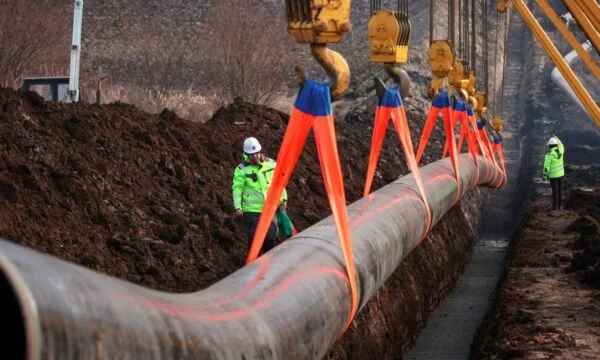
These projects include new gas pipelines, liquid gas and gas power plants, and are supported politically and financially by the US and the European Union.
Some of these projects are already in construction or contracting phase, while others are still in the planning phase.
In general, the regional energy system is gradually oriented towards natural gas from the US, Azerbaijan and the Mediterranean.
Jonathan Stern, professor at the Oxford Institute for Energy Studies, estimates that Southeast Europe has already developed alternative supply routes.
“Exists LNG terminals in Greece and Croatia, and Azerbaijan's South Gas Corridor, along with the Romanian gas field Neptun Deep on the Black Sea, whose use is expected to begin next year and whose reserves are estimated at 100 billion cubic metres”, says Stern for Radio Free Europe.
End of Bosnia and Herzegovina's dependence on Russia
Bosnia and Herzegovina was the focus of attention in recent months, due to the Gaz Southern Liaison project with Croatia, which would ensure the entity of the Federation of Bosnia access to the LNG terminal in Research and Alternative gas suppliers.
At the same time, Bosnia's other entity authorities, Republika Srpska, continue to develop separate gas ties with Serbia, including the Eastern Liaison Project from Bijeljina to Banja Luka.
For nearly five decades, Bosnia and Herzegovina has been fully dependent on Russian gas, which runs through Turkish Stream.
It is used mainly for heating in Sarajevo and, compared to Serbia, Bosnia is a negligible consumer.
The agreement between Bosnia and Herzegovina and Croatia on connecting the pipeline from Dalmatia to central Bosnia, with branches in Herzegovina and the country's northwest, was signed with the participation of US Energy Secretary Chris Wright in Mojanin in Dubrovnik.
It precedes several months of official support from Washington for the project, which was described as “strategic for energy security in the region”.
The Croatian part of the project is run by the state-owned company Plinacro, while in Bosnia and Herzegovina by US private company AAFS Infrascture and Energy, whose directors are part of US President Donald Trump's narrow circle.
The project prompted criticism from the European Commission and the Energy Community, whose member is Bosnia and Herzegovina, due to a special law (lex specialis) in the Federation of Bosnia that includes a private American company, as well as issues of compliance with EU regulations.
The project must be implemented within a framework that is fully in line with the Energy Community's legal acquis and with EU energy policy principles”, EU member states Bosnia and Herzegovina and other countries in the region told Free Europe Radio.
Bosnia and Herzegovina consumes up to 250m cubic metres of gas annually, while through the new pipeline, it is projected to transport around 1.5 billion cubic metres.
For this reason, construction of gas power plants is under consideration, which could supply some 400,000 households with electricity.
Currently, 80 percent of electricity is produced in coal power plants, some built more than 50 years ago.
The planned pipeline will be linked to the existing one coming from Serbia.
Stern, from Oxford Institute for Energy Studies, believes the “pipeline is important for Bosnia and Herzegovina, but not for the wider region”.
It also expresses doubts about the investment leverage of about 1 billion euros how much construction of this new pipeline is estimated.
“Croatia does not have the available LNG capacity for transit of gas through Bosnia and Herzegovina. So where would he go? Serbia can now take it through Bulgaria”, Stern says.
Serbia-based strategic partnership USA
Serbia is expanding its gas infrastructure in an effort to preserve its role as a regional energy centre, while simultaneously opening space for US LNG and new Western investments in the energy sector.
Serbian Energy Minister Dubravka Gjedovic Handanovic signed a joint statement with the US and several Eastern and Central European countries at a summit in Washington in February of this year.
The chief of the Srbijagas company, Dusan Bajatovic, later stated that Serbia “would have to buy American gas”, though formal quantities and contracts have not been determined yet.
The 2024 Strategic Energy Agreement with the US envisions diversification of resources, but there is still no formal contract for the purchase of US LNG.
American gas can be reached through the Croatian terminal in Greek Research or Alexandroupolis, thanks to new interconnections with Bulgaria and North Macedonia.
Serbia operates a network of about 2,500km of gas pipelines and plans new pipelines, including northern Macedonia, and is expanding the Banatski Dvor storage facility.
Currently, more than 80 per cent of the gas, Serbia receives it from Russia via Turkish Stream.
Despite reports of diversification, main gas facilities in Serbia, including thermal power plant T E-TO Pancevo, continue to be linked to Russian Gazprom and Serbia's Oil Industry.
LNG Terminal in Tivar, gas thermals
Montenegro, although without a gas network, is becoming part of the American LNG framework, through plans for a terminal at Tivar port and future gas power plants.
Montenegro also attended the American Transatlantic Gas Security Summit in Washington in February of this year, where it signed a joint declaration with which some Central and South European countries announced they would co-operate with the US in energy.
Even though American companies Enerfflex and Wethington Energy Innovation signed a memorandum with Montenegro Government in 2023 for project preparation, there are still no agreements on LNG supply, no quantities have been allocated and no concrete contracts have been signed.
Montenegro, meanwhile, has supported the Ion-Adriatic Gas pipeline project (IAP), which would link the Transadriatic Gas pipeline (TAP) in Albania with Croatia, but still remains in the phase of the initial plan.
Otherwise, several gas-gas power plants, ranging from 50 to 400 megawatts, are being considered in Tivar, Podgorica and Plelevle, including hybrid models and converting of existing thermal power plants.
According to research conducted on Montenegro's Elektroeconomics by Japan's JERA company and Swiss consultancy SS&A Power Consultancy, all options discussed are technically feasible and economically convenient.
Depending on the capacity of the thermal power plant and gas supply source, investments are estimated to range from 233m to 362m euros.
Kosovo currently out of plans
Kosovo does not have gas infrastructure and is fully based on coal thermal power plants.
The project for a gas interconector with Northern Macedonia is included earlier in the EU's investment plan for the Western Balkans, but has been halted because of, as the Government has said, high costs and strategic focus on renewable energy sources.
The pipeline would provide Kosovo with access to gas from Greek LNG terminals in the Aegean Sea, and the idea was to also build a pipeline towards Albania.
“If and when market conditions change and the business environment becomes more attractive, the [US] Energy Department will be willing to help connect American companies with partners in Kosovo”, US Department of Energy Special Envoy Joshua Volz told Radio Free Europe.
Kosovo has refused to invest about $200m in gas infrastructure through the Millennium Challenge Corporation (MCC) programme and has diverted funds to power storage systems in batteries.
Northern Macedonia ʹ key South Corridor link
Skopje, currently, is building new gas infrastructure with support from Washington and Brussels, with the aim of breaking away from multi-year-old dependence on Russian gas and positioning as a new regional energy centre.
Northern Macedonia is a member of NATO and a candidate for the EU, so diversification of energy supply has also become geopolitical issues.
T-comering thermal power plant E-TO Skopje, which supplies the capital with heat and produces electricity, depends on Russian gas and is under the control of the Russian Sintez group.
Skopje has signed a memorandum of American suppliers for the purchase of LNG, but details have not been made public.
The Gevgeli-Negotina pipeline is under construction and will link this country to LNG terminals in Greece, with an initial capacity of 1.5 billion cubic metres annually.
EU institutions are funding the project with a combination of loans and grants, while, in parallel, a link with Serbia is also being planned with works expected to begin in 2027.
North Macedonia plans to build 67 new energy facilities, with a total installed capacity of 4,416 megawatts, including a co-production plant near Negotin”, the North Macedonia Ministry of Energy, Mining and Mine Resources told Radio Free Europe.
Albania ʹ LNG centre in Adriatic
In April of this year, Albania signed a strategic agreement, worth $6 billion, with US company Venture Global and Greek company Actor LNG USA, which will buy LNG from the United States for long-term supply, starting in 2030.
The plan includes the development of an energy centre in Vlora, with an LNG terminal and a gas-powered power plant of about 380 megawatts, with links to the Trans-Adriatic Gas pipeline (TAP), which transports gas from Azerbaijan to Italy since 2020.
The project is supported by the American administration, which views Albania as a potential entry point for the distribution of American gas to Kosovo, Northern Macedonia and other parts of the Western Balkans.
Albania does not have a functional internal gas network, and the existing infrastructure from the socialist period is largely useless.
For Albania, which almost all electricity is produced by hydropower plants, construction of a gas power plant would serve as a safety reserve in periods of drought and increased consumption.
“The solution to Albania's gasification is the construction of the Ion-Adriatic Gas pipeline (IAP) and the connection to the LNG terminal in Croatia, the link to the Trans-Adriatic Gas pipeline (TAP), through which comes gas from the Caspian region, and the construction of an LNG terminal and gas storage plant at Dumrei”, says Stavrkov, from the European University in Tirana, which has been working for 20 years at the Institute for Oil and Gaser Research at the Institute.
The LNG terminal in the port of Vlora could be a gas centre for the supply of Albania, Montenegro, northern Macedonia and Kosovo, and via IAP and TAP gas can also go to Bosnia and Herzegovina and Italy.
The infrastructure alone does not guarantee energy security”, Free Europe Sophie Corbeau, from the Global Energy Policy Centre in Paris, referring to plans to build new LNG terminals, gas pipelines and gas power plants.
Countries that want to reduce their dependence on Russian gas should first secure reliable long-term contracts with some suppliers, Corbeau concludes.