4 days ago
The wall of Mitrovica. Confessing a Project to Stop

Periskopi(3 months ago)
(3 months ago)The wall that was never raised because someone decided to tear down before Baton Haxhiu was built in May 2001, a project on the physical division of Kosovo was about to become reality. His publication was not journalism. It was a decision to intervene in history and not allow concrete to [...]
Baton Haxhiu
In May 2001, a Kosovo physical division project was about to become reality. His publication was not journalism. It was a decision to intervene in history and not allow concrete to replace freedom. Three weeks I kept it to myself. After I took the project in hand, I shared it with Nebi Dog and Garentina Kraye. I decided it should be published. And no one knew. But no one until the publication.
I didn't make that decision as editor. I took it as someone who understood what was happening beyond the letter and the project I held in my hand. That project was not just a technical plan. It was a line that would irreversibly divide Kosovo. It was a decision that was being prepared in silence, with military logic and cold bureaucratic language, but with lasting consequences.
Koha Ditore, before, during and after the war, was not just the newspaper, it was not just the institution, at the time when we had neither the state nor the Albanian political power, and when the internationals decided everything, it was the voice, the very resistance and consciousness of a society that refused to surrender.
I immediately saw that it was not a story to be preserved for analysis. It was a project that had to be dropped before it took shape. Because when a wall starts to build, it's not just concrete anymore. It becomes political reality, becomes a habit, becomes a limit in mind before it becomes on the ground.
So I decided to publish it. Not to inform, but to intervene. Not to show a development, but to stop it. Because at that moment, silence would be cooperation. And publishing was the only way to disrupt a project that was about to become irreversible.
There is a generation that talks a lot about the Ibër Bridge, the north, the partition, the sovereignty, but I don't know anything about the time when these were not slogans but real risks, when a single decision could divide Kosovo physically and eventually. There are people in public life who talk about the wall as if it were political metaphors, while at one time it was a concrete project, with technical drawings, with construction plans, with international support and hours counted to become reality.
This is the confession of the wall that was going to divide Mitrovica.
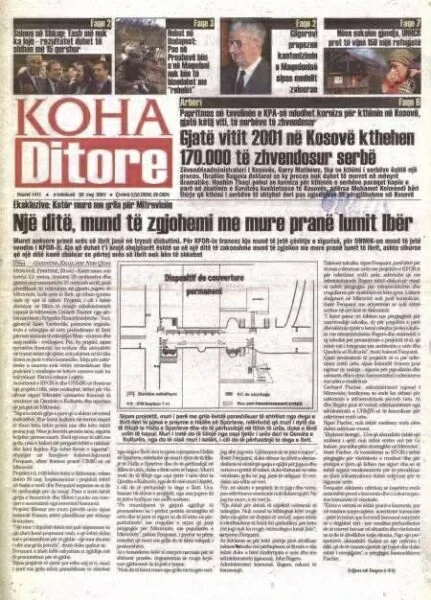
On May 30, 2001, Koha Ditore published a scripture that should be read today as a document, not as a journalist. The title was brutal in its simplicity. One day we may wake up with a wall near the river Iber. It was no rhetorical warning. It was a description of a fact that was being prepared in silence.
Within that scripture was the confession of a seriously drafted project by the French KFOR forces, which had claimed responsibility for the north according to NATO's operational division. It wasn't a crazy idea for any local officer. It was a structured concept of military logic and support of a part of the international chain of command. The goal was clear. Stability through physical separation. Quiet through concrete.
The sketch published in that scripture was evidence of that opinion. A wall along the Ibri, with permanent security elements, checkpoints, restrictions of movement, and a architecture that was not temporary. There was a barricade coming off tomorrow. It was a structure intended to become an irreversible fact.
Legend under the sketch was not merely a technical explanation. It was a political statement hidden in engineering. The permanent defense device. This personal word is the essence of history. There was no temporary solution to postwar tensions. It was about institutionalizing separation. For a line that would become a daily reality and then in fact acceptable.
At the time, the project had passed the discussion phase. He was on the verge of implementation. And what happened next was not just journalism. It was a history intervention.
The project has been delivered to me. Like a document that should be kept secret. Like a plan that shouldn't go public. And that's where the missing part of today's collective memory begins. It wasn't just a matter of information. It was a decision to publicize a project that could divide Kosovo forever.
After the publication, the reaction was not institutional, it was investigative. In the French barracks in Mitrovica, I have been questioned three times. The question was the same. Who mined the project. They didn't call him journalism. They called it sabotage. And somehow they were right. Because what was done was sabotaged an idea that was taking real shape.
Problems with French generals were not easy. They were heavy, direct, and without diplomacy. Because for them, the project was a solution. For us, it was the beginning of a division that would not return.
Today, when I hear people talking about the wall of Ibr as a new idea, like the current debate, as a political option, you realize how shallow memory is and how dangerous ignorance is. It's not a problem they don't know the story. The problem is they talk for sure about things they haven't lived through and they haven't.
The wall was not a metaphor. It wasn't a figure of speech. It was a project. There was a drawing. There was a budget. There was a military command behind him. And there was a moment when it could come true.
And it didn't.
It wasn't because someone decided to take him out. Because someone decided to risk it. Because someone saw it, not as a compromise, but as a chapter.
At another time, the names of those who made it impossible to build the wall across the Iber River will be revealed. Not personal history. But as part of a chapter that is now being forgotten with a frightening ease.
Post Script
There is also part of this story that should not be forgotten. The courage to keep the secret for three weeks, at a time when each leak could destroy everything. Garentine Kraja and Nebi Dog took the burden and kept it. It wasn't just journalism. It was responsibility. And at that time, there was danger. These machine guns in politics, sentences on television and letters will never understand the history of war and its struggle.