15 minutes ago
Joseph: Political crisis in Kosovo endangers state interests
Periskopi(4 months ago)
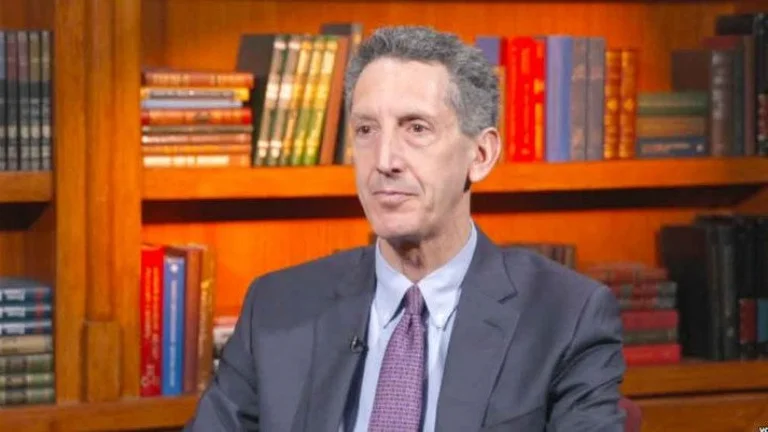
(4 months ago)Edward P. Joseph, former American official and expert on Balkan issues, describes the political situation in Kosovo as <x0 disaster” and “artificial crisis”. In an interview for Radio Kosovo, he stresses that Prime Minister Albin Kurti's failure to fulfill constitutional duties has created institutional chaos, which not only weakens democratic and reforming processes, [...]
Edward P. Joseph, former American official and expert on Balkan issues, describes the political situation in Kosovo as <x0 disaster” and “artificial crisis”. In an interview for Radio Kosovo, he stresses that Prime Minister Albin Kurti's failure to fulfill constitutional duties has created institutional chaos, not only weakening democratic and reforming processes, but also boosts Serbia's influence and strains Kosovo's international relations.
How do you assess the current political situation in Kosovo and the main challenges for the stability of governance?
Edward P. Joseph: I have a word to describe the current situation in Kosovo. Disaster! As I said, it's an artificial political crisis. Why do you use the artificial word? Because there may be a political crisis that is natural, when the electorate itself is split when voters are divided and give a very tight election result, and then it becomes very difficult to form a government. This has happened in Europe, for example, in Belgium, where the record was set for the delay in forming government. But in Kosovo we do not have this situation. There has been a clear election result, and it has given Prime Minister Albin Kurti responsibility to lead the processes to fully establish Kosovo's government, including the constitutional requirement for electing the president. And Prime Minister Kurti has failed to fully meet that responsibility. So this is an artificial political crisis, and it's catastrophic, which means there are serious consequences both inside the country and because of institutional chaos and vacuum that can be created very quickly, depending on the answer Kosovo Constitutional Court will give both abroad and abroad. It is catastrophic for a country like Kosovo, which has a hostile neighbour like Serbia, which has unresolved issues and a high level of anxiety in Kosovo's Serb population, and still remains unknown from many countries of the world, including four NATO and five countries in the European Union. So this is an artificial crisis and a crisis that Kosovo cannot afford.
But why do you think this artificial crisis was created? From who and why?
Edward P. Joseph: I want to focus first on what your listeners need to understand: the great cost, unfortunately unnecessary, that they and the country will pay. And I'm just giving you one quick example. So, just this week, you have the Minister of Defence, or Defence Minister Ejup Macedonia's taskman, who tells a NATO official that Kosovo, once again, wants to join NATO. This, of course, is understandable and, as I have written, is absolutely essential for Kosovo, for Serbia and for the region. So you have the defence minister, Macedonia, expressing Kosovo's fundamental interest in joining NATO while you have a Kosovo Parliament MP from the ruling Vetevendosje Movement, Adnan Rrustemi, who is warning ambassadors: “Do not interfere with Constitution”Like they would do that. So do you see irony? On the one hand, you have an official in the government of Prime Minister Albin Kurti, who says we want to be in NATO, while you have another official who is essentially insulting key ambassadors whose support is essential for Kosovo to join NATO because Kosovo is still not recognised by four NATO nations. So this is chaos, and it's a farce entirely. It would be funny, if it were really funny, but the consequences are serious. And, again, this is completely unnecessary.
I would insist again: who created this artificial crisis, as mentioned earlier?
Edward P. Joseph: Yes, as I said in the first response, Prime Minister Albin Kurti and his party, Vetevendosje Movement, won a very strong result in the December elections. And that gave him the responsibility to further the process. He knew everyone knew about the petition in the Constitution to elect the president. It was his responsibility to gather his deputies in the Kosovo Assembly to hold a clear discussion with opposition parties and move forward with the process. First, then, Prime Minister Kurti had that responsibility. Second, he had a very clear and very natural option: to continue with current president Vjosa Osmani.
So why do you think Mr. Kurt didn't propose it again. Osman for president of the country?
Edward P. Joseph: This is a speculation, and I don't answer speculation. It's very difficult to know people's motives. It may be difficult to understand the motives even in the foreign policy of the countries, but it is even more difficult when it comes to individual politicians: what was the real motivating factor? I can ask some questions that others in Kosovo can discuss and answer: Did he fear that Vjosa Osmani could not control him? Was that his motive? Did he want complete control over all institutions, including the presidency? Did he want a situation like in Albania, where Prime Minister Edi Rama has a calmer president and thus manages to dominate the political scene? Was there any personal discontent or tension between them that may have affected this situation? Maybe that was some of the reasons. But these are just speculations, and I can't answer those questions. There may have been another reason.
We already have a Constitutional Court ruling, which has suspended the work of the assembly by 31 March. How do you think this situation will affect democracy in the country?
Edward P. Joseph: It is already a very bad demonstration of the democratic process. And, again, the greatest responsibility falls on Prime Minister Albin Kurti, but of course other parties have their share of responsibility. In any democracy, especially in a parliamentary democracy, the system functions only if there is readiness for compromise on the part of the leadership. This system is different from our (presidential) system; there is a parliamentary system in Europe, and in this system, it is essential that leaders have compromise skills. But if the dominant leader does not show willingness to compromise, then an internal democratic problem arises. At that moment, you push others away and make compromise impossible. And so creates an institutional vacuum and chaos. This raises another question: Is that actually the result Prime Minister Kurti wants? Does he want this kind of institutional chaos and vacuum, because maybe it gives him more freedom to do what you want? If that were true and that's a question that I put forward then it would be a clear example of a politician who puts personal interests above the interests of the country in this case of Kosovo.
But it must be taken into account that neither came the opposition with any concrete proposal for consensual names.
Edward P. Joseph: Yeah, and that's a very valuable point you're getting up. That is why I said that although Prime Minister Albin Kurti bears the primary responsibility, this does not make him exclusive responsibility. In a parliamentary democracy, the opposition has an obligation to co-operate within the system and not create complete frustration of the process. This becomes especially difficult when a leader who will be prime minister shows no readiness for co-operation. So your points are valid, and I want to be very clear: this doesn't mean 100% of responsibility falls on Albin Kurti. The opposition also has its word and an important role in this very delicate situation. It has the responsibility to show commitment to Kosovo's interests, and not only to its personal political interests.
Mr. Joseph, in Kosovo, for years we talk about implementing reforms. How much do you think this political polarisation affects Kosovo's ability to implement these necessary reforms, including NATO membership, the European Union and other international relations that are necessary?
Edward P. Joseph: Of course. This political polarisation is completely at odds and the obstacle to any significant reform. Having chaos and an unnecessary political crisis for so long is a very bad institutional development. We must remember that Kosovo is not yet in a position to move forward with NATO membership or the European Union. This is important to remember. So, to discuss reforms, yes, they are essential, but Kosovo does not have a clear path towards NATO or the EU due to the blockade from Serbia. This requires political support to be resolved. And you cannot have deputies from the Vetevendosje Movement who are insulting ambassadors of countries which are necessary to open this road to Kosovo. This clearly shows that political polarisation and lack of co-operation hinder any real progress.
When you mentioned Serbia, you talked a lot about dialogue and relations between Kosovo and Serbia. How do you see, does dialogue between Kosovo and Serbia have a future after the latest events?
Edward P. Joseph: See, who benefits from political chaos in Kosovo? Serbia benefits. This is a clear benefit. And it happens at just one point when Kosovo should be showing that there is a stable political order, while Serbia is facing internal unrest with constant protests and the oppression of journalists and opposition figures, which continue from protests that started over a year ago. This is a great loss for Kosovo. It gives Belgrade victory, which may say: “Look at this chaos, this so-called one, as they call it in Belgrade, so-called Kosovo.” This creates the possibility for Serbia to continue with its concept that this is a so-called Kosovo, which is not a real state, which does not function and abuses the rights of Serbs. Of course, it increases the great and legitimate anxiety of Kosovo Serbs, who are in a very vulnerable position and under the rule of Prime Minister Albin Kurti, have not been fully and adequately consulted. This is proved by the position of the former American ambassador, a great friend of Kosovo. So this is simply catastrophic for Kosovo's position on Serbia and a gift for Aleksandar Vucinq.
Do you think that Serbs, as minorities in Kosovo, actually have the greatest rights that all minorities in other countries of the region have? Even the simplest constitutional changes cannot be made by Albanians if there are no votes on the Serbian side.
Edward P. Joseph: Yes, we can talk about rights under the Constitution, and we can also talk about rights as experienced in practice. And we have many questions about implementing the laws on ownership in the north, we have questions about the foreign law, which has caused great anxiety in Kosovo's Serb population, and we have questions about the possibility of functioning of the community, given that this is a community of major language differences. So the greatest sensitivity must be decided by the government in Pristina on its role, taking into account the responsibility to protect the rights and security of the Serb community in Kosovo.
Don't you think they're being manipulated by the government of Serbia?
Edward P. Joseph: We have to be real. The Republika Srpska list has much to do with Aleksandar Vuciq's policy. But we must distinguish between the rights of Kosovo citizens and political orientation. As I said, all this chaos only strengthens the proximity and support of Belgrade's position here. And I don't accept the idea that Serbs, if you mean this, are creating their own problems. Problems arise from the institutional and political situation that creates, not from the Serb community itself.
Do you believe that he is being manipulated by Alexander Vuciq through the Serbian List in Kosovo?
Edward P. Joseph: The political orientation of Kosovo Serbs is, in my opinion, a dynamic. This is the key point. The political orientation of Kosovo Serbs is dynamic, and depends largely on what Serbia does and, perhaps, more importantly, on what Pristina does. When there is a hostile attitude in Pristina towards Kosovo Serbs, and we know this because the US Embassy and the main embassies of the European Union have attracted attention to the uncoordinated actions of Prime Minister Albin Kurti, then problems arise. When bold actions are carried out to undermine the Serb influence that is legitimate but do not associate with clear and sustainable approaches to Kosovo Serb citizens, telling them: “Look, your government is here in Pristina and we respect you as full citizens of Kosovo. We show this through the functioning of courts, police, economic policies we care about you as citizens. ” Meanwhile, Belgrade does not do this; they only use you for their interests. This should be the message a government responsible in Pristina must deliver: We care about you, Belgrade don't! This is the formula for success. This is the path that advances Kosovo towards NATO and the European Union. This is the journey that isolates Alexander Vuciq's regime.
Based on what we are seeing recently, would I say how real is it to reach a stable agreement between Kosovo and Serbia?
Edward P. Joseph: I would say that it is very little opportunity, if we have political chaos and institutional vacuum in Kosovo, facing a hostile neighbour like Serbia. So the prediction is very weak, and I've written that many times in articles, reports and interviews. This is a completely different topic from our current interview, which focuses on the current political crisis, but there is a broader problem that makes dialogue very difficult: countries that do not recognise Kosovo. This is not a standard difference like what Northern Macedonia and Bulgaria face. See, Northern Macedonia faces a blockade from Bulgaria because Bulgaria is a partner in the European Union. Thus, there is a limit to what Northern Macedonia can do, and despite its actions, Bulgaria can control its process towards the EU. In the same way, for Kosovo, limited international accession and non-recognition by some countries strongly hinders any progress in dialogue with Serbia.
Do you think that the European Union and the United States can influence the changing dynamics of this dialogue?
Edward P. Joseph: Yes, of course! This is exactly the center of what I'm trying to say in this interview. Yes, the US and the EU can influence, and NATO, as well, primarily with US involvement. But how will you influence the US if it shows full political irresponsible and lack of leadership in Pristina? If you have a leadership in Pristina that says: “I don't care what others think, I'm going to control every element of government, I'm going to have my president, I'm going to have this, I don't care about the consequences,” do you think the U.S. would invest in a country with this kind of approach? There was an acceptable option to avoid the presidential crisis and this artificial crisis: to preserve Vjosa Osmani as president. In theory, that can still happen. No matter how personal you might like it, you might not like it, you might criticize it, the fact is how it performed as president and if it deserves a second term is the key issue. As someone speaking from Washington, D.C., where I personally welcomed President Osmani last summer, I have seen him be a visible and effective presence. It had meetings when Kosovo had difficult relations with the US in September, the administration suspended strategic dialogue with Kosovo, and Serbia took advantage of it. Who was the official who continued to have critical and high-level communication with Trump administration? President Osmani! Under its leadership, Kosovo has been invited to the Peace Board, where there have been visible presence in Davos and Washington. He met Secretary of State Marco Rubio and Deputy Secretary of State. So for a country like Kosovo, which has a hostile neighbour, it is not recognised by four NATO and five EU countries, and which absolutely needs a strong strategic relationship with the US, why not just keep Vjosa Osman in office for another year? There was no scandal or horrible act that opposed that decision. For the interests of the Republic of Kosovo, it would be better to continue with Vjosa Osmani as president of the country.
Do you think Vjosa Osmani's presence in Washington has prevented her from being reruned as president?
Edward P. Joseph: I'll tell you this: you asked earlier about my motives. I cannot give a definitive answer on what were the motives of Prime Minister Albin Kurti or others in the Kosovo Assembly. I can't answer that question about their motives. What I can say is that the main and only motivation for Prime Minister Kurti and his colleagues at this critical moment should not be individual preferences. This should not be their primary motive. The primary motive should be the interests of the Republic of Kosovo, and they are clear and unequivocal: preserving a president is not referring to the name ʹ that has built a humble and respected relationship with the administration in Washington, which it has done. So even though I cannot analyze the true motives, the main fact is that at this critical moment Kosovo's interests should be foremost.