20 hours ago
Vlasi, Surroi ʹ Yugoslavia's Voices in Free Kosovo

Periskopi(a year ago)
(a year ago)With careers built on the privileges of the occupation regime, today they try to sell Yugoslavia's homesickness as “barazi” and “stability”, hiding crimes over Albanians. It says: Ramadan Avdiu in post-war liberation Kosovo, efforts to build a democratic and fair future are often facing numerous obstacles. Every day and me [...]
It says: Ramadan Avdiu
In post-war Kosovo, efforts to build a democratic and fair future are often facing numerous obstacles. We are seeing more and more that there are still voices, which, rather than looking forward, show homesickness for the past under the Yugoslav occupational system.
This show of homesickness for that invading system is not only wrong in essence, but constitutes a tendency to distort collective memory and a downplay of historical injustices against the occupied Albanian people. Minimizing discrimination, explosion, persecution, deportation, mistreatment, imprisonment, and murder to the extent of genocide.
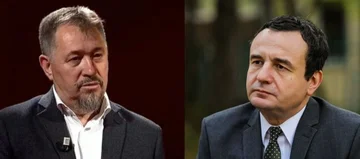
Two of the figures that have often been articulating this feeling are Azem Vlasi and Veton Surroi, two names known in public life in Kosovo, which at various times have been tools of the invading Serbian-Yugoslav system.
The naturalist, cloning Yugoslavia as a state of equality, economic development, and social stability, is a nostalgic construction in order to ignore or hide the reality of fierce systematic oppression against Albanians in the former Yugoslavia.
In this context, it is unacceptable, denigrating, insulting and derogatory to the absolute majority of Albanians, for individuals like Azem Vlads and Veton Surroi, who have benefited from their positions within the Serbian-Yugoslav chauvinist system, to show sympathy for that regime, with a tendency to relativise violence, oppression, discrimination, countless mistreatment, imprisonment and murder of that numerous invading system of Albanian captive people.
Azem Vlasi was part of the highest communist hierarchy in Kosovo for almost two decades, 1970s,1988. He served as secretary of the League of Kosovo Communists and represented the interests of the Communist Party of Yugoslavia, not the Kosovo Albanian people. It has led to so-called unpolitical differentiation, creating premises for the chase of intellectuals and natives who disagreed with the situation of the captive Albanian people in Yugoslavia.
Although it is often mentioned that he left his post in 1988, at the time of the so-called «revolutionous» initiated by Slobodan Milosevic, the truth is that Vlads has always defended the oppressive Yugoslav system, which he served with devotion, as well as that structure that mistreated and marginalized Albanians. Amazingly, to this day, he attempts to legalize that regime that was bloody for Albanians.
Even Veton Surroi's personal and professional history shows a close link to the structures of the Yugoslav regime. More known as a liberal semi-intellectual, he comes from a family closely linked to the structures of the former Yugoslav state. His father, Rexhai Surroi, has been a high-profile and official faithful diplomat of Yugoslavia, while Veton Surroi himself grew up and was formed with a serious totalitarianity, within a cultural and political elite that had privileged access to the Yugoslav federal system. Although in later periods he became critical of Serbian nationalism and contributed to building a medium to say a little democratic in Kosovo, in his public analysis he has shown the tendency of idealising the era of Yugoslav savage rule over Albanians.
Both individuals, in various ways, served the system and viewed themselves as part of the elite, both through the Communist party and through political, cultural, and diplomatic privileges. This reaction to the regime was not only ideological but also material and career.
Their instrumentizing as part of the system was not forced but chosen as the form of personal and carrieering interests. In this way, they try to eclipse resistance through examples of sophisticated conglomerateism or even despise it to take its place.
Listening to the conversation between them at the point best testifies to this, as those with humiliation said that «paculi and verac» made it an obstacle for Kosovo not only to become a state within the Yugoslav federation, but to be convinced that these serviles of invaders had been putting the entire Yugoslavia into Kosovo.
Vlas and Surroi were not only passive participants of the system. They were obedient instruments of the Communist regime. Hence, their voice should be carefully heard today, not as moral authorities, but as examples of what happens when intelligence serves power rather than standing before it.
Had it not been for the systematic resistance of the natives against their invaders and tools and the KLA's liberation war, they would at present have held the conversation in Serbian.