 21 hours ago
I've seen international justice on the inside, so I can't keep quiet.
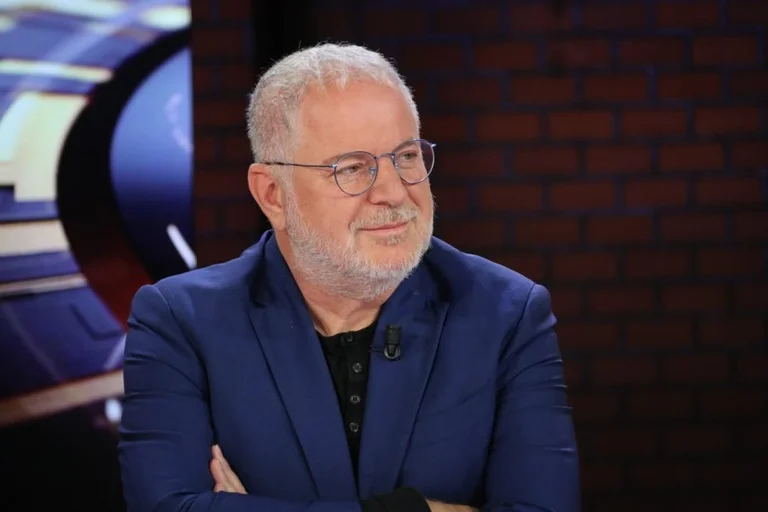
Periskopi(a year ago)
(a year ago)I have not written until today, because those who fought me to vote this court are now acting as advocates of Hashim Thaci. When lies become a protection, the truth can no longer remain silent. It says: Baton Haxhiu the last interview of Ekaterina Trendafilova makes me speak. Not to argue formally, but to [...]
I have not written until today, because those who fought me to vote this court are now acting as advocates of Hashim Thaci. When lies become a protection, the truth can no longer remain silent.
It says: Baton Haxhiu
The last interview of Ekaterina Trendafilova makes me speak. Not to formally object, but to prove that she knowingly avoids.
The Rose speaks of transparency and equality in the process, but its interview is evidence of a cold and separate justice from history. I haven't written until now because I knew who was keeping this lighthouse alive. But my silence will no longer be a covering for lies.
What I write is neither a theoretical nor a political reflection. It is a direct response to the Kosovo Special Court President Ekaterina Trendafilova's interview. I've heard every word of it. I've read every thesis that he's articulating to protect this court. And I have felt the need to tell her and anyone who listens: This is not the justice I know. And the less the justice that Kosovo deserves. Because there is no transparency in this process, but there is isolation. There is no procedural equality, but there are unilateral scales. There is no care for the victims, but there is an attempt to produce guilt for those who are the symbol of liberation. And above all, there is no honesty in confession. So this is not a common text. It's a late act of truth.
I testified at The Hague's Tribunal in the case against Slobodan Milosevic and later in the process against Milan Milutinovici and others. I have seen closely how an international court functions, how witnesses are questioned, how defence is organised, how the disproportionate of force and the size of crime is respected. And above all: how the principle of equality of parties is respected, even when it was a president who had brought war and genocide.
That is why I cannot remain indifferent when I hear Special Court for Kosovo President Ekaterina Trendafilova speak of the current process with a technical calm, cut off from history, and from the burden that the court carries on its shoulders. When I read her interview, what is immediately apparent is not a new legal argument, but the lack of any sensitivity to context, to the symbolic, and to the very act of liberation upon which Kosovo's legitimacy is built.
The Special Court, which was established to prove that Kosovo is willing to face the past, today acts as a frozen structure that views the parties sterilely and treats the symbols of freedom as merely administrative files. In essence, Trandafilova speaks of an supervised, fair process built on equality and open to the public. But it never explains how the justice it represents denies the leaders of the Liberation Army the possibility of being protected in freedom, even after four years in custody.
And right here, I have to stop at Mrs. Ekaterina Trendafilova's last interview. It's not an interview that explains. It is a bureaucratic declaration to keep a facade of justice alive. When it speaks of “transparency “, for “barazi in the process, for “International Observation”, for “the guaranteed rights of defendants”, it seems to be describing an ideal on paper, not the reality of a process where people are held four years in detention, without a decision, no real ability to be protected in freedom, and no mechanism to re-evaluate the security measure.
When Trendafilova says the process is fair because it is “transparent” and the internationally supervised “”, spends words on court windows, not on its core. Because what value does transparency have when the process takes place outside Kosovo, with rules not adopted by its Parliament and with a language that does not reflect the sensitivity the history of Kosovo deserves? There is no international supervision that could cover the lack of substantial justice.
She says all defendants have equal rights and mention the legal assistance they have been offered. But in practice, the prosecution has had years to investigate, there have been access to all institutions and documents, while protection has been limited by the physical inability of free communication, the lack of access to evidence, and the time printed by isolation. Easia in the procedure is worthless when in the substance process it is uneven.
The Rose speaks for “the rights of victims” as an attempt to balance justice. But in this case, the process is not designed to expose the victims, but to punish the political figures of a liberation army. What justice for the victims can be built on an imposed torturer, denying that there has been an occupation, genocide and freedom struggle in Kosovo?
She never mentions that this court was created by the Assembly of Kosovo under international pressure. It does not mention being established as a political instrument, not as a result of any real investigation. It does not say the law on which it functions is not a law harmonised with the Constitution of Kosovo. And he never admits that what is happening is a process that could not happen in any country in the European Union without being described as flagrant violation of human rights.
In this interview, Trandafilova is not the voice of a court. It's the voice of a distance. And that's why this text I write today is not just evidence. It's an answer.
In the years that I witnessed in The Hague, the tribunal itself has used detention as a means to silence the indictees' dignity. Milutinovici, president of Serbia during the war in Kosovo, has been provisionally released during the trial. Milosevic was also considered alternative forms of treatment, respecting not only the state of health but also the human dynamic of a process that should not be turned into revenge. In no case was detention used automatically
But that's exactly what's happening here. There is no guilty decision. There's no decision of shape. There is no real danger of escape, for the fact that Hashim Thaci was president of a internationally recognised state, with full record of co-operation and institutional responsibility. However, it is kept in custody indefinitely and without any guarantees that the procedure will be completed within a reasonable time. If it's not a silent form of punishment, then what is it?
The European Convention for Human Rights has sanctioned at Article 5 that no one can be held in protracted detention without a clear, periodic, revised argument and guarantee that justice will not be reduced to the oppression of freedom. The European Court of Human Rights's jurisdiction is rich in decisions condemning states for keeping in custody beyond reason and beyond need.
What remains with a society that has agreed to face the past when justice offered is no longer confrontation but exception? Kosovo has established this court. With political will, with parliamentary approval, with a silent pact that international justice would behave with the same respect that Kosovo gave her. But the court no longer belongs to Kosovo. It develops the process on another continent, with laws that Kosovo has not adopted, with judicial culture ignoring our history, and a wooden language that does not recognise the moral burden of liberation.
I know this not as an external observer, but as a direct witness to the way this court was established. When Milosevic and the others were imprisoned at The Hague Tribulal for crimes in all the wars of the former Yugoslavia, an important conversation took place after the scene between Zoran Djindjic and Carla del Ponte. It was Djindjic who requested, on behalf of a “political imbalance”, that even KLA leaders in all its military areas be investigated one day. Her promise, more than legal, was political.
And as we know, trials were made against the commanders of the area and sentenced to hundreds of years in prison. It was known that wasn't enough.
I've been against this special trial since. In December of the year when the Assembly of Kosovo was called to discuss its abolition, I have done everything to stop her from breathing as an uncontrolled political creature. I have openly told Hashim Thaci at the time that what he was doing was a self-trial of his nation, a mechanism that would one day be used against him personally. And so it was.
I have not written earlier about this process because all those who were hysterically against me and any attempts to stop this court, personally committing themselves to being voted, today have become the biggest defenders of Hashim Thaci and others and without a face forget what damage they have done to this process by supporting him. Even some of the witnesses present in The Hague have invented situations during interrogations, building false confessions with the idea that the entire burden of war was left to one man. Because they never imagined a president could be imprisoned. By lying, they have established a process against themselves and against them KLA. Only I have seen every rise and every war of the KLA know it's possible for whatever it is, but not for war crimes. Zero. Witnesses have therefore used the lighthouse to build a history of peace. That's the truth, Miss Trendafilova. And that's why I haven't written until today. Because the ungodly are still busy dealing with Hashim Thaci's defence. But those whom I have seen with my own eyes, once coveted to send to The Hague.









