19 hours ago
Europe must snatch away the revolutionary plans Trump has for the world
Periskopi(a year ago)
(a year ago)Ivan Krastev, listening to US vice president JD Vance's speech in Munich and seeing the results of the parliamentary elections in Germany, remembered East Berlin in 1989 and the collapse of communist regimes throughout Eastern Europe. It was the last weeks of the Soviet Empire in Europe when Mikhail Gorbachev, the reformist Soviet leader, was told [...]
Ivan Krastev
Listening to US Vice President JD Vance's speech in Munich and seeing the results of the parliamentary elections in Germany, East Berlin was remembered in 1989 and the collapse of communist regimes across Eastern Europe. It was the last weeks of the Soviet Empire in Europe when Mikhail Gorbachev, the Soviet reformist leader, told his fellow hardliners in East Germany that they were in danger of staying on the wrong side of history and that <x0... a risk awaits those who do not react to reality”. Vance gave a similar speech, telling Europeans they were on the wrong side of President Donald Trump. But this message did not have the expected effect.
It turned out that the main beneficiary of posts on the social networks of Elon Musk and Vance's warning was not the far-right alternative party for Germany, but the radical leftist party, Die Linke. The next surprise result was that Friedrich Merz, most likely Germany's next Chancellor, was turned overnight from an old Atlantist to a European gaulist. Immediately after the vote, Merz announced readiness to fight for Europe's independence from the US.
The trumpet revolution has already changed the nature of European politics. Less than two months after the start of the new mandate at the White House, the European political scene has turned into a clash between the revolutionaries of the Trump coalition and nationalist resistance liberals, who say “don't blackmail us”.
It is now the right extreme's duty to justify the expected Trump tariffs on Europe, which this week has been threatened with 25 percent, and to ask Europeans to follow Washington's leadership in foreign policy. Meanwhile, the main parties act as defenders of national sovereignty, hoping to mobilise support by appealing to national interest and dignity.
Munich's conference also ended the heated debate on how to take the Trump: seriously (so, not literally) or literally (so, not seriously). Now we know that he should be taken both seriously and literally. As Vladimir Putin correctly noted, Russia's president, Trumpi “not only says what he thinks, but he says what he wants”. His comments about taking control of Greenland or Panama Canal are not signals, but clear targets. The American president is convinced that America's strategic interest is to make Canada the state of 51. He strongly believes he can separate Russia from China and blame the deep “state” (deep stage) American, for preventing him from doing so in the first term.
In this context, Europeans are wasting valuable time assuming what Trump's plan for Ukraine will be, as well as complaining about their exclusion from the negotiating table.
To understand Trump properly, it is primarily needed to recognize that a revolutionary government is in power in Washington, though organized as an imperial courtyard. Revolutions have no detailed plans. They are guided by time plans: Use the moment; do not plan ahead. It is not clear what Trump exactly wants to achieve in negotiations with Putin, but he wants to achieve something very big and achieve it soon, very soon.
What Trump offers Putin is not just the possibility of ending the war in Ukraine under generally favourable conditions for Moscow, but a major deal to rebuild world order. This market includes America's presence in Europe, as well as in the Middle East and Arctic. The Trump promises Putin that Russia will quickly reintegration into the global economy and that Moscow will regain the status of a great power, which it lost in the humiliating years of APU90.
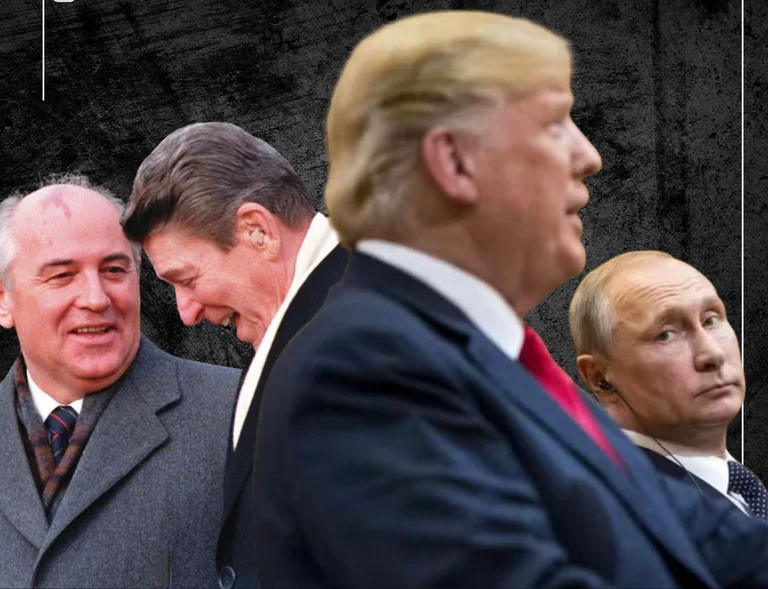
Trump hopes it will convince Russia to terminate the alliance with China. The US refusal in a UN vote to condemn Russia's aggression against Ukraine shocked some of the president's most devoted fans. But this act was intended to convince the Kremlin that the American leader is willing to do the unimaginable and reconfigure the world shaped by Reagan and Gorbachev in the late 1980s.
What will happen to Trump's revolutionary dreams is a separate issue. It's one of the ironys of history that the Russians are waiting with a cautious enthusiasm for Trump's determination to reform the world, an enthusiasm that reminds you of the prudent U.S. reaction to Gorbachev, nearly 40 years ago. What Sergei Lavrov, Russia's foreign minister, says today, is not much different from what Dick Cheney, US Defence Secretary in 1989: “We must be careful not to hang our nation's security, given what may be a temporary deviation in the conduct of our main enemy. ”
George Orwell once observed that “all revolutions are failures, but they are not all the same failures”. What kind of failure will be the trumpet revolution, we don't know yet. But history teaches us that the best strategy is not to resist revolutionaries, but to rob them of the revolution. In this direction, Europe's success will largely depend, not on its ability to resist, but on its showing of talent to surprise. Can Europe find a way to benefit from its expulsion from the US-Russia negotiating table? Should Trump be left exclusively on his grand peace plan for Ukraine, and its implementation?
In a moment of existential crisis like the one we are experiencing, a precious source of the weaker side stands out among others - political imaginations.