 a day ago
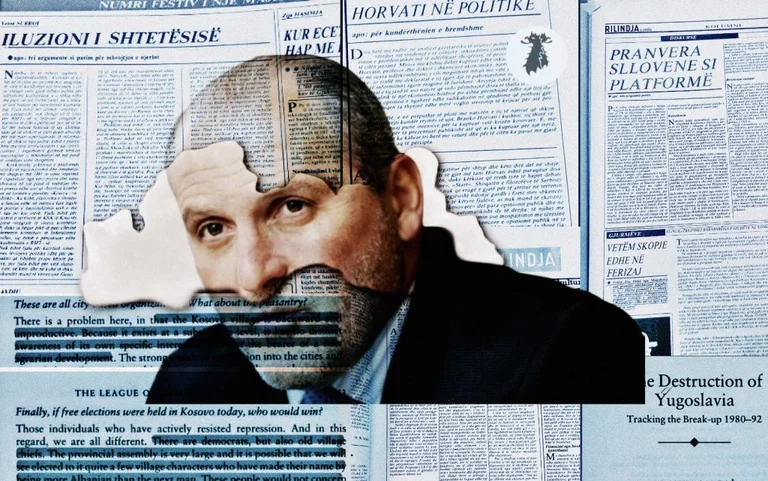
Veton Surroi, evil son of the people
Periskopi(2 years ago)
(2 years ago)Write researchers for Veton Surroi's political activity by journalist Lirim Mehmetaj when years ago I read in Sir Ivor Anthony Roberts' book Slobodan Milosevic loved Veton Surroi for Kosovo prime minister and later in Warren Zimmmanman's book on how Surroi at a meeting with US Secretary [...]
Researcher for Veton Surroi political activity by journalist Lirim Mehmetaj
When I had read in Sir Ivor Anthony Robert's book that Slobodan Milosevic loved Veton Surroo for Kosovo prime minister and later in Warren Zimmerman's book how Surroi at a meeting with US Secretary of State Lawrence Eagleburger, at the American Embassy in Belgrade, on February 26, 1990, had told Albanians that they are not interested in independence, I was surprised and couldn't understand why politics and Albanians gave life to this person even after the last war in Kosovo.
However, by the time I met with these two facts about this man, he was wasted as a political character because he had failed to pass the threshold with his party “Ora”, while from time to time he used his sister's medium for any text here and there, but that did not provide any value as content or a publicist noise.
I would then read a little bit of his writings to create an impression that he was a member of a group that was accommodated in the Yugoslav system with the possibility of family cellification while most Albanians lived in collective prison.
The regime had enabled the kitchen <x0).
If Veton Surroi continued to remain a piece of Yugoslav remains I wouldn't learn more about it, nor would this writing ever be written. I would just expose her as an Esat Pasha who didn't understand when the subx0>-perandoria” who dreamt of doing it either way or again.
But, as Father Zef Pellumb “has once said, unfortunately, that people who fail to pledge their bad sons”, and perhaps Albanians do not have that skill.
Through Albin Kurti prime minister, Veton Surroi, this bad son of the people, returned. It's again like <x0).
He is today an adviser to the Kosovo prime minister and is not the only Surroi in that cabinet.
So I returned to reread what I knew about him, not knowing what I would find was much darker than my early knowledge.
In the text below (which because of the format I had had to cut so many times) you could read how Veton Surroi accused Albanians of driving away Montenegrin Serbs from Kosovo; he lied to internationals that in Kosovo there is an ethnic problem, but it is a question of democracy in Serbia; he accused miners as Albanian identifiators who want to join Albania; he deemed strongly foreign intellectuals when searching for the Republic for Kosovo; he was secretly meeting with people like Mihajlo Markovic in Belgrade, the extreme wing of Milosevic party, the villagers wrote as a mistake of being asked for independence: The Albanians should play and many other games.
The same one, now shows up on TV on behalf of the Government of Kosovo and tells us how we have business in politics, what agreement to accept, how much land to leave to the Serbian churches in Kosovo, and how wide to give autonomy to Kosovo Serbs.
...
In the early 1990s, an American-Serbian businessman named Milan Panic had come from America. Successful as entrepreneur, naturalised American and liberal approach, Panic constituted a more acceptable Serb for the West who had its dissatisfaction with Milosevic. But Panic was no stranger to Milosevic's opponent, and he was not viewed as such. Therefore, in July 1992, Panic takes up the post of prime minister of the Federal Republic of Yugoslavia at the request of Yugoslav President Dobrica Cosic and Serbian President Slobodan Milosevic.
Later, because of some political differences, these two were attacked by Milosevic, and Panic decided to challenge Milosevic in the December 19th 1993 elections.
At this time the Democratic League of Kosovo refused to become part of the elections, because parallel institutions of independent Kosovo had already been declared and the eventual participation in the election would delegate the entire process by giving up an achievement that was beyond symbolic and on the other side would legitimise the apartheid that Serbian politics exercised on Kosovo Albanians.
The goal of Albanians was to internationalise the issue in that form for Westerners to address Kosovo as a problem with Serbia and not as a problem for Serbia.
Panic, since he needed votes for him and against Milosevic, had tried to persuade Ibrahim Rugova to become part of the election process, promising him he would reconsider aggressive policies by then.
The meetings with Rugova Panic were also documented in a book written with Kevin C. Murphy, for his life and short career in Yugoslav politics.
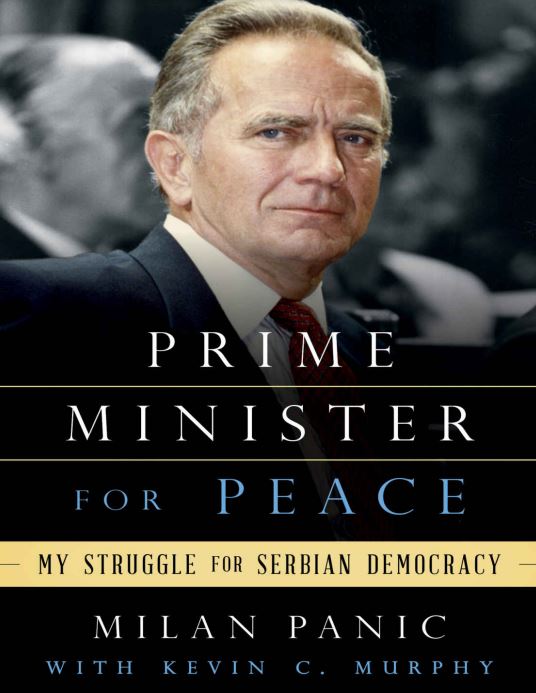
Milan Panic's book
In the book “Prime Minister for Peace my challenge for democracy in Serbia”, Panic unveiled his trips to Pristina in efforts to convince Rugova to become part of the elections.
“I flew myself towards Kosovo for talks with Rugova”, Panic shows. “Dedicated to convince, I publicly exalted the Albanian leader and accepted all the Albanians' demands except secession”.
“Dr. Rugova, I will democratise Yugoslav system”, Panic had declared, and this was happening at the time Milosevic practically ruled by military law in Kosovo.
“In private conversations, I urged Albanians, who made up 90 percent of Kosovo's 2.1 million people, to participate in the political process in order to defeat Milosevic in the upcoming elections. Albanian vote block would represent something crucial”.
But, Rugova, as Panic, well-known with Serbian “trics, says, had refused.
Hoping that the second time it will succeed, Panic had returned to Kosovo prepared to make a dramatic announcement: restoring autonomy for the province of Kosovo in the footsteps of Tito's limited “sovrate”.
“All I needed was a poser of Rugova's head. But Rugova rejected me”, recalls Panic in the book.
The event, like Panic, had later been shown by David Owen, former British foreign relations secretary who at the meeting represented the European Union and was accompanied by Cyrus Vance, UN representative.
Owen wrote that “we asked Rugova to reconsider his decision, but he was in a mood for dissemination. Albanians were most interested in a future in Yugoslavia”.
Time would show Rugova was right. Even so, elections would be completely controlled by Milosevic.
Had Rugova accepted participation in the elections, he would have waved a creative reality promoting Milosevic. Voter turnout would imply that Albanians acknowledge there are democratic means to politically compete and would deny what they had declared by then.
Moreover, it turns out that Americans themselves agreed with Rugova. Panic admits in the book that he had tried to intervene with Americans to convince Rugova, but they really took no step.
The official American stance was for Albanians to participate in the elections, but Panic finds out how US Deputy Secretary of State at the time, Lawrence Eagleburger, had helped, even prevented, to convince Rugova.
“I wrote Eagleburger”, Panic shows. “If you want to help us, I have to ask you to use your good connections to beg Albanian leaders to participate in political life in Serbia and Yugoslavia through the election process, I need their participation in the elections. But Eagleburger just threw a roadblock. I was confused”.
“Encouraged by Albanians to participate in political life was a request not made by Americans”, is the description of Panic in the book published in 2015.
The decision to boycott the total political life by the LDK did not come merely from a political intuition. But the clearest signal they could give to the internationals was the complete departure from institutional life that was already legitimate and violently overused.
This is a view supported by many scholars of civil resistance under occupation. French historian Jacques Sémelin, in his study of resistance movements under Nazi occupation during World War II, suggests that in all cases there is only one general axioma -- “the creative dynamics of resistance, above all, from the initiative and declaration of the act of non-participation in the political process”.
He says the fundamental act of resistance to the occupation is “acceptance of the de jure superiority that has the Occupator”, because it delegifies power.
The more the issue of legitimacy is unclear, the less likely the civil resistance to develop”, Samel writes.
Rugova, the same, wanted to make it clear that Albanians are excluded from political life in Serbia.
Even non-violent civil resistance researcher Howard Clark supports the well-thought strategy of political boycott.
He in his book “Civil Resistance in Kosovo” writes that “The strategic argument may change at a later stage, but at this early stage (where the Albanians were in Yugoslavia) the issue is announcement of and actually denouncing crime”.
And that, he writes, becomes “Basically for an international audience”, but also enables “Internal migration of the people”.
“This is not to deny the value of any connection, or co-operation with opposition groups in Serbian society, but providing perspective to strategic priorities”, it's Clark's phrase.
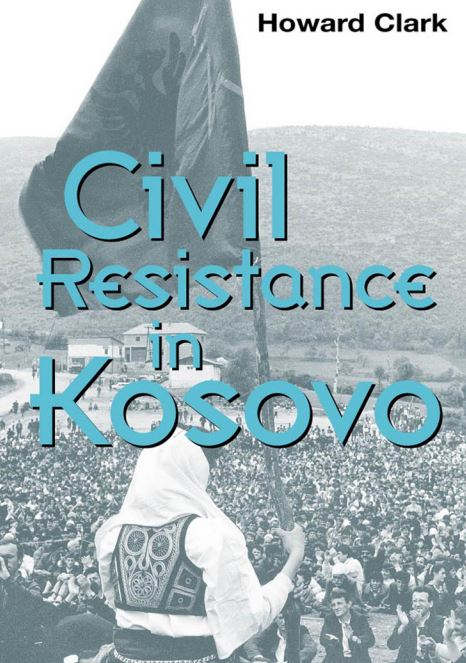
Howard Clark's book
In the same book, he also speaks of Panic's offer to Rugova, which he says had no power to win, much more was not serious.
But despite Rugova, who flatly refused the elections; Americans who did not pressure him to act otherwise; theorists who suggested boycotting and studies that pose as the only <x0xiosioma”, Kosovo had other political players struggling to the contrary.
The semi-publicist and semi-political Veton Surroi was waging battles to convince Albanians to participate in the election.
Surroi on October 29, 1993, wrote in the Serbian newspaper “Borba” (reports that especially from 1994 were in Milosevic's full service) that what Albanians were doing was with parallel structures and the break from Serbia's political system was “Talk to yourself”.
He wrongly taunted the Albanian bid for independence from Serbia/Yugoslavia as something ineffective, and especially the LDK's statements that “Albanians will not participate in these elections, as they have held their elections and through the referendum have expressed their will for independence”.
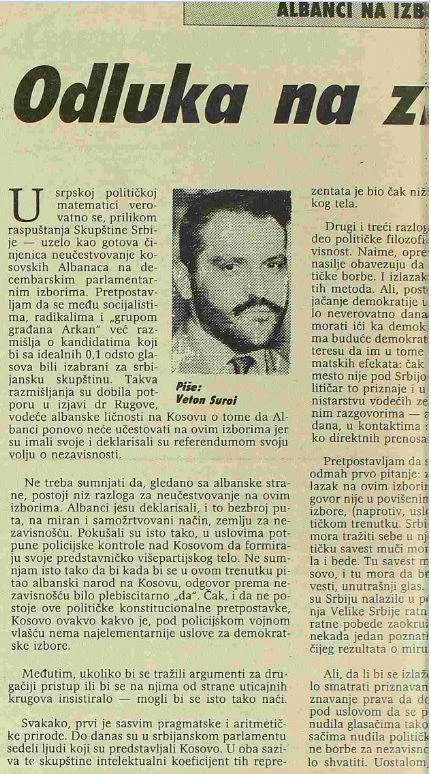
Aware that there were not even the most basic conditions for the development of democratic elections, Surroi invited the turnout.
So, he wrote, becomes “Strengthening Democracy in Serbia” and Albanians “must help on this road”.
Surroi in this writing also proves a ruse, telling Albanians that even if they are finally to secede from Yugoslavia and full independence, then to do so through parliamentary participation in Serbia's Parliament “So they should participate in the elections”.
But the open writings for this political action that sʹe supported no significant Albanian political force were just one of Surroi's methods of operating.
He never gave up.
It would later be understood that even after these elections, Surroi had organised meetings of close people of Slobodan Milosevic in an effort to make Albanians abandon the parallel form of operation and return to Yugoslavia's political system to legitimise Milosevic's policy.
Zoran Stijovic, former head of state security in Kosovo, speaks of such a meeting in his book “Kosovo ʹ my testimony”.
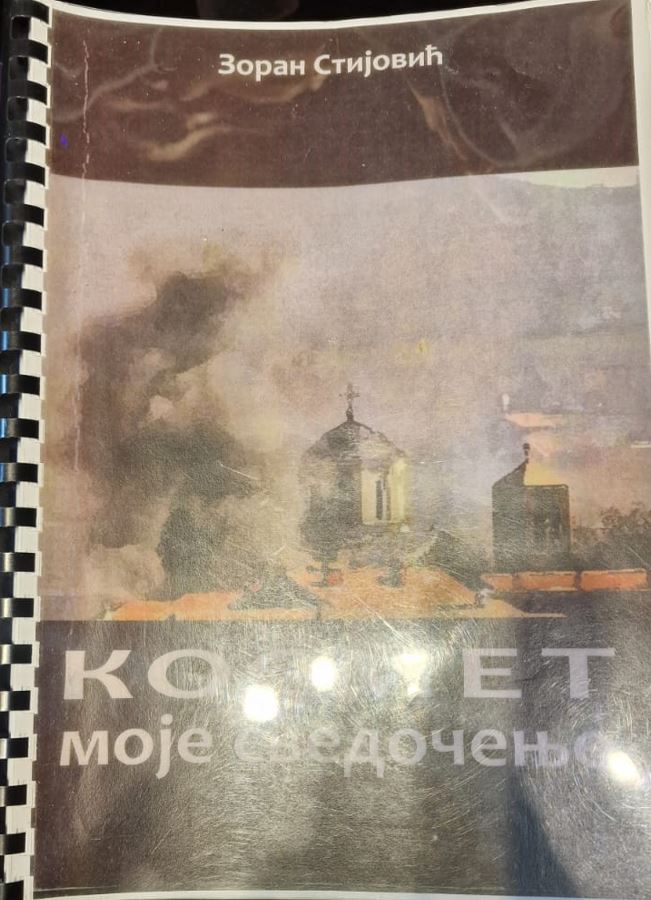
On page 54 of the book Stjovic briefly tells of a secret meeting that Surroi had had had with Mihajlo Markovic in Belgrade.
“In June 1994, the informal meeting between senior SPS official Mihajlo Markovic and Gazmendi's Gazmend Pula Veton at the Swiss Embassy in Belgrade triggered sensational negative reactions of the Albanian factor, on charges that they are accomplices of the Occupator government.”, writes in his book with memories, Stjovic.
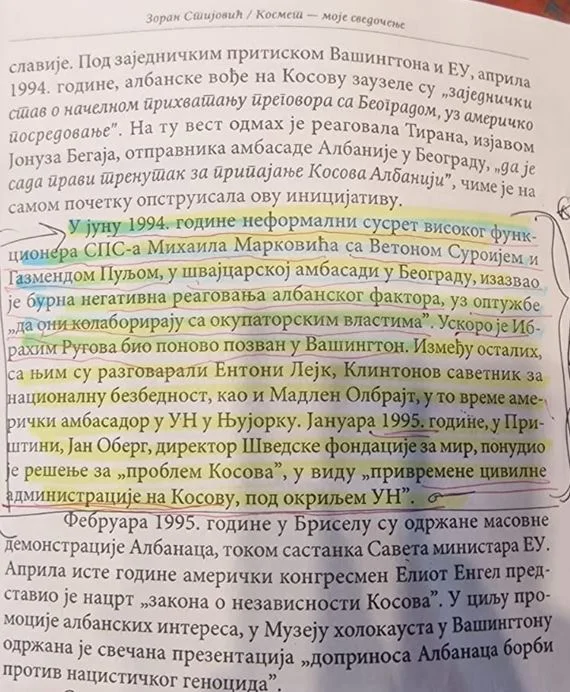
Surroi sé has never denied this meeting.
In addition to the non-formal meeting in Belgrade, he was holding with Markovic, the radical arm of Slobodan Milosevic's party.
One of Milosevic's fiercest supporters of the hard line, Markovic is also co-author of the notorious Memorandum of the Serbian Academy of Sciences and Arts.
This memorandum, which for many is the reason for the wars in the former Yugoslavia, formulated attitudes on how Serbs are discriminated against within Yugoslavia and that Serbia's development was undermined for the sake of other parts of Yugoslavia.
The memorandum claimed that other republics have flourished at the expense of Serbia.
That document presented Serbs in Yugoslavia as victims and others as beneficiaries at the expense of Serbs.
In an extraordinary edition of the numbers and in full disregard of historical facts, the memorandum accused Albanians of torturing Serbs who led up to their Kosovo exodus.
Part of the memorandum reportedly only after World War II “over 200 thousand Serbs have been forced to leave Kosovo”.
“Not only are the recent remains of the Serbian nation leaving their homes at a constant pace, but according to all the evidence, faced with a physical, moral and psychological rule of terror, they seem to be preparing for their final exode. If things do not change radically, in less than ten years there will be no Serbs in Kosovo, and there will be a ethnically clean Kosovo, which is clearly declared target of major Albanian racists”.
The author of these lines was Markovic, with whom Surroi was formally met to discuss the joint plans of bringing Albanians into the political system.
So serious was Markovic's memorandum, which was originally to be published in 1986, in addition to denouncing the League of Communists of Yugoslavia, against him would come up Slobodan Milosevic himself, who would publicly call “anything more than dark nationalism” and Radovan Karacic, would claim that “bolsevisation is evil, but that nationalism is still the worst”.
When Milosevic later decided to play with the nationalist card, he would turn this plan into his political programme.
It is unknown where and when Surroi's relationship with Markovic begins, but his influence on Surroi is seen in the latter's writings.
Similar formulas like Markovic's in Memorandum for blaming Albanians for the departure of Serbs are found in Surroi's writings in the newspaper of time.
The verses are almost similar.
Just as Markovic accused Albanians of terror against Serbs and forcing them to leave Kosovo, so writes Veton Surroi in several articles in the Renaissance newspaper.
This language is noted for example in the April 3, 1988, text where Surro wrote that “The practical application of the violence of Albanian nationalists for realisation of its political platform has also been investigated and warned, which has brought serious consequences to inter-nationalist relations., to harm all nationals”.
In his famous replica with Croatian intellectual Branko Horvat, Surroi, the same as the SANU memorandum and later Milosevic, accuses Albanians of nationalist militants and writes that “about national ideology, these militant nationalist forces have been brought together.”.
The moment when Surroi's writing “Horvati in politics” uses almost identical phrases like SANU is when he accuses these Albanian nationalists of “Kosovo Serb, Montenegrin pressure drive”.
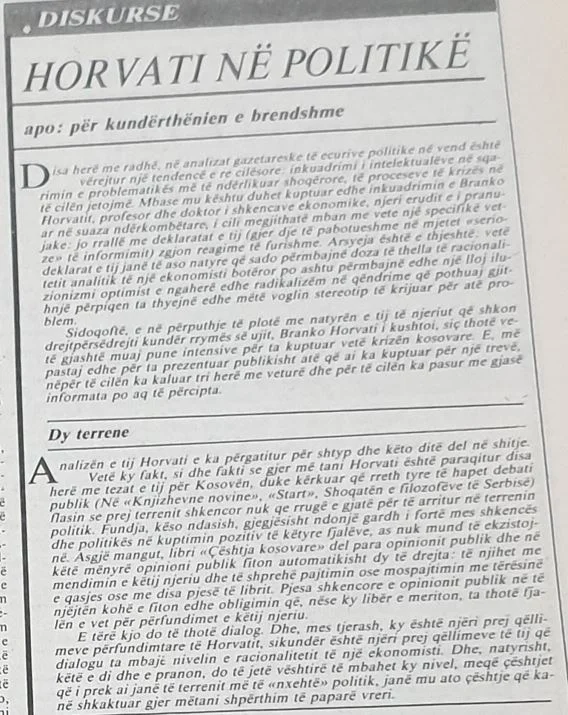
A sentence like this can also be found in the second half of the SANU memorandum, called “The status of Serbia and the Serbian nation”, where authors say “Persecution and the continued expulsion of Serbs from Kosovo” is taking place.
Even there, much of the text is talked about “Albanian nationalists” and the “Albanian savage nationalism” that is clearing Kosovo of Serbs.
Unfortunately, something with softer tones also writes Surroi in some cases, such as the April 3, 1988, article saying that “Albanian nationalists manipulating with the slogan about Kosovo's status the biggest damage was done to this province”, when it speaks of “Pressureed Perseverance of Serbs, Montenegrins from Kosovo”.
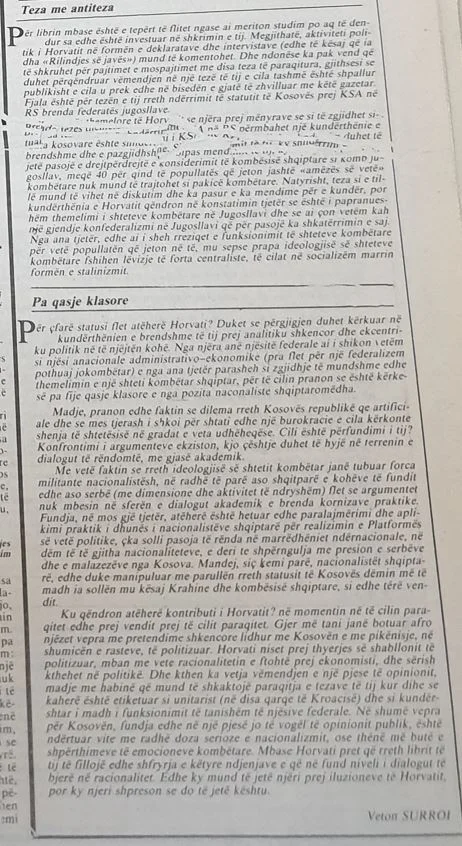
In the same article, the Replic against Horvat, professor and economic science doctor known for a Puritan rationalist, Surroi decides against the idea of the state of Kosovo, under the argument that this is a nationalist request.
The workshop at the time had published a book entitled “Kosovo's” case.
There he argues for being Kosovo Republic and attacks the until then argument that “Kosovo can have the Republic within Yugoslavia, since Albanians already have a mother Republic -- Albania”.
The Horvat gives the analysis of the change of Kosovo's status from the Autonomous Wing in the Republic, but Surroi attacks hard, saying his request leads to Yugoslavia's confederacy and reminds Horvat that he too was opposed.
Finally, Surroi calls Horvat's request for Kosovo the Republic through his book “An illusion” and “Amazed With His Tees”.
He warned this claim of <x0.>illusion” in another format, he does so in an authorial text of May 1, 1988, in the Renaissance newspaper.
In write “Albanian nationalists and iredentists” that people are being deceived when they tell them that “Kosovo Republika” is the solution to their problems.
The scripture proves to be behind generalising terms, but in many countries, however, Surroi candidly says his opinion against having a national state of Albanians in Kosovo.
The citizenship dilemma, writes Surroi, is “absurd... for an outwardly informed man”.
This “dileme” that Surro says to be “artificial” to Albanians come, he writes, from “The starting point of the political platform of Albanian nationalism and iredentism in 1981 (according to the action organised by these positions, and according to impressions on some part of consciousness, the presence is seen even today) that national citizenship in the form of the Parliament, Kosovo Republic)”.
Surroi elaborates in this article that the idea presented by Albanian nationalists (also made a comparison to Serbian nationalists) that the national state solved problems “It's an illusion.”.
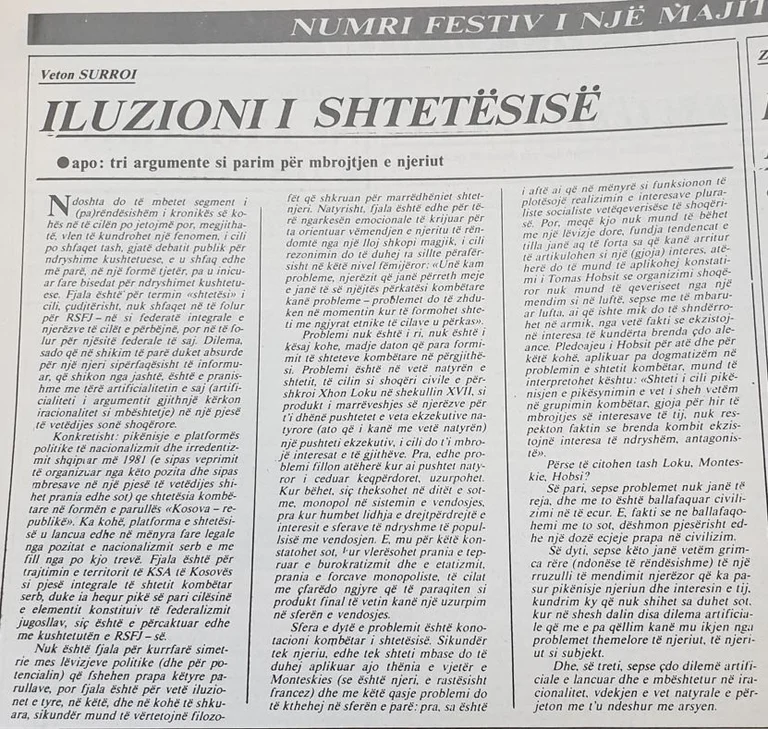
Even the argument in this direction, Surroi says, comes from a “child - level resonance”.
“... as the philosophers who wrote about state-man relations can also confirm. Of course, it is also about the emotional burden created to direct the attention of the ordinary man from a kind of magic wand, which the resonance would have to bring approximately to this childly level: I have problems, the people around me and they're of the same national affiliation have problems. The problems are going to disappear when the state is formed with the ethnic colors I have.”.
So Surroi taunts the very idea of the national state for Albanians and anyone who thinks of it as a solution to a people's problems.
He's on this issue, as you're correct, to explain how false the conspiracy is, until he says the claim is being presented as “the interest choice”, but it's not.
Here he even devales national importance by citing completely inappropriate French philosopher Montesquieu that “is a man, an accident French”.
Surroi continues by saying that those Albanian nationalists who love the state-national also make up some sort of anachronic people.
“Problems are not new, and civilization has been faced in walking. And the fact that we face them today is partly proof of a dose of going back to civilization.”, write at the bottom of the text.
Until, it concludes by saying that the desire for the national state will die as far as reason is concerned.
“Third, every artificial and irrationally endorsed dilemma, experiencing its natural death, and facing reason”.
Surroi's historic mistake in this writing gets even worse when the fact that he was writing just a few months before Milosevic defended Kosovo's autonomy and forced Kosovo Albanians to take the rights acquired with the 1974 Constitution.
However, before obtaining political rights with an Inskenm in Kosovo's parliament, where through controlled votes, Serbia virtually, with constitutional changes, occupied Kosovo on March 23rd 1989, Veton Surroi had also criticised the miners' strike, which tried to stop what could not be avoided.
Just 18 days earlier, on March 5th, in his writing, titled “The Fronts of Constitution”, Surroi hits the miners and those who protected them, at the time that support for the miners came from Croatia, Slovenia and other states outside Yugoslavia.
There Surroi objects to the miners' strike and tries to show the public in Serbia that in fact it is not about what the miners are saying, but it is Albanian nationalists who are trying to destroy the country for “Great Albania”
In text “Surroi is concerned about how these blind Albanian nationalists are not thinking at all how bad they are making Serbs and Montenegrins feel.
“First, serving primarily with the numeric presence of Albanian nationalism the country where they live and work and declare it Albanian troops by ranking all other nationalities that are a great injustice to them.”.
Surroi goes on to say that this “great injustice” is not only for Serbs and Montenegrins, but “And to Albanians who share good and evil with them.”.
Later, as the argument that miners do not have the strike against lifting the autonomy of Kosovo's province, they use the fact that “are protesting apart from Albanians”.
“According to all odds, they don't even think of Yugoslavia when it comes to Albanian careers, because in full compliance with the map of Greater Albania, even this one as no major nationalism can stand borders other than ethnic ones, so even separatist pamphlets are mentioned as the final war of separation from Yugoslavia”.
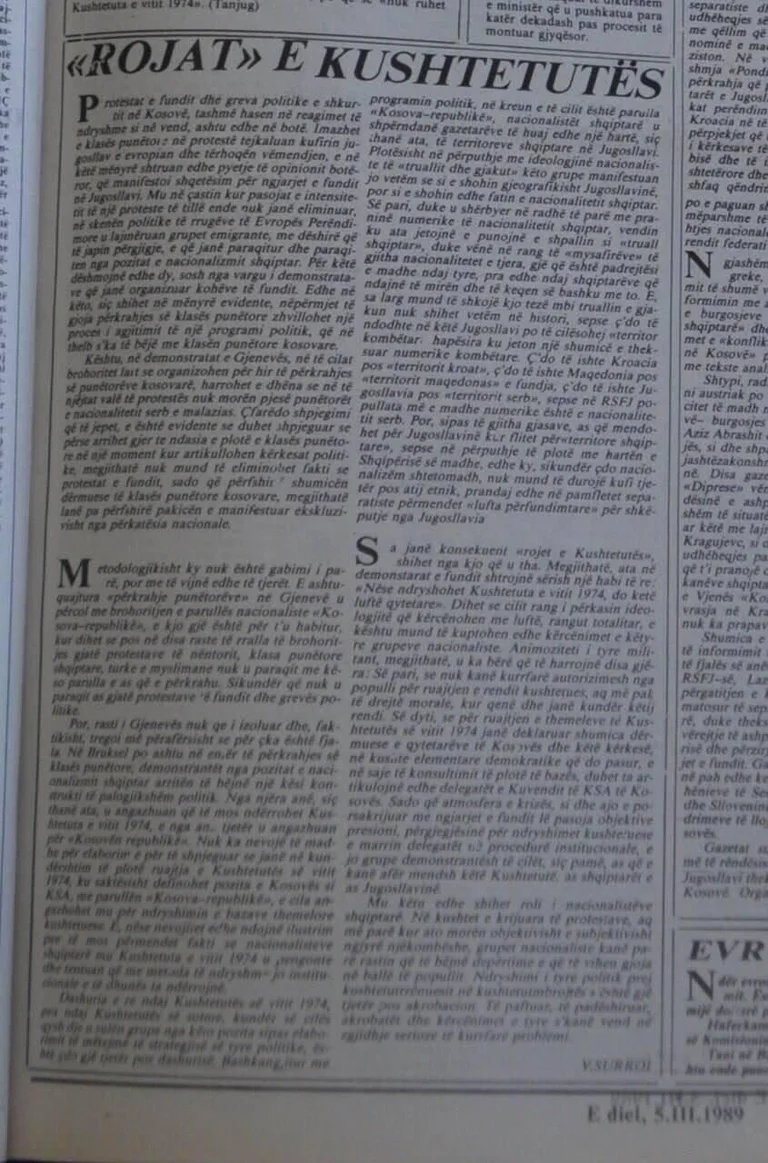
Surroi's writings against Albanian miners demanding the return of Autonomia, and no more, do not look heavy only by the established historical distance. At the time, such writings did not write even Suri's friends and associates.
Shkelzen Maliqi, an intellectual of the time that he himself accepts in later writings and interviews, titanist, did not call himself, but did not even think of the breakup of Yugoslavia and was sympathetic to Albanian nationalists, highly appreciated the miners' strike, because they were ultimately watching Yugoslavia.
“has been a sublim response”, Maliqi said.
At that time, in the “the unexpected and spontaneous withdrawal of Albanians”, against Serbian nationalism, Maliqi would publish a comment on the weekly “Dani” in Sarajevo, titled “Nationals also taking place” in response to the slogan of Serbian nationalists “has occurred the nation (serb)”.
Maliqi strikes miners in another case calls “Great, heroic and dignified” Undertaking.
The miners' strike was valid on many plains. One of the most important of the times and the reason why they were supported in other republics of Yugoslavia was by the fact that the failure to hear their concerns de-legitimate the backbone of the communist system, since they were not being respected by the labour class revolt, over what communism-Yugoslav stood.
The national equality policy that Tito had installed was also lost.
Clearly, Veton Surroi was not writing from an Albanian's perspective, but neither from that of a Yugoslav or titan.
Because the Yugoslav miners' strike was highly appreciated, even beyond Kosovo.
Slovenia had shown great solidarity with the miners' strike. It had been declared that AVNOJ Yugoslavia was being protected in Trepca, urging Serbia to withdraw from violent claims in Kosovo.
When demands were not respected, Slovenia had taken the course of separation.
Slovenia even organized supporters.
Largest known “Cankajev Dom” on February 18, 1989 in Ljubljana. At that gathering, the most vocal politician at the time, Milan Kucan, would say the famous sentence that “in Trepca is protecting Yugoslavia”.
There was also in Croatia, in Zagreb a newly formed Yugoslav Association for Democratic Initiative had issued an official statement demanding that a referendum be held on the province's status within the federation.
The call to protect the miners and their efforts had also gone out of Yugoslavia.
Renowned Croatian historian Branka Magash writes in her book “The destruction of Yugoslavia” that even in the former Soviet Union, there were designated politicians and intellectuals who were shouting in defense of what Albanian miners in Kosovo were striking.
“Meanwhile, in Moscow, (at the request of the London-based committee) two members of the Moscow People's Front, Boris Kagarlitsky (which had won the Memorial Isaac Deutscher) and Sergei Stankevik (later MP) wrote an appeal for peaceful and fair solutions to issues in Kosovo)”, show Magash in her book.
The same book mentions Veton Surroi, who leads the author to wrong conclusions when in his interview he says that what is happening in Kosovo is not about ethnicity and that Kosovo is not happening to the fact that it is populated with Albanians, but that the issue has to do with pro and against democracy.
“Interview with Veton Surroi, an important member of the democratic opposition, shows that we are facing, not ethnic conflict, in the province, but with efforts between democratic forces and against democratic ones”, write Magash.
Even the interview title is “Kosovo and the bid for Democracy in Yugoslavia”.
Beyond the misrepresentation of the situation in Kosovo, Surroi issues some of the most brutal insults for Kosovo's villages Albanians.
When in a moment asked Surro who makes up the opposition in Kosovo, he mentioned the organisations founded in Pristina, until Croatian historian tells him that “these are all organisations based on the town”.
And what about peasantity?
Here follows Surro's brutal response: “We have a problem here, in that the village in Kosovo is backward and not productive. That's because there's a survival level, there's no particular awareness of its specific interests and it's not a host of new agrarian developments.”.
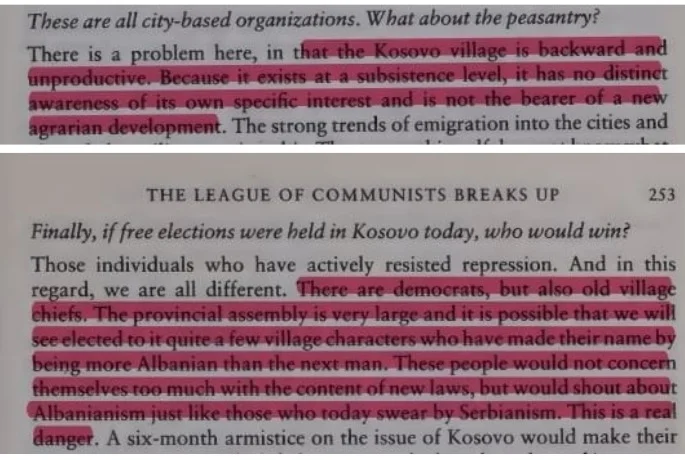
The claim of unconsciousness and poverty at that level in Kosovo villages is completely false by Surroi.
The village in Kosovo was more developed than the one in other parts of Serbia, where the province of Kosovo met.
Shkelzen Maliqi, friend of Surroi, who for 16 years lived in Serbia, a time during studies had worked as a curer of church frescoes and in the book “Shkelzen Maliqi, dialogue with Baton Haxhiun émbija of Yugoslavia, Kosovo and Tjera”, shows that for work reasons he had visited many villages in Serbia.
He in the book indicates that, to his surprise, “Land prices in Kosovo were two or triple higher than in Serbia”, while adding that the Serbian village was poorer than the Kosovo one.
Moreover, says “The standard of residence and lifestyle among Albanians in villages has been (and still is) higher than in Serbs. Albanians combined all ways of working for family welfare”.
Surroi's statement about the underdeveloped and unconscious village in Kosovo also conflicts with a later statement, when in a bid to defend Yugoslavia, it said Kosovo in Yugoslavia has produced enough to support itself.
Surroy in this interview only deceives when it portrays the problem as a battle issue for democracy and not an ethnic problem, re-produces Serbian fascism for “Albanian tailing”, but also lays the foundation for what will later be known as Pristina urban fascism where <x2-citizen” attempts to create quantitative difference from “rider<5> Kosovo.
But the interviews with our fascist Magash interviews with Surroi continue and becomes worse.
In the last question, the author invites Surro to a prediction: “If there are free elections in Kosovo today, who would win”
Here Surroi tries to make differentials from Albanians, aiming to say that the undemocratic regime and protest and resist two groups, but not for the same purposes.
“We're different.”, he says.
“It's the Democrats, but also the village bosses”.
Surroi in the interview despises what he calls “these characters” from the village.
“The province's assembly is large and it is possible to see many characters from the village being chosen there that have made a name showing more Albanians than the other”, Surroi says.
He expresses concern that the eventual election, and in large number, will much Albanians the Assembly.
“These people won't worry themselves too much about the content of the laws, but they're gonna scream for Albanianization... This is real danger.”.
His anti-Albanian beliefs Surroi did not only put them into newspaper writing, media interviews and various journalists, but how many times did he have access to meetings, such as he was with the American secretary in 1990, where he had declared Albanians not in favour of Kosovo independence.
What Surroi had declared at that meeting would never be understood if, in 1996, Warren Zimmermann, the last ambassador of the United States of America to Yugoslavia, published the book “Origin of a Disaster: Yugoslavia and its destroyers”.

The book Zimmermann reports an important meeting at the American Embassy in Belgrade on February 26, 1990, where US Secretary of State Lawrence Eagleburger listened to the opposition voices of political representatives in Yugoslavia.
In this book, Zimmerman told about the attitudes that Veton Surroi takes at that meeting.
On page 61 of Zimmerman's book exactly says: “Veton Surroi, a young Albanian with perfect English, said the people of Kosovo do not accept the Serbian regime, but (also) is not in favour of independence (of Kosovo)”.
Of all the statements that Surroi could make at that important meeting for Albanians, he chooses to promote a pro-Serbian stance as it was of declaring that Albanians do not want independence from Serbia.
So Surroi told Americans at the meeting that Kosovo's “Albanians are not in favour of Kosovo independence”.
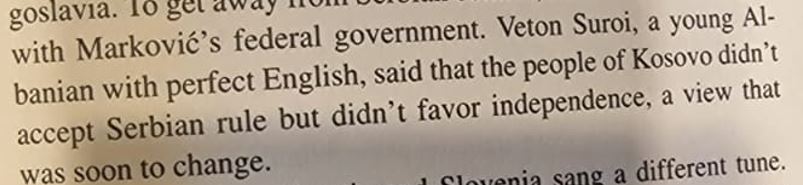
In fact, the most favourable of Kosovo at that meeting had spoken, Tanja Petovar, a woman described in the book as the bold “”, who also led the human rights group.
She had told Eagleburger that “Milosevic is trying to survive in power by promoting nationalism as a way to block democratic change”.
Petovar, writes Zimmermann, “prayed for maximum pressure on Serbia on the Kosovo issue”.
While Surro was speaking in the name of the people of Kosovo, saying that <x0 people are not pro-independence”, it would not spend much time when people would speak differently. Close to a year later, a referendum would be organised about Kosovo's independence.
The referendum emerged in a background of tensions. The Co-ordination Council orchestrated this act of courage, challenging the oppressive hand of Serbian authorities.
Their efforts culminated in a five-day vote, a costly effort resulting in over forty imprisoned organisers. The options were clear: continued independence or submission.
And when the dust fell to the ground, the numbers were spoken with clarity. Out of 914 thousand, 802 votes made up 87 percent of the electorate, 99.87 percent were in favour of independence.
The message was clear.
Currently, Surroi's eradicated thoughts about Kosovo's aspirations for independence lay within two strong historical facts: as long as a full decade of sacrifice was ahead of his claims in the service of Kosovo independence.
The demand for independence, which once whispered in illegal margins, already buzzed with dominantness in the streets, in schools, in improvised hospitals and, with minor exceptions, in every Kosovo family.
However, when the demand for independence was so widespread, the question of why did Surroi speak so?
He tried to clean himself up 26 years later.
In an explanatory writing on February 29th of 2016, Surroi wrote what he meant at the meeting was that “was not Kosovo, as accused by Serbian chauvinism, which was ruining Yugoslavia”.
As his 1990 representation unfolds Surroi's anti-national stance, in the vindication of 2016 it is disfigured by its brutal speculation in the attempt to produce a historic lie and brings itself even worse than at the aforementioned meeting.
First, the meeting was not about what Serbia accuses Kosovo, or Albanians, but what is the request of Kosovo Albanians.
In the American question that “what Albanians want”, Surroi had assured Americans that “Albanians do not want independence”.
The second, even if it was accepted for a wave of reasoning, among those who accused Albanians of wanting to destroy Yugoslavia was it.
As shown above, he has several writings published in the Renaissance newspaper, but also in newspapers and other media that are constantly triald by Albanian <x0-nationalists” and called “separatists”.
So does this mean that Surroi has wanted to excuse the Albanians before the Americans for an accusation he made himself every time the case was given?
He told the Serbian public that neither the miners' strike is to return autonomy, but to separate from Yugoslavia.
In a writing published in Renaissance on March 5, 1989, just one year before meeting with the American secretary, Surroi wrote that “According to all odds, they don't even think of Yugoslavia when it comes to Albanian careers, because in full compliance with the map of Greater Albania, even this one like any national nationalism can't stand borders other than ethnic ones, so even separatist pamphlets are mentioned as the final war fight for secession from Yugoslavia.”.
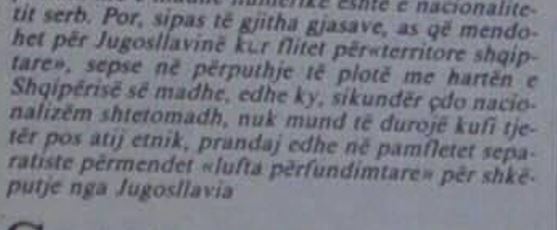
Thus, proving the ill-repressed rescue trick, it reflects for itself that Milosevic's positions for Albanians were too often even his own views of Albanians.
And the third problem of that meeting is the question: Why did Surroi at that meeting talk about what Albanians don't want, not what they want? He, if nothing else, could seek what Rugova had asked for at the meeting, which was “Stand Within a Yugoslav Confederation, but With Full autonomy”.
Why did Surroi maintain such attitudes is explained in another book, another diplomat, Sir Ivor Roberts.
Roberts was ambassador of Great Britain at the time of the wars in Yugoslavia and a meeting of him with Slobodan Milosevic, where Veton Surroi was mentioned, explains much.
The story is like this.
Roberts had completed his term in late 1997.
He was indignant with a Richard Holbrooke negotiator of the United States of America because he looked like the US diplomat had presented the tendency to underestimate the role of European actors.
Roberts just got back from the mission, with fresh memories and notes from the meetings, he started writing a book.
When he wanted to publish it, the British government wouldn't let him. I claimed it would set a bad example for an ambassador so soon to discover conversations with a head of another state.
Unlike Holbrooke, who presented a chosen negotiator, he as ambassador was the official voice of state, so they had not allowed him.
Roberts left the draft of his book somewhere in the drawer with the idea he would never publish.
Years later, when he had just forgotten about that draft, his phone rang.
They were from “Freign Office”.
It's been so long. You can print the book”, they told him.
He took it into English in 2016 under the title “Biseda with Milosevic”.
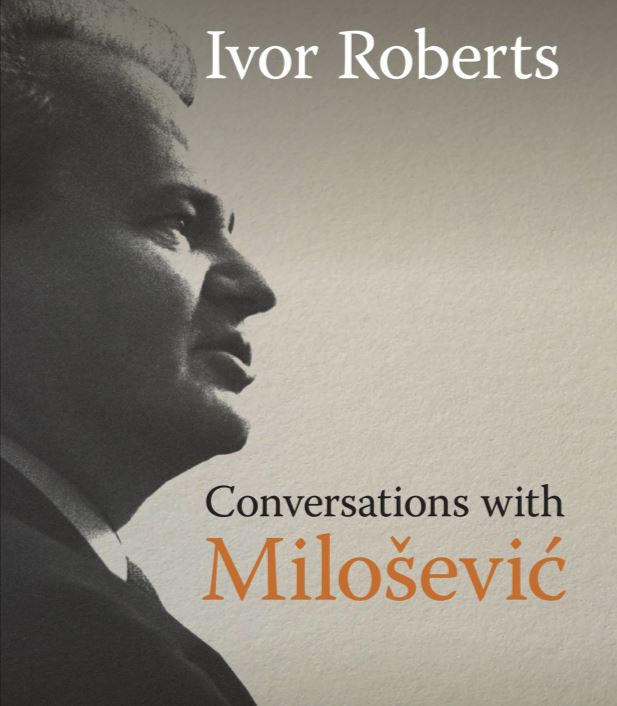
On page 206 of the book, Roberts relates one of these discussions and mentions a shocking fact about Veton Surro.
He testifies that as the Balkan Kasap, Milosevic, he had sympathy for Surroi and saw him as Kosovo's leader under his regime in Serbia.
While Roberts was asking Milosevic to repel troops and was telling him that without this step Ibrahim Rugova would have difficulty engaging in dialogue for the solution, Milosevic turns the other focus on.
“Milosevic spoke with positive marks for the meeting, and mentioned Veton Surroi in particular as Kosovo's (Kosovo) prime minister instead of Bujar Bukoshi”, writes Roberts.
Milosevic had a problem with Albanians, but not with Veton Surroi.
The latter has never seen fit to explain this closeness to Milosevic and the choice the dictator had made.
//
One of Surroi's recent efforts to do all he could do to undermine Albanians' possibility of a state of his own in Kosovo, which would mean the destruction of Yugoslavia if it did, but also the secession from Serbia, is marked in Rambouille, during the time of the Albanian delegation's talks with the Serbian delegation.
The total event has been brought by French journalist, writer, and historian Jacques Baudawin.
Baudawin, appointed knights in National Order of the Legion of Honor In France, which was then a adviser to Bernard Kouchner, the first administrator of UNMIK in post-war Kosovo, when it wrote its book “The Order of a Democracy, Hashim Thaci and the Road to Independent Kosovo”, a portion specifically dedicated to Veton Surroi.
True to the book, Kouchner himself has pledged, then Minister of Foreign Affairs of France, who has also written the preface of the book.
On page 181 of this book marks a chapter called “Veton Surroi Game”.
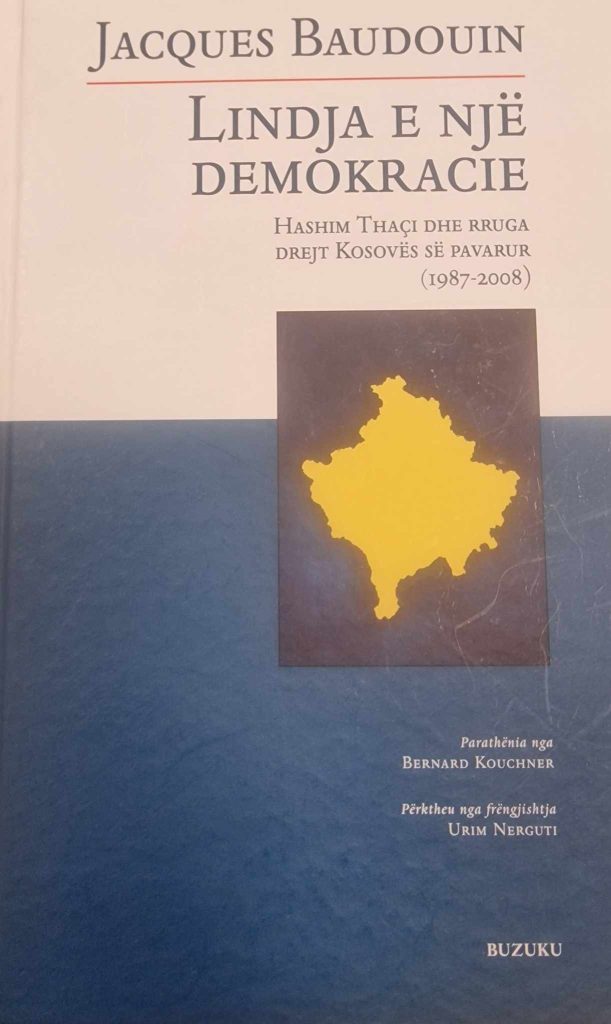
There Baudowin writes how Veton Surroi had tried to make a trick to put Kosovo's group, consisting of Hashim Thaci, Ibrahim Rugova and Rexhep Qosja, in madness.
Baudowin writes in the book that Surroi, without the knowledge of others, had received the letter proposed by internationals for Agreements with Serbs and was translating it.
This Hashim Thaci had only understood by chance when during a walk he had seen Christopher Hill and Wolfgang Petrischin, who approached and “praised for accepting such an agreement as they had proposed in their letter”.
“Spectacular Hashim Thaci entered the hall and discovered then the text of common paper for both sides he had to convey to the Contact Group, which said: The sides have accepted Kosovo's basic agreement and political chapters for peace and autonomous governance today”, shows Baudowin.
This text, as writes Baudowin in the book, “did not mention the KLA transformation or independence referendum”.
Then Thaci, who was chief of the delegation, writes Baudowin, had not signed the letter, but “He wanted to know who had given the delegation consent without talking to him”.
“Veton Surroi remained silent and could not give an explanation”, describes Baudouin tension.
“Everyone knew he had declared that he was satisfied with autonomy and realized he had played behind the delegation's back.”, says the book of French writer/journalist.
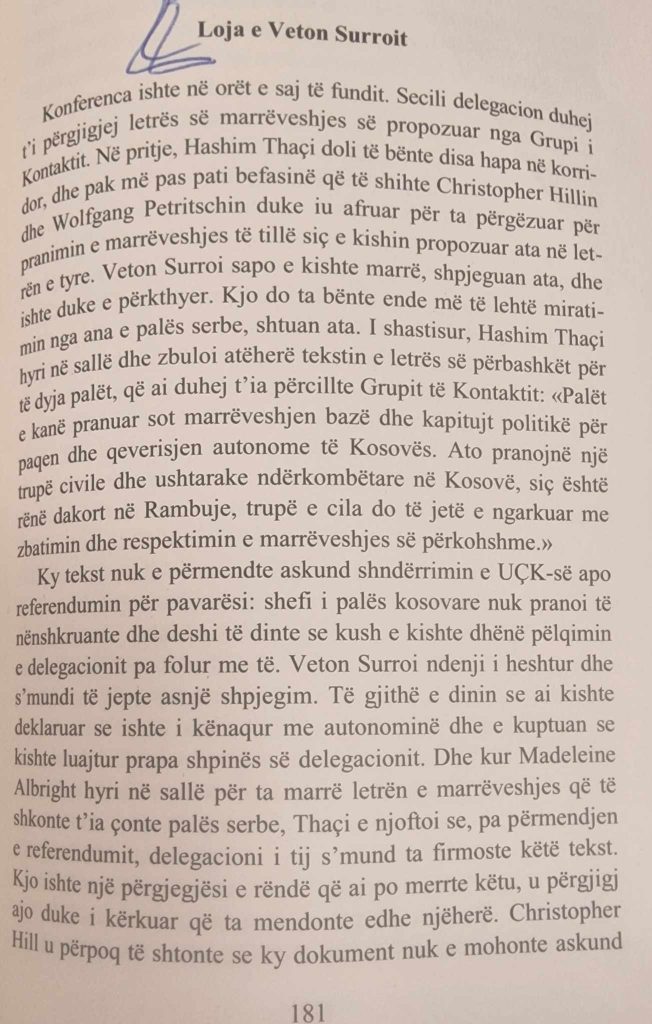
Veton Surroi had tried to double-play the Albanian team, and on the other hand had assured the internationals that Albanians were agreeing with autonomy within Serbia, abolishing the KLA and not transforming into another body and did not seek independence in a later phase.
This game had put the Albanian team in Rambouillet in an extremely non-compliable position.
Hashim Thaci would have to clarify for the internationals that he does not accept this kind of agreement, when they had already already given the impression that everything was done.
Baudowin explains it in the book.
“When Madeleine Albright entered the hall to get the letter of the agreement to go to the Serbian side, Thaci announced that, without mentioning the referendum, his delegation could not sign this text.”.
“That's a heavy responsibility you're taking on.”, he told Albright suggesting that he think again.
He even explains Baudowin situation, “Christopher Hill tried to add that this document was nowhere to deny the idea of a referendum, but Thaci could reply that it is just as true that this text didn't even authorize it anywhere.”.
The U.S. Secretary of State by the end of the afternoon had once again tried to convince Thaci by telling her that “If they wanted American troops to come to Kosovo, they should say yes”.
“But to no avail”, Thaci and the Albanian team insisted on respecting their right to Vetevendosje.
So Thaci had fled the game of Surroi, eventually securing from the United States of America the guarantee that a referendum on independence would be allowed in the future and the second most important point, not the deregulation of the KLA, but the transformation of the Kosovo Protection Corps.
The book also provides a situation when the US secretary told Thaci that “accepting the referendum would be like accepting Kosovo independence”, so it was impossible to convince any of the ministers of that option.
The Kosovo team would then sign the agreement with necessary American guarantees and the rest is history, but the story about Surroi and Surroi himself was spared.
This dark episode of it in Rambouille had never been shown.
Even despite all this life, historic errors; anti-Albanian positions; pro-Serbian and certainly pro-Yugoslav writings, after the war in Kosovo Surroi would somehow be re-made in public life.
He, with the flexibility of adaptation, was even seen near the leaders of war who were familiar with the polluted history of the preceding one. Later, it would also form a political party and once managed to enter the Kosovo Parliament to eventually be boycotted by the people of Kosovo, trying to pass the threshold.
Surroi would have served Kosovo for several years, leading a life outside the public's eyes, outside Kosovo, mainly in Albania, and with rare and insignificant presentations to the public in Kosovo, until, after a slight rehabilitation, he began to return with some propagandistic books against the Kosovo Liberation Army.
He began to create thesis on how the KLA more than a military organisation of Albanians constituted a frustration of villagers with the harsh Serbian regime, his associates in Rambouilles began to insult Hashim Thaci, who stood behind the war and criticised him for a unaware that he was destroying Kosovo.
His book with fascist tones “The Legs of the Serpent” was translated and promoted with pomp in Serbia, while Surroi also attacked his associates in journalism, as if the case with the attempted “Determining the Love of Mary John”.
There he tries a schizophrenic maneuver by participating in his family's story as a close associate of the Serbian regime and shades of his history to paint the characters of books.
Gradually, the insults and consultations of the desperate writer Surroi began climbing to the discus of the Vetevendosje Movement.
They had found a common enemy: former parties out of the war.
Albin Kurti on several television shows provides public trial to political and public figures in Kosovo and when asked about evidence refers to Surroi novels.
Today Surroi is an adviser to Albin Kurti. Besides him, Surroi's daughter is also an adviser to Albin Kurti. Surro's media, KTV, is a medium who is primarily in service to Albin Kurti's power with some risk of objectivity to make confession more reliable, while Kurt's cabinet is filled with descendants of similar lines like those of Surroi.









