 a day ago
From what success comes 20 million copies of Harary?
Periskopi(2 years ago)
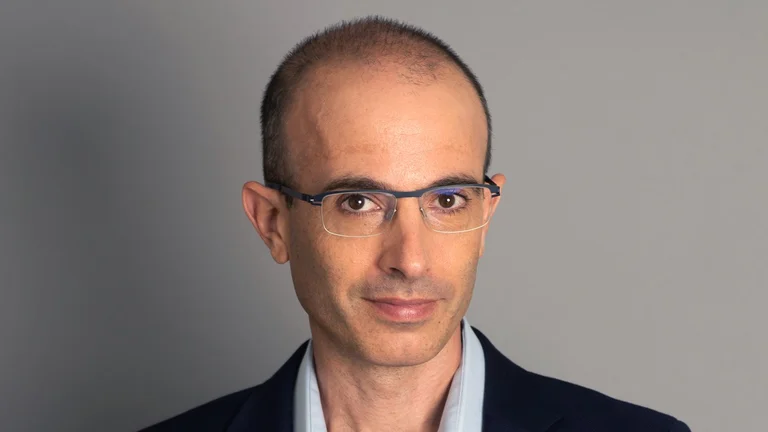
(2 years ago)Yuval Noah Harary, an Israeli historian, has become a global figure through his best sold books dealing with the technological and anthropological future of mankind, including Sapiens and recently published in Albanian “Nexus”. How could he, with three internationally recognised books sold in 20 million copies, [...]
How could it, with three internationally recognised books sold in 20 million copies -- a dark Israeli military historian becoming the world oracle of a new world, born of “the combination of infotechnology and biotechnology”? This is the path of Sapiens' author, Yuval Noah Harary.
When Yuval Noah Harari mentions in his books the difficulty of predicting great technological innovations ahead, he often uses the same example: In the 1950 ' s, people dreamed of colonies in Mars, a nuclear propulsion machine. None of this happened. However, no one managed to predict that simply because of the connections between some computers an invention of engineers would create this technology that has completely overthrown our societies today: Internet.
As is usually the case with Harary, the parable is perfect enough to ask if she can get autobiographical notes. Because who would have predicted, twenty years ago, his current status as a global rock of the bionumeric future? In 2005, at the age of 29, he served as an assistant at Jerusalem's Hebrew University, specializing in the military history of the Middle Ages. Nothing special to attract the curiosity of crowds. But when the institution's directorate decided to create a first-level course on the subject: “A entry into world history” was the one who took over, as many other professors were not enthusiastic about such a proposal. His course pleased the students, he doubled it in volume and then had the idea of converting it into a book that all great Israeli publishers refused: very broad, unknown author... They probably didn't even look through it. Then a publisher who agreed to take risks was found, and “A short history of humanity” The book had yet to have the title “Sapiens” became a best-seller in Israel in 2011. Crossing the international market was complicated. Harary was forced to translate the first edition of his book, which he accomplished through an online service at a request offered by the Amazon. He sold 2,000 copies! Until a known Israeli literary agent solved the situation.
Ignored by Critics
“Sapiens” appeared in 2014 in Great Britain and in the United States becoming the best-seller we know today, but that did not happen immediately, as is the claim on legends. In its publication, the book was not recommended by any of the major newspapers that form opinion, such as “New York Times”, “New York Review of Books”, etc. In fact, the hearing system worked. He had the fate of some prestigious support: Bill Gates promoted it, Mark Zuckerberg “Mr. Facebook” included it in the list of recommendations of his reading club and, last of all, but no less important, Barack Obama said on CNN about this “history of the first human being from heaven” that he had given him the same emotion as his visit to the pyramids of Egypt!
How do we explain this enthusiasm? Determined critics ignored “Sapiens” because they thought it was from the type of product that only one book reads a year: they treated it as one of those vulgar books bought at airport stores to make less boring a long flight. In fact, they had not. Because if “Sapiens” has all the stigmas of a blockbuster, over 500 pages in large format, it attracts immediately to its narrative qualities. And this is noted that in the first chapter, where Harary claims how, 100,000 years ago, Homo sapiens, which then were non-partial animals, that had no more impact on their environment than the gorillas ormedulase”, expelled the Neanderthals and colonized the planet. A sarga worthy of a trumpet in the style inspired by American geography and biologist Jared Diamond. According to the 1998 Pulitzer Award Reader, “for the inequality between the societies”, there was a “detection” for it. There he took the pattern that it is possible to present ideas without becoming boring, even keeping the standard quite high and without irritating the reader!
Because “Sapiens” is a book of ideas, and of an original idea in particular, which returns to all of Harari's works of “cognitive”
According to this aunt, Homo sapiens ' fort comes from the fact that, unlike other animals, he managed to create through language things that do not exist in reality God, nation, human rights, dollar, etc. This ability to create “intersubjective” explains, according to Harari, how Homo sapiens managed to organise great co-operation among individuals who did not know each other.
From this particular capacity of “agricultural revolution” and then, in these last five hundred years, “revolution science”, but from here on, the book also raises a dramatic question: is it because of the genetic genius and empowerment of these “organic entities, which are artificial intelligence, we're looking at the sunset of Homo sapiens and replacing it quickly by a new species of the gender Homo?
We understand, in light of this summary, why Silicon Valley made “Sapiens” totamine. A suspicion arose from here: Could a megaphone Harary be of a technology sector that claims to become hegemon? This is actually a big misunderstanding. Because, although he is oriented, in a reflection of the future, he has done so in his provocative manner. He has often warned of the creation of a two - speed society that, on the one hand, has a rich, active elite and immortal “” (from new medicine, which lasts endlessly in addition to accidents) and on the other hand, a measure whose necessity has become unnecessary by artificial intelligence. And other times it has predicted the AI's appearance based on sophisticated algorithms that can get to know us better than ourselves, by controlling, therefore, all sectors of our lives.
Willing to Insult
It is no pleasure to be seen as a pessimist. But it is true that he guards himself from every naive flight on the benefits of progress. Who else could qualify the agricultural revolution like “The largest ever production in history”? Or to write that “we have no proof that people's well-being is definitely improved over the course of times”? It can even be said that there is a cynical aspect in his thinking.
He is an obedient atheist, he is not a fan of Judaism, nor is he, above all, of the Jewish State under the law of 2018, which the Israelites criticize. He is also antinationalist, rejecting the idea of the nation, which seems very narrow to him in a world where all major issues are global. He does not hesitate to provoke. His statements on terrorism, in the book “21 lessons for the XXI” saying it kills thousands of times less than sugar added to industrial foods, have caused much controversy. It also denouncing the role of “mish as object to” which he doesn't consume, because it's the widow we attribute to animals, or refuse anti-homossexual mentality. Harari's gay and married to his manager. Not only does he not hide it but he often says that this status as an exiter in his country (he has made marriage in Cyprus because same - sex ties are not known in Israel) has given him the ability to “challenge common ideas”.
He is by no means a boring pervert, like most vulgarists. Harary has an author approach. He has a tone, a true personality. Even if he repeats himself, he does not remain in place, as he continues to move forward in his reflection, as indicated by the new work, “Nexus”, which handles information issues.
As with all the successful authors, Harary has faced much criticism, not always reasonable. Some academics have emphasized mistakes in his actions. This may be true in detail, but is it so important?
The Harry answers that his aim is not enough to describe exactly the new technologies, but to reflect on their impact on people. He's more of a historian-filozof than a scientist, and however few minor shortcomings in scientific truths may be present in his texts, that doesn't really matter! However, he has corrected his mistakes. While criticising him for lack of resources in “Sapiens” His preamble on man-made myths has had many predecessors allegedly ignored, like Nietzs and Georges Soril he has expanded his latest notes to “Homo Deus” and “Nexus”.
His style of losing in detail
In fact, the greatest criticism that can be done is elsewhere: It has to do with the uncertainty or fluidity of his conclusions. Even his fans often complain that they have not learned more after closing his books. This comes from his style of losing in detail. The hare makes his thesis so rich with side data that we end up not knowing what it means. A British magazine, the New Stateman”, has even compared its conclusions to the simple maxima found in Chinese cookies.
That's true, but rather unfair. Harary is not certainly the most important thinker of the 20th century, just as he is praised, but he has a well - informed universal message that is always worth reading. And his “budism” he practices daily meditation viassana ʹ which means that the only constant “of this world is change”, is part of his message. More than one stone, it could be named, more like the prototype of the honest man of the new millennium, a difficult-time leader who may not bring about a genetic mutation, but certainly a radical transformation of our societies. Maybe it's not enough, but through his doubts, Yuval Noah Harary is preparing us for this?
Patrice BOLON by Lire Magazine/ T Cela, pens.al









