 a day ago
The Greatest Challenge in Half a Century for Israel
Periskopi(3 years ago)
(3 years ago)It is not too dramatic to say that yesterday's attack was the most important military challenge against Israel in half a century since the 1973 Yom Kipur War (also known as the October War), when a coalition of Arab states launched a surprise attack together. Hamas organized the attack on the scale of [...]
It is not too dramatic to say that yesterday's attack was the most important military challenge against Israel in half a century since the 1973 Yom Kipur War (also known as the October War), when a coalition of Arab states launched a surprise attack together. Hamas organised the large-scale attack almost 50 years from the day the conflict began. And no one saw her come. Israel says it is now too determined to fight.
“This is not a so-called military operation, not even a “raund” fighting”, Prime Minister Benjamin Netanyahu said, while ordering a wide recruit of militias and mobilizing forces to fight. Our enemy will pay a price he's never seen. We're at war, we're going to win”.
The cautious rhetoric that sometimes appears in Israeli officials' speeches in times of military escalation, including phrases such as “proportional response” and “defense”, was missing in this statement. This time it's different. And the consequences will be great.
Netanyah's speech is likely to decide all options on the table from a nearby Earth invasion of Gaza, as we have never seen before, to the possible long-term resuscitation of Israeli soldiers inside Gaza. It would be the first since Israel's unilateral withdrawal from the small Gaza Strip in 2005.
There will be consequences for the unstable Western Coast, where violence has increased in recent months and about 200 Palestinians have been killed in Israeli military attacks this year alone. Israel is likely to move the brutality of the reaction to the west.
Peace negotiations between the Israelis and Palestinians have long been dead, but any light of hope to rekindle the idea of a two-state solution can now be extinguished.
Some have argued over the years that Israel has played the existential threat of Hamas and militant factions associated with it.
From now on, Israel will mention October 7th as an example of such a threat.
For the Israelites, there will be noisy questions about how this attack was not revealed on the radar. Israel is famous as home to the most powerful surveillance software in the world. He has eyes on Gaza, which is only 42km long and 12km wide.
When you're in the Gaza Strip, the only constant is the constant sound of Israeli observer fears in the sky. They have intelligence on the ground. They have (or had) almost complete control of what is happening inside and outside Gaza along its borders after establishing a 16-year blockade, following the violent takeover of Hamas' Belt in 2007. But apparently they have not seen this attack approach.
The Israelis in the <x0f of Gaza”, which are areas in Israel around Gaza, are taking refuge in their homes and hiding as Hamas' armed men roam the streets. Other Israelis told local networks that militants were actually inside homes.
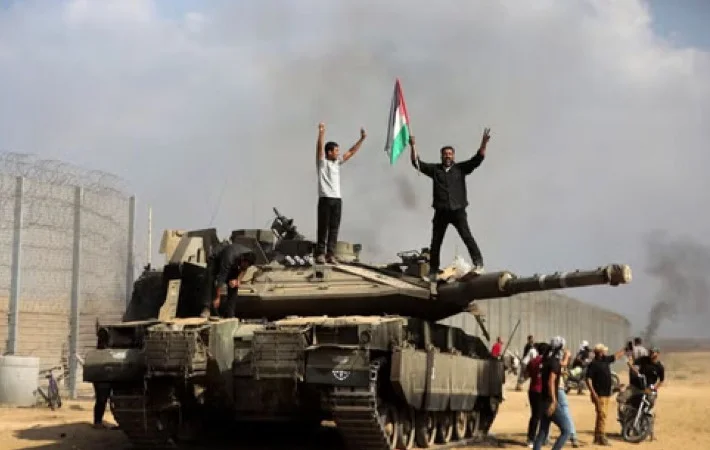
Film footage showed Israeli civilians running to save their lives in the fields. Other climates scattered by Hamas media, which could not be independently verified, showed Palestinian militants holding Israeli civilians hostage, taking soldiers captive and bringing the troops of Israeli soldiers to Gaza. There were images of the broke border fence and also a destroyed Israeli tank.
The Lebanese militant group Hezbollah, which supports Hamas, said the attack was a response to the “crimes of Israeli occupation and aggression at holy sites” and was intended to send a clear message to the Arab world and Islam “especially to those who are trying to normalize”.
This statement is about Saudi Arabia and the United States. Washington was working on reaching an agreement that would normalise ties between Israel and Saudi Arabia for the first time, following the steps of the United Arab Emirates.
Saudi Arabia issued an extremely quick statement yesterday calling for the immediate halting of escalation between the two sides”. The statement carefully added that the “Majesty remembers its repeated warnings of the risk of an explosive situation, as a result of continued occupation and privatisation of Palestinian people's rights.” Is Riyadh afraid of violence within its borders?
At present, the situation is disturbing and increasingly violent. Israeli police, who is also calling all reserve and volunteers, said there were “21 active” scenes south of Israel, pointing to the extent of the attack. Missiles still strike southern Israel, sirens are still heard. The Israelite army has not yet taken full control of the south.
The only guarantee is that this is a bloody and determining moment in history. / The Independent World.al









