24 minutes ago
Albin Kurti's material constitution and best models of autonomy in Europe
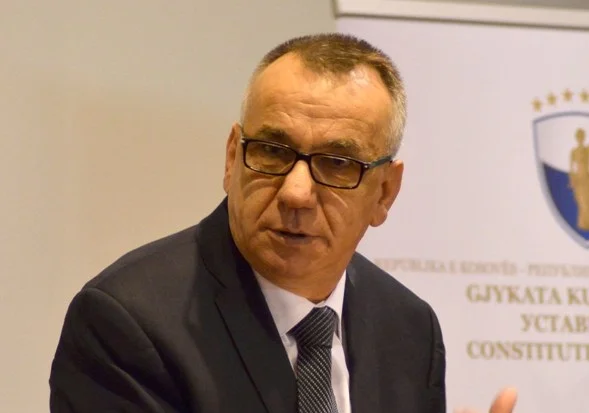
Periskopi(3 years ago)
(3 years ago)It says: Enver Hasani Agreement De Gaspar é Gruber has been and is final, the Ohrid annex remains provisional, with clear aim of keeping the Kosovo state's state's constant state-of-law under hold on February 17th 2008. This is the essence of the material constitution and the Third Republic of Kosovo [...]
The De Gaspar Gruber agreement has been and is final, the Ohrid annex remains temporary, with a clear aim of keeping the Kosovo state's state's nature under constant scrutiny proclaimed on February 17th 2008. This is the essence of the material constitution and the Third Republic of Kosovo that has created Prime Minister Albin Kurti
On Material Constitution
In theory and practice, the formal constitution implies the situation when there is one or more legal texts, usually one, where in written form the whole standards that regulate constitutional matter are found. The constitutional matter, meanwhile, implies matter involving definition of origin, functioning and organisation of power and its relations with the individual and himself.
The opposite is the situation with the material constitution, which distinguishes from the constitution in a material sense, where there can be a legal text that codifies the constitutional substance in a written constitution, or in certain legal texts, but that there are also constitutional subjects that are standardized with legal acts that do not have the character of the formal constitution (not called the constitution, but standardise constitutional principle), that does not endorse the constitutional body with jurisdiction for making and changing the constitution, with a common majority and so forth). These differences and discussions, which may seem theoretical but are not, are encountered in each book of constitutional law, which has been published everywhere by serious authors in these last hundred years, in Europe and beyond.
To date, what is known in Kosovo, in addition to the practice of the Constitutional Court, which processes the constitution because it is in its mandate, the only legal acts that can be described as a material constitution, are the laws with which the process of forming the Kosovo Army has begun. The rest of the constitutional matter is rated with the Constitution of Kosovo in effect, which was adopted by the Parliament on 15 April 2008 and entered into force on June 15th of that year.
By constitution, Kosovo is not defined and is not a second Albanian state. This should be said firmly and clearly, because an illusion has been created on this promise that is producing distorted political action, completely contrary to the reality that sanctions the Constitution of Kosovo. This constitution speaks of a state that is not defined in terms of nationality of ethnic origin, but of a civil state in which ethnic communities are defined as the starting point in a completely nominal way: substance of the origin of power and the formation of political will, organisation and its overall functioning rely on the parameters of civic constitutional democracy, with a clear constitutional basis, in which ethnic communities and elites dictate the nature and character of the state and its regime. The initial idea of each provision of the Kosovo Constitution, as a derivative of the Ahtisaari Plan, has been to create a free and equal society for all its citizens and communities they belong to. On the basis of this equality, where this idea starts, the expectation has been that it would be built, in time, a new Kosovo nation, not in the ethnic sense but in the constitutional sense and from the aspect of international law. This process of forming states has had Europe in the past, but other countries on four sides of the world.
The example Austria and Turkey are like two typical cases close to the space we live in: Austria was dubbed the German “Austria” and for decades it has been specifically prohibited by international law banning union with Germany, something Austrians have not discussed at all today.
Turkey, after Ataturk, became a national, with violence and blood and suppressing any religious, ethnic, cultural, national, regional and other identity that had existed for centuries in the Ottoman Empire, leaving only ethnic Turkish identity in force. There are endless cases like these and are mainly related to state-formation according to the French model. This was clearly seen days ago when France recognised Corsica's autonomy within the single French nation, meaning France as a nation-state.
This process of gradual shaping the identity of the new Kosovars, which we have seen unfold quietly and gradually after declaring the country's independence, only makes sense if we approach from the angle of the constitution in a material sense, where the study is the social processes that are conducted on the social basis and the effect that they have on deform and material deformity of the constitution simultaneously.
The use of this method of study is the Italian constitutionalist of archobraean origin Costantino Mortati, about a century earlier. As in other countries in the past, Kosovo's identity with a reference point of independence and sovereign Kosovo, the same as elsewhere, is defined in friction with actors and social forces around itself and beyond, through contacts with the world, where none of us can be defined differently than Kosovo.
The passport says that, so say the symbols of the citizen-based new state, which was created on February 17th 2008. In this process of adaptation, symbols and traditional national identity gradually give way to this new state identity, which is postponed in the suburbs of the Albanian world in the Balkans, in northern Macedonia, South Serbia and Montenegro. As a result, the real equipment for cultivating and maintaining traditional identity on the international plan remains the Albanian state, not Kosovo.
Any strain and insist on the non-existing idea of the second Albanian subx0 state in the Balkans” produces unacceptable political action on the local and international plan.
In the first case, to legitimise itself, all political forces are obliged to produce votes in groupings and institutional religious structures with the virulent face of traditional nationalism. These structures are the opposite of traditional Albanian nationalism, not just with it, but with no version of nationalism that Albanians have cultivated in the past. The struggle for political legitimacy that is not based on promoting Kosovo's new constitutional identity has energized the Selafus version of political Islam, which also undermines traditional Kosovo Islam, which has largely had Hanef base and relates to the religious practices of Sultan Hamiti. These practices are modeled after the Austro-Hungarian idea of the emperor as father of the nation and state religion. The modeling process has well described scholar Kemal Carpat in the “Politisation of Islam” (2001).
What we see has happened, in this race for political legitimacy flowing from the ballot box in Kosovo, has to do with landslides in the political and cultural stock of traditional Kosovo society that existed in Kosovo before February 17th 2008, gradually replacing itself with a more radical version of Islam Éfis that are well maintained and orchestrated by the political organisation of the Muslim “Brotherhood<1>, but also of other currents of political ideology Islam.
The progress that this morbide slide in political culture is going on, for a generation, the state-of-the-national Constitution of Kosovo will be a strongly-based Islamic nation, with political action shaped according to anti-Western ideology of Selafist Islam. We've had this opportunity to look at it from time to time when our wives and sons were killed in Syria for ISIS, leaving behind orphaned children, in protest in support of terrorist acts involving Europeans and Western countries around the world, in protests led by terrorists. SIS in support right between Pristina's barbarous terror of Hamas and the mad anti-Semitism that articulated the same with militants in the Gaza Strip and so on.
This trend was taken into account by Vasa Cubrillofovic when he wrote his elaborate for the extermination of Albanians, saying that the most radical Islam among Albanians is the necessary condition for winning the Serbian battle against them. This amate, renewed by Dobrica Cosic in all his political works, seems to be taking positive steps to carry out the strains that no one knows about as well as financed, and that have an extreme degree of indoctrination, zeal and religious intolerance, never seen in Albanian society.
Finally, two words concerning the international aspect of Kosovo identity, things are clearer because there is the area where this identity is defined. By making an essential contribution to the initial definition of this constitutional identity of Kosovo, Kosovo's most concerned internationals take on the Kosovo political action that deviates from the constitutional standard that distorts secular constitutional democracy, turning it into a non-religious democracy based on political Islam to the name of ethnic Albanian nationalism.
We don't have to go easy on what we see. As paradoxically, if it should be chosen between an Albanian populist nationalism and an Islamist-based Kosovo, Westerners can choose this second and that for two reasons. The first, whatever it is, that Islam will be obliged to accommodate within the transparent constitutional structures of the current constitutional system, was walled naked by secularism after his coming to power.
This is part of the culture of tolerance that cultivates Westernness towards religious, cultural, ethnic, linguistic and other diversity, which with so much success has replaced other foreign cultures for it. Second, to pose danger, political Islam in Kosovo must build a physical alliance with a state structure in its immediate vicinity -- a key condition for the success of any destabilising project. In the case of Kosovo, it is difficult to achieve such a thing unless it changes the current world order overall, and the Chinese axis of authoritarian countries gains specific weight as much as Kosovo accords the role of the fifth column on Europe soil. It remains the option, then, that the change of the constitutional structure and its transformation into a Selafite structure to fold into our inner back and make an additional element in the easier embrace of Serbia's projects, seeing Kosovo's state interest through Islamist lenses, as hosting a deeply foreign political culture for Kosovo and Albanians as a majority people.
That's why some people make efforts to Islamistise Adem Jashar, introduce Xhafer Deva and other Nazi Albanian ideologists into the pantheon of national nationalists, design Kosovo's sacred alliance with Sandzak and the Muslim countries around and so on.
September 24, 2023 Kosovo's Sedan
“Draw in dialogue, do not use police”, said next to Kosovo's newest hero. This saying resounds well today as the day that was spoken, full of vision and clarity. Even before the body of Kosovo's hero came home, one politician noted that the problem was political, not a matter of rule of law through the exercise of violence and imposing local government structures without any legitimacy. This was said in secular terms, to expose the hypocrisy of current power and the consequences of uncontrolled and unequivocal political use of police violence in the north. A similar, tragic situation reminds us of France on the eve of the Third Republic, when its decades-long leadership had designed strength by supporting nationalist movements in Europe that led to German and Italian unification, but left France in a miserable and insignificant position in the international reports of time.
The Third Republic was created after the battle of Sedan, in which Germany had scuttled France, reducing Napoleon's grandson Empire to a republic with a still-rated president. It operated on some chaotic constitutional laws that stripped France of the ideals of the 1789 Revolution by turning it into an egalist society at the expense of the middle class and the elite. French playwright Gustave Le Bonn has done this best in artistic terms to his “Turma” (1896). It turns out, Kosovo and France have no serious parameters of comparison, beyond this completely constitutional aspect with clear norm messages.
As it is known, France of the Third Republic ended up in the betrayal of Marshal Petain, the former hero in World War I. It can be singled out, along with this common constitutional denominator with a normative message, another common denominator between the two republics of the French Third and what is being created by Albin Kurti through the production of the public's eye on the basis of completely internal agendas, never in relation to dialogue with Serbia.
That denominator has to do with the human frustration that arises when it distorts political will arbitraryly from those who lead. Following the defeat of Sedan and the humiliating French capitulation that had occurred in 1781, Clemanso France in 1920 in Versailles avenged Germany. This revenge was highly priced because it contributed greatly to the creation of the climate of humiliating frustration and Hitler's coming to power - the price paid by the whole of Europe and the world, not just France. Above all, a third people, Jews who had nothing to do with the French reports, paid the price most expensive.
Kosovo's Sedan, which took place on 24 September, is unlikely to produce a moment of frustration that clears up the object and the goal of operating state bodies. On that fateful day that people's lives lost, Kosovo won a hero, Africa Bunjak. That day in the morning, it could not have been known whether he would be a hero; he had gone to work like any other day, to turn to hero at the end of the day; the speed by which the hero was declared has been strange, and there is no other explanation beyond the current propagandistic effect of daily policy disappearing with the events following.
In that sense, it was extremely significant, touching and memorable the story of the deceased's daughter who gave it “Euronews Albany”, where she said that “always knew I had a hero father, but now Kosovo found out”. In this sense, heroes such as Affromity are all those policemen, women, and men, who for decades in the north of the country put forth satanic efforts to maintain order and quiet.
Beyond this heroism, no further frustration that can generate mobilization for constructive state action with clear political intent cannot produce the September 24th terrorist act.
About dialog and current draft
The recent visit to Pristina of the Euro-American Emisars, on 20 October 2023, spread the entire tragic position of Kosovo's current international position and its prime minister -- five emissaries, with their advisers clearly seen as being real powers behind the mediators -- dictated the humiliating conditions to Kosovo and its prime minister, with a single requirement of accepting the last night's implementation in Brussels, left pending due to the tragic events of the September 24th terror.
Not even one maneuvering space was left to Kurt, at his home, to orchestrate any next rhetorical victory speech for his fans' gallery: From the outside, it was clearly the prime minister's subtaliatory report, which did not spell out the main word "Kosovo" is a security issue.
He had forgotten the rule of law, the restoration of sovereignty in the north, and other nonsense like this: Kosovo said from now on constitutes a security issue. Perhaps the prime minister thinks the people are so naive and believe that additional troops of NATO's friendly countries are coming for winter holidays in Copaonic or are on the transit in Kosovo (like!).
From surrounding sources, the concept of the draft status that Kosovo must compile, which has accepted Kurti and his team, a new norm structure that, based on it, has not the Constitution of Kosovo, but the Brussels Agreement and the Ohrid annex of spring this year. The origin and legitimacy of the local Serbs' powers in its entirety, always according to this concept, is based and derived from the will of local Serbs, with Serbia's right to final formation as political constitutional power towards official Pristina.
This approach presents the framework for a new contract by local Serbs who did not participate in Kosovo's state contract on February 17th 2008. Now it is recognised and recognised as legitimate on Kosovo's territory and a power that has origin and is produced by the free vote of local Serbs in parallel and outside of the current electoral system, which is designed to complete by the structures of the sovereign and independent Serbian state. The organisation and functioning of this new constitutional power that teaches to be justified in the new statute of Serbian autonomy (territorial and cultural policy) -- in its entirety, is based on the norms of the Ohrid Agreements and Brussels of this spring -- never in the provisions of the Kosovo Constitution: Serbs will have as their community umbrella, so not the Association of municipalities, an institutional structure within which the rival local Serbs are expressed and organised in all spheres of life, beginning with economic representation, spatial security, justice, culture, historical heritage, historical heritage with the Serbian Orthodox Church, which is currently brought out of the Serb government's overall territory, and the Serb Serb government's territory, which is currently occupied by the Serb leadership in charge. This is the essence of the South Tyrol model, which appears to be largely in light of the draft draft statute for Serbian autonomy in Kosovo.
Attempting to ease the consequences of this “Republic Srspka”, through the introduction of the cards on alone, the de facto recognition of Kosovo, the failure to sign the Ohrid Agreement, the requirement for signing it as a concession for de facto recognition of Kosovo, the opening of diplomatic relations, and so on, are stories that no one believes. After all, when implementing the provisions of Kosovo's new material constitution begins next year and away, it will clearly be seen that it is the establishment of a “Republika Srpska”, which has no real political, judicial, economic, cultural, historical and other ties to Kosovo on February 17th 2008. There cannot be because the international pledges taken this spring in Brussels and Ohrid are the new contract. As such, he recognises the international custom law, described as “novatio”, or the renewal of the initial commitment, where the side acknowledges the construction of a new pledge or modification of the existing one. In our case, construction of a new law-political, economic, social, cultural and other power and structure in Ohrid has been accepted since the decentralisation process. Unlike any other commitments, the Ohrid pledge, except that it installs full political and cultural autonomy in favour of local Serbs and their state in Belgrade, there are some more painful qualities inside. In the first place, Ohrid has given up the right to prejudice Kosovo's status in relation to Serbia, formalising on Kosovo's territory the views of five non-recognising Kosovo nations. This is a serious situation because it rules out their future recognition. Second, the territorial integrity and sovereignty of “garned” in Ohrid has diametrically different meaning for the parties: for Serbia it is confirmed that Kosovo is part of its constitutional order, while for Kosovo it expresses a demand that the side face see another reality on the ground, unlike the one found in the Serbian Constitution. Third, de facto recognition does not exist, unless someone in the meantime has discovered in law and international relations another category of recognition: to be such, recognition must have a claim from the controversial state of citizenship, beyond the claim that should come simultaneously from international environmental actors in which it operates the ethnicity that requires recognition. This statement consists of the clear confirmation that the relationship between the states that contradict and other actors that reconcile with such a state and unknown entity, develop and operate in order to create the effect of de facto recognition, the cause of the circumstances of the actual case. As it is known, until now, by the EU and by Serbia in progress, it has become clear that this is not the case. And since this is so, then any claim that Ohrid has within de facto recognition is not true. Third, therefore, for establishing diplomatic relations between countries must exist one
6 / 7
Bilateral agreements based on preliminary recognition between the parties -- the Kosovo office in Belgrade has been and will be without immunity and diplomatic privileges granting Vienna Convention on Diplomatic Relations (1961). Our officials there are foreign citizens and subject to Serbian jurisdiction in all but limited functional aspects involving Serbia's relations with the EU with Kosovo and its office there and Pristina. If our officials there do not believe, let them try to hide their taxes, make a traffic accident, pass the transit and take other actions that are otherwise communicated with the standards of the Vienna Convention, and see how they end up. It would be nice to take with them one of these here, trumpeting on television screens that these offices are embassies, except for their name. Finally, and at worst, Ohrid does not close the dialogue with Serbia, reopening it into another dimension in eternity, at an indefinite time, restoring it to a regional security issue, in a European problem whose solution will get sweat, wrestling and, perhaps, the lives of those who come after us.
More short words for the best European <x0-models”
When the whole mess began for the establishment of Serbian autonomy in Kosovo, it was said that the agreement would be a framework, with the recognition in the centre and, as the concession of Kosovo, would be modeled after the example of the two Germans. It did not turn out to be that way: the two Germans were sovereign and independent states, with diplomatic missions according to the standards of the international customary law and the Vienna Convention, of states that had recognised each other at the borders designated at the Oder Nise River (no matter that the communication line of German birth diplomats was through the government in Bonn, at the lowest level). Germany, however, in the international plan never relinquished its right as legitimate representatives of the entire territory of the former German Rajhu, which surrendered on May 9, 1945. With the Constitution of Germany, either the Founding Law, as German citizens are now called, were also considered those living in the Communist state of the east. When the bipolar nature of the international system and East Germany lost its patron, Germany absorbed the entire former communist German state, took on its unilateral debts, and the issue of inheritance was never settled among them: Germany was seen as the judiciary-international continuation of the former German Rajh, the only one. East Germany disappeared as if it had never existed, melted into the German constitutional order gradually. In Ohrid's Annex provisions, it is not at all about Kosovo's heritage in relation to Serbia, nor the responsibility of the Serbian state for crimes in Kosovo, nor the damage to the war, nor is it due to the border, or external debt, or citizenship, or archives, nor state objects, nor any other subject. This annex, simply, is a different nature than that between the two Germans even looks like it.
It is now being said that Serbian autonomy in Kosovo will model the most advanced European practices, meaning in the first place South Tyrol, judged by what is circulated on Kosovo executive offices, but also for the fact that Italian representatives have been very active and parallel mediators between Pristina and Belgrade as far as this point is concerned. Even this model does not match what Italians and Austrians have accomplished at the end of World War II. The foundation of South Tyrol's autonomy lies in a UN-registered international agreement known as the De Gaspar Gruber agreement, which has then received judicial-unconstitutional status with later constitutional changes and through the practice of Italy's Constitutional Court over decades. However, never in that agreement has Austria been granted any privileged status of the guarantor, much less of the state sovereignty carrier in the part about southern Tyrol. This autonomy has flourished, being from the start an internal issue of Italian State, with no outside interference. Above all, the De Gaspar Agreement
Gruber has liquidated an old problem between the two countries, once and for all, which is not the case with Kosovo: Anexi Ohrid has cemented the new status in endlessly, has seriously questioned Kosovo's state status towards Serbia, but also the very nature of the state that was declared sovereign and independent on February 17th 2008, because it turns it from a unitary state to a regional state, ultimately turns away the demand for mutual recognition with Serbia and, finally, opens the door for continued procurement of the Serbian state into the judicial, political, security and military plan at the time to come. The De Gaspar Gruber agreement has been and is final, Anexi Ohrid remains temporary, with a clear aim of keeping the Kosovo state's state on hold and in constant assessment of the nature of February 17th 2008. This is the essence of the material constitution and the Third Republic of Kosovo that has created Prime Minister Albin Kurti.