 a day ago
What is behind China's position on Russia and the war in Ukraine?
Periskopi(4 years ago)
(4 years ago)Russia has remained few allies in the international community following its invasion in Ukraine. But China, which shares 4300km of border lines with Russia, is one of the few countries that has refused to condemn Vladimir Putin's actions until it has criticised Western responses to the crisis and its role towards rising [...]
What is behind China's position on Russia and the war in Ukraine?
China's president, Xi Yingping, said on March 8th he feels pain watching war flashers start up in Europe. But, China has been reserved to criticise Russia.
Russia's Foreign Ministry, on February 28th 2022, had described China as one of the remaining key friends of Russia, and Moscow hopes Beijing will continue to donate substatic and rhetorical assistance.
Beijing is sensitive to Western efforts to address relations tensions and China's Foreign Minister Wang Yi spoke of ties with Moscow as strong stone. He added that China and Russia “will maintain their strategic focus and strongly advance our partnership for the new period”.
China has carefully guaranteed that its media will remain pro-Russian and has even revised false reports released by Russia's state media.
However, Ukraine's conquest is remaining problematic for Beijing. It is unclear how much economic aid China can offer to Russia. And the Chinese government will not endanger its financial interests significantly so that Russia can exceed sanctions.
Meanwhile, China is trying to maintain its reputation as a responsible side and protect its economic, trade and political ties with Europe. Underlining this, Xi met with his German and French counterparts on March 8th 2022 to discuss a diplomatic solution to the war in Ukraine.
Beijing's Balance Act - in view of its decision to abstain from the United Nations Security Council's veto of punishing the invasion - will get harder as long as the fighting continues, especially as the Russian army is preparing to start more brutal methods and as the Russian economy continues to deteriorate.
What was Beijing's reaction to sanctions against Russia?
Beijing has been critical of Western sanctions against Russia and clearly does not want to see the full collapse of the Russian economy. Such a result would enable no stability in the neighbouring state that Beijing views as an important strategic partner.
But, so far, China has not rushed to support the Russian Federation economically. China is very vulnerable to secondary sanctions imposed on institutions that are under primary sanctions -- and it is evident that some Chinese financial institutions have begun to distance themselves from Russia's economy.
In the meantime, the Asian Bank for Infrastural Investment, a development bank China has approved and owns 27% of the power of the vote, has banned its work in Russia and Belarus as a sign of the Ukraine's occupation.
What remains to be seen is whether China will use creative and less careful methods to help Russia's economy so that it does not decide on its larger institutions on sanctions charges.
Beijing is also likely taking lessons about possible sanctions that China sometimes, as if Russia, finds itself in high-scale Western economic penalties.
What role does it play in China-Russia relations?
Russia and China have experienced decades of rivalry and hostility during most of the Cold War era. But decades of reassemblement have taken over in recent years based on controversy against the West.
The governments of the two countries take a similar view of America's role in Europe and Asia. They also share distance to Western democracy and a desire to create a global opinion to welcome authorities.
But Washington is not the only factor that moves them to join. In the 2000s, Russia and China had finally resolved their long-standing disputes over their border. Both countries are also trade partners: Russia sells weapons, gas and oil to China, while China offers goods to consumption and investment.
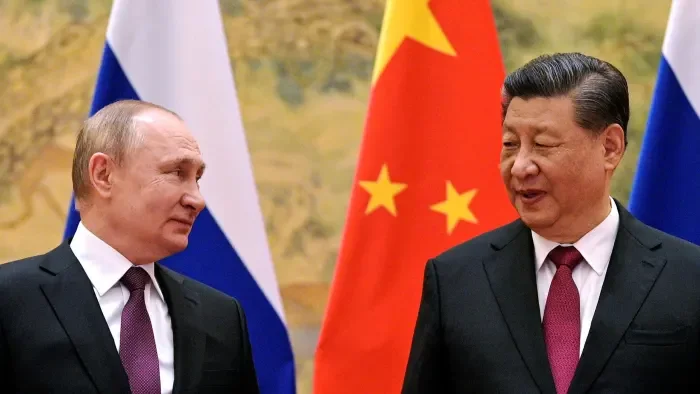
Close ties are reflected even at the highest level, with Putin and Xi establishing personal relations that they are willing to present to the world. In July 2021, Wang, the Chinese foreign minister, described Moscow-Russia relations as anything but an alliance, but also as something better than the alliance. And then, in February, Xi and Putin, they signed a joint statement underlining their same positions on several issues.
How significant was that statement that came shortly before the conquest?
The moment of the joint declaration came on the eve of the Beijing Olympics, and Putin's presence on that event was a strong contrast to the lack of Western leaders, most of whom had established a diplomatic boycott.
The document was signed at the moment of pre-war tensions against Ukraine, and included critical languages to the American alliance system in Europe and Asia. It specifically stated that countries jointly oppose any enlargement away from NATO.
There are also some scriptures in the Western media that China has been warned before that pact about the Russian invasion of Ukraine. Details of the conversation between Putin and Xi about Ukraine are not fully known, but the joint statement clearly gave Western connoisseur reason to believe that China's behaviour may have helped establish Russian aggression.
A China plays a war stop?
China has unveiled the idea of playing the moderator role, but what exactly it can mean remains unclear. China is widely seen in the West as a lot of pro-Russian and it has no experience playing such a role in Europe.
Of course there is hope that China will pressure Russia to stop the conflict. Ukraine's Foreign Minister Dmytro Kuleba in March said he had acknowledged some assurances that '%Kina is interested in halting this fight”, adding: “Chinese diplomacy has enough tools to make the difference, and we estimate that it is already included”.
Western policymakers have signalled China that Beijing can face consequences if it is seen to enable Russia's continued aggression. And Putin can be sensitive to any change in Xi's position. But China lacks the desire and ability to make Russia completely withdraw. And both sides have reason for now to try to manage whatever strains there may be.
Joseph Toorgian is a Russian-Kin relations specialist and associate professor of International Services at the American University of Washington
Artique published in the “The Conversion”/ ♪ Periscop /









