 14 hours ago
Russia blows “to” of the Balkan conflict to threaten the EU and NATO
Periskopi(4 years ago)
(4 years ago)“As Russia threatens to invade Ukraine, its games continue in Southeast Europe as well, where Moscow is playing a major role in the shock of already fragile peace in countries that make up the former Yugoslavia. Russia is constantly supplying weapons to Serbia, and is promoting interethnic hatred in Bosnia and Herzegovina. It is threatening Kosovo and northern Macedonia. He's interfering in Montenegro. Kremlin support for ethnic Serbs has helped spur [...]
As Russia threatens to invade Ukraine, its games continue in Southeast Europe as well, where Moscow is playing a major role in the shock of already fragile peace in countries that make up the former Yugoslavia. Russia is constantly supplying weapons to Serbia, and is promoting interethnic hatred in Bosnia and Herzegovina.
It is threatening Kosovo and northern Macedonia. He's interfering in Montenegro. Kremlin support for ethnic Serbs has helped fuel the recent wave of nationalism, which threatens to break peace in Bosnia, potentially rekindle armed conflict over Kosovo, and spur political unrest in northern Macedonia and Montenegro.
Throughout the Balkans, Including NATO and EU states such as Bulgaria and Hungary, Moscow is buying or gaining control of strategic assets in key sectors such as media, security, communication and finances. They implement the notorious reflection control doctrine for controlling enemy decision-making processes. We can expect Russia to cause a war in Ukraine, but war can erupt anywhere else” said Ivana Stradner from American think-tank “American Enterprise Institute”.
I would not rule out the Balkans as another battlefield, where Russia can challenge the European Union and NATO, to show that both are “Tigra of paper”- add-Strader. Russia views the Balkans as an important region with strong cultural and historical ties.
Moscow has repeatedly accused the West of destabilising and interfering with its policy, beginning with Germany's quick recognition of Croatia's independence from Yugoslavia, which triggered the federation's eventual breakup.
US and several other Western countries, aimed at confirming their dominance in the region, have been a serious destabilising factor for the Balkans”, Russian President Vladimir Putin said in an interview in 2019 quoted by Serbian media.
But Moscow is also accused of inciting ethnic tensions through biased coverage of events supported by Russia or spreading false news from pro-Russian media in the region. In Serbia, Bosnia and Montenegro, it has exploited ties between the Russian and Serbian Orthodox Churches to influence public opinion.
Moscow and Belgrade recently signed a pact to reject what they described as a <x0-colored multicolored revolution”, a popular uprising against authoritarian rule considered to be Western-led. Sputnik, the leading media spreading Russian propaganda around the world, has a branch in Belgrade as well.
“Sputnik Serbia” spreads Narrativa to all major media in the region, which has nothing to do with reality but strengthens the Russian view of the various international crises”- says Thomas Brey, journalist and researcher who has long covered the Balkans.
Russia has sold Pantsir air defence systems to Serbia - S1M, tanks, armoured transporters, helicopters and anti-tank Kornet missiles. It has also established a military secret service base for collecting intelligence data at NATO's Bondsteel Base in Kosovo.
A scandal erupted last month, when it was discovered that Serbian Interior Minister Aleksandar Vulin had been spying on Russian dissidents who gathered at a meeting in Belgrade last year, handing the transcripts of discussions to a Putin associate. One of those dissidents was later arrested by Russian authorities.
Despite the scandal, Voul continues to remain in office. Bosnia and Herzegovina, the potentially dangerous hot spot in Southeast Europe, has been one of the main focus of Russia's interest and its local ally Serbia, which is Kremlin's main representative to the Balkans.
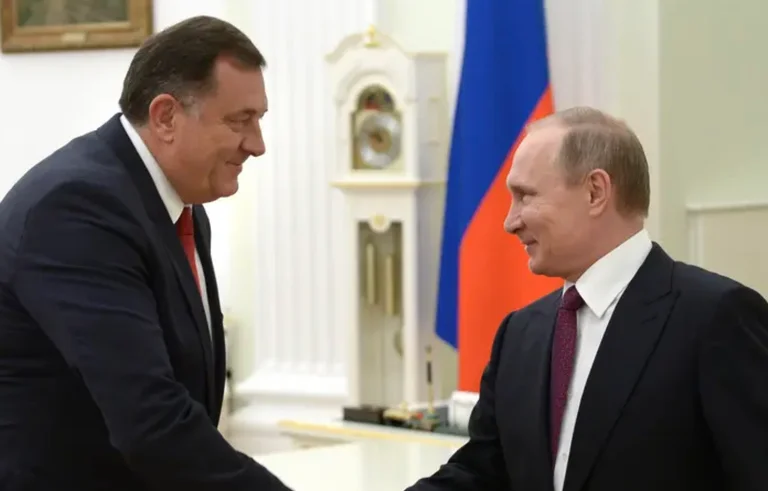
Bosnian Serb leader Milorad Dodik, running for a new mandate in the October 2022 elections, often heads to Moscow to meet with Putin, who helps boost his popularity. In early December 2021, a few days after meeting with Putin, he declared Russia's support for Serbs' disputes with other ethnic factions in Bosnia and Herzegovina.
Dodik said the Russian president had promised Bosnia Serb entity Republika Srpska, a new gas line, fuel and a thermal power plant with solar panels. Despite allegations of corruption, Dodik is expected to win the elections easily, continuing political control of Republika Srpska.
“Before any party elections, Dodik meets Putin for several minutes. That is enough for ordinary Serbs to see who their friend” says Srdjan Puhalo, political analyst in Banja Luka, the de facto capital of Republika Srpska.
“While the Russians come to Sarajevo, the only message is: Do not join NATO, nor the European Union” says Sead Tucalo, professor and dean of the Faculty of Political Sciences at Sarajevo University.
Russia has blocked all UN resolutions, considered unfavourable for Bosnian Serbs, and along with China, rejected the appointment of the head of an body that oversees the implementation of the Dayton Agreement, which ended the 1990s civil war in Bosnia.
Serbia, meanwhile, has threatened Kosovo with war, which declared independence 14 years ago despite Belgrade and Moscow's opposition. At a meeting held in Soci last year, Putin assured President Vuccic of the Kremlin's support. Russian media continue to describe Kosovo as a “autonomation” of Serbia.
In Montenegro, after allegedly supporting a failed coup effort in 2016, pro-Russian elements supported by the Serbian Orthodox Church played a major role in the collapse of the Djukanovic government, and the deployment of a more pro-Kremlin government, which went into crisis several weeks ago, prompting concerns about new Russian interventions.
In northern Macedonia, the newest NATO member, Russia is said to be continuing to influence domestic politics. Likely, Russia does not want to see a re-enhancing of the traumatic Balkan wars, which ended only with strong international intervention, including NATO bombings.
But the shock of the region drains Western diplomatic energy, increasing migration problems from this region and instability. The “Russians are increasing tensions in the region”- says Tucalo. Disturbing and intimidation have helped Moscow achieve its strategic goals. “Russia would like to create chaos and then position itself as mediator in the Balkans.
He would later use this power to renegotiate with the West over the chaos he caused in Ukraine itself. One of Putin's intentions is to restore Russia as a great power. And a revanst Russia is about to use force unilaterally in the 20th century, because in Putin's mind that's exactly what the West did during the 20th century”.
Taken by Cutback










