a day ago
Europe has a problem: France and Germany have forgotten how to argue
Periskopi(4 years ago)
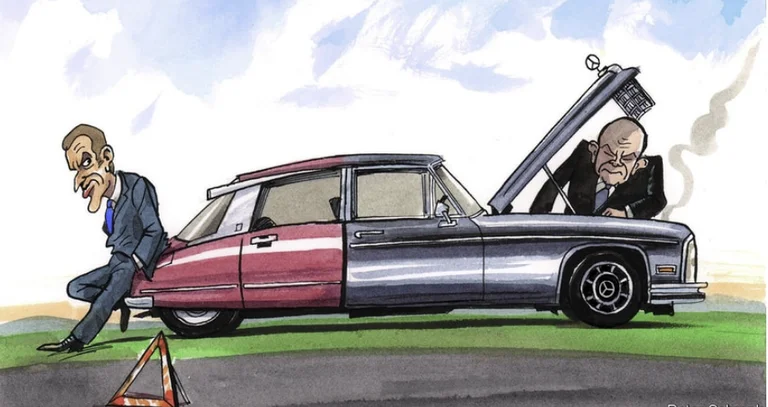
(4 years ago)The relationship between France and Germany is so important to both that each side has its own version of it. For romantics in France, at Charles Baudelaire and Victor Hugo's place, the alliance is often described as a couple who occasionally quarrel with each other and fight with others. In Germany, [...]
In Germany, the house of Audi and Volkswagen, the pair forms a motor, a series of controlled explosions used to move Europe forward.
Whatever image you prefer, the current state of the relationship is terrible. Previous clashes of French-German disputes tensed the EU, but led to resolutions promoting European integration.
Today's conflict between the two countries is nothing spectacular, but it is disturbing: no one can know how it will end and whether it will be a productive compromise on both sides.
This week should have marked the renewal of Franco-German relations. A joint cabinet meeting that would bring together the ministers of the two countries would take place on 26 October.
But the meeting was postponed, and instead a lunch was organised between German Chancellor Olaf Scholz and Emmanuel Macro, president of France.
In fact, Germany and France are on the opposite sides of an extremely long list of subjects.
Each of the parties knew very well that none of their ministers had much to talk about.
The repeated guarantees of both sides that the situation is good, in fact, only to add even more doubts that in fact things don't seem as much. Much of the conflict is certainly associated with Ukraine. In terms of war itself, France and Germany have agreed that Ukraine needs support, but not at the cost of Russia's total alienation, an approach that has led both to oppose “skifts” in Central and Eastern Europe.
That is how these countries are dealing with the war that has deepened the long - standing divisions.
France had hoped for more joint EU borrowing to finance the cost of energy growth, or to limit gas prices; Germany promoted an internal subvention package of 200 billion euros.
Germany wants to reverse EU budget rules before Coved; France wants to continue with its spending package. France wants joint procurement of military equipment from the EU; Germany thinks it is an obstacle to French firms and prefers American means.
But of course the list is longer.
Tensions in relations between France and Germany are of great importance beyond Paris and Berlin. Although it can be incredible in 25 of the EU's 27 nations, “chift” is at the top of the effort.
All European integration stages, from euro to free movement, enlargement or single market, were the result of French-German compromises.
The agreement between the two is a necessary condition for European politics and a always necessary condition.
Partly because of their size.
Both make up one third of the EU's population and its two fifths of GDP. But the fundamental differences between the two strengthened the impact of any agreement these countries reached, abcnews.al reports.
A policy that was appropriate for heart - guided French people was supposed to influence most of South Europe. What stubborn Germany considered acceptable would also be applied anywhere from the Netherlands to Austria and Eastern Europe, at least before the war.
But sharing jobs for an old couple has shown up over the years. France has many new ideas, and Germany joins many of them.
Macron called for a large Eurozone budget, for example, and then Chancellor Angela Merkel eventually agreed to a large fund of pandemic recovery.
The dispute has been a major feature of the relationship, not a defect.
These days France still reveals its new plans. But in her eyes Germany is not so irresponsible. In the past finding compromise could be dramatic.
A decade ago, Merkel was tears down when she was offered a French plan to save the euro, a plan she agreed on later.
Scholz, on the other hand, seems completely adamant by these conflicts between the two countries. But something like that certainly doesn't help to fix their personal relationship.
Both are different and need different ideas from each other. The French president is a endangered person whose best path towards a legacy as a reformer runs across Europe.
Scholz is a former regional politician near the pension, who will probably be remembered (or not) for reforming German defence and foreign policy that followed the invasion of Ukraine.
Macron needs Germany to achieve its goals, while Scholz is focused on pleasing both of his local coalicon partners.
Low-level issues such as subsidies and budget regulations are usually not enough to exacerbate French-German relations.
But the way Europe is changing means that such issues can get another dimension, according to Luuk van Middelaar, a Dutch political writer.
The war has taken on the view of an EU extending to Kiev and beyond, as Scholz noted. At least geographically speaking, a set to the east would make Germany appear central and France would look pretty peripheral, especially after Brex, reports abcnews.al.
Politically, in some cases, a more convincing Germany after Zeitung (turning point) can find ways to replace its century - old French ally if the circumstances are favorable, although France on the other hand has no way of bypassing Germany.
This still looks a distant target at the moment: Germany is isolated in Europe and France is not.
The Macro's agenda for <x0 strategic economy” is out of fashion more than German dependence on Russian gas and exports to China. But things can change.
A future where France is simply one of many potential partners for its biggest neighbour is a reason to worry in Paris. A conflict with Germany, followed by an episode filled with new EU policies, would be a way for France to show it is still important.
But you can't fight someone who doesn't seem to care. /abcnews/
Author: The Economist