10 hours ago
Berlin Priorities and Albin Priorities
Periskopi(5 years ago)
(5 years ago)German Chancellor Angela Merkel ended her trip to the Balkan region today, which for seven years has been under her auspices through the Berlin Process, launched in 2014. This process includes 12 states, six of the Western Balkans, Albania, Serbia, Kosovo, northern Macedonia, Montenegro and Bosnia, and [...]
German Chancellor Angela Merkel ended her trip to the Balkan region today, which for seven years has been under her auspices through the Berlin Process, launched in 2014. This process includes 12 countries, six of the Western Balkans, Albania, Serbia, Kosovo, northern Macedonia, Montenegro and Bosnia, and six EU member states Austria, Croatia, France, Germany, Italy, and Slovenia.
The process began as an effort by the European Union not to suffer trauma from the slowdown of the Western Balkans' involvement in the European Union and was conceived as a multilateral political initiative among Western Balkan countries, below “German passport”.
The process was aimed at promoting reforms of these countries, giving priority to investments and interactions between the countries of the region and resolving in this framework and pending issues.
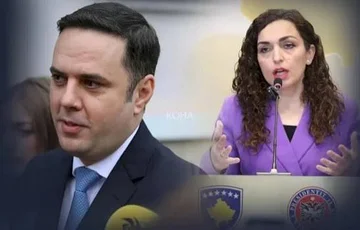
Kosovo Prime Minister Albin Kurti said today after meeting with Chancellor Merkel that Kosovo will stick to the Berlin Process and assigned this process to its four priorities, which, according to Kurti, will be:
1 -The rule of law that acts against corruption and oligarchs. 2-democratisation that enables free and independent media and acts against the Ottomans. 3-Communication with the past and does not allow it to have war criminals at large and less to be in power. 4-Reciprocytes, balance between national minorities and against nationalist hegemony.
I have nothing against Albin Kurt's priorities, even though two of them are his duties and two other Serbian tasks. His two duties have been lost since the bones, as Albin Kurti's government is the most aggressive government in the region against press freedom.
She has a lynching sense of critical journalists with her. A senior official, Hakki Abazi, just two days ago publicly threatened a journalist, saying that “would mourn as once on TV Klan”.
Cleared to the public, this is that with the government coming to power of Albin Kurti, this journalist was dismissed by TV director Klan, and now according to the government, it must continue to be persecuted.
Here comes Albin Kurti's first commitment, as it shows that with oligarchs, such as the owner of Kosovo Clan, he is well off and not at war. He's only in the war with reporters.
It would suffice to look at Albin Kurt's verbal remarks to critical journalists, or personal attacks, such as he was to Halil Matosh last week, to understand that Albin Kurti has set the two priorities he has set for the Berlin Process, has lost them since the start. The other two dependent on Serbia may never succeed, but it is easy to blame Serbia.
But actually the Berlin Process has its priority, not that of Albin.
The process has a diplomatic dimension, which forces countries in the region to resolve problems between them on a peaceful path and not block each other on the road to advancing EU membership, confirmed by the Summit of Foreign Ministers in Vienna.
The Berlin process also has an economic priority, aimed at joint infrastructure projects and functional regional market.
At the Trieste Summit in 2017, the idea of the Regional Economic Zone was held, which should help Balkan states meet EU economic criteria.
The six Balkan state pledged four priorities regarding the Regional Economic Zone and they are free trade, investments, furniture and digital dimension of the EU.
Trade aims at circulation of goods and services without obstacles; harmonisation of the principles of the Central European Trade Agreement (CEFTA) and EU standards;
Second priority is investments in the region.
The third priority is the Mobility agenda, which provides better opportunities for qualified professionals through mutually interested agreements.
And the fourth priority is digital integration, which means greater digital access; security in digital services; digital economy and digital society, which is similar to the digital standards of the European Union.
These are the four priorities of the Berlin process and not Albin's four priorities. Albin is free to say she does not support the Berlin Process, but Kosovo has not been called into that process to change Europe, but to change its reports with the region and solve its history problems.
The Trieste summit, which Kosovo has attended, has developed as a new commitment to what is called the Regional Economic Zone, which, if implemented by Kosovo, would benefit from the criteria of visa-free movement, would benefit from recognition of Kosovo authorities in the region, and the validity of a set of documents of its citizenship, since birth certificates, licenses, diplomas and exchanges of professionals.
Above all, through this process Kosovo meets one of the most important criteria of the Association Agreement (MSA), which is the good relationship with neighbours and regional co-operation.
The so-called “Open Balkan” that is being cursed by Albin Kurti is exactly an initiative stemming from the Berlin process and precisely from the concept of the Regional Economic Zone adopted in Trieste, as a regional tool for its implementation.
It is low speculation to say that this is sabotage of the Berlin Process, or not under EU auspices, as it is within the concept of the Berlin Process.
Albin Kurti is free not to participate in it, as the process is therefore left open, so that no one can block each other. But it must respect the Berlin Process as it has been formatted and not as it seeks to format.
Berlin's priorities and Albin's priorities have nothing to do with each other. Berlin's priorities seek to introduce the Balkans into the EU, while Albin's priorities seek to introduce Europe into the Balkans and that the Berlin Process is a weapon for war against all that Albin does not want in the Balkans. Especially Albania.
I'm not against his wishes, but it's not about the Berlin Process. This process, which Albin has in mind, has died in 1999 in the Balkans. It was called the Milosevic process.