11 hours ago
Why did America fail in Afghanistan?
Periskopi(5 years ago)
(5 years ago)By Henry Kissinger, Afghanistan's retake by the Taliban, focuses immediate concern on the evacuation of tens of thousands of Americans, allies and Afghans trapped there. Saving them should be our priority with emergency. However, the most fundamental concern is how the United States decided to withdraw through a decision made without much [...]
By Henry Kissinger
Afghanistan's recovery by the Taliban focuses immediate concern on the evacuation of tens of thousands of Americans, allies and Afghans trapped there. Saving them should be our priority with emergency.
However, the most fundamental concern is how the US decided to withdraw through a decision made without many warnings or consultations with allies, or with people who were directly involved in 20 years of war and sacrifice.
And why the fundamental challenge in Afghanistan is conceived and presented to the public, as a choice between full control of Afghanistan, or full withdrawal from there. A fundamental issue has prompted our similar operations from Vietnam to Iraq for more than one generation.
When America endangers the lives of its soldiers, it risks its prestige, and if it decides to include other countries, it must do so on the basis of a combination of strategic and political goals.
Strategic, to make clear the circumstances for which we fight, and politics to define the governing framework, as well as to preserve the outcome both at home and internationally.
The United States is divided between its efforts against rebellion, and its inability to determine reachable goals, and to connect them in a sustainable manner with the American political process.
Military targets have been very absolute and elusive. And the very abstract and elusive political ones. The failure to connect them to each other has mixed America into conflicts with no definite final points, and has forced us within the country to turn unified goal into a “mocal” internal controversy.
We entered Afghanistan amid widespread public support, in response to al-Qaeda's terrorist attack on America, initiated by the Taliban-controlled Afghanistan. The initial military campaign has had great effectiveness. The Taliban survived mainly on their Pakistani bases, from which they organized occasional rebellions in Afghanistan with the help of some Pakistani authorities.
But as the Taliban fled the country, we lost our strategic focus. We convinced ourselves that the restoration of terrorist bases could only be prevented by transforming Afghanistan into a modern state, with democratic institutions, and with a government that would rule constitutionally.
But such a process cannot have a timeline compatible with American political processes. In 2010, in a reaction to the addition of our troops there, I spoke out against such a long and laboring process, as it could turn non-gihad Afghans against all American enterprise.
Afghanistan has never been a modern state. Citizenship presupposes a sense of common obligation and centralisation of authority. Afghan troops, with many natural resources, lack those traits. The construction of a modern democratic state in Afghanistan, where the government's decree is implemented uniformly throughout the country, requires a long-term, in fact, decades.
Above all, this process goes against the country's geographical and ethno-religious essence. It was the fragmentation, indecisiveness and lack of the central authority of Afghanistan, that made this country an attractive basis for terrorist networks.
Although a particular Afghan autonomous unit dates back to the 20th century, its constituent peoples have always stood by centralisation. Political and especially military consolidation in Afghanistan has continued to take place along ethnic and clan lines, with a centrally secular structure, where middlemen and crucial power are clan leaders.
Usually in secret conflict with one another, these commanders unite in broad coalitions primarily when any outside force -- such as when the British army invaded it in 1839, or the Soviet army in 1979 -- aims to impose centralization and cohesion.
Both the catastrophic British withdrawal from Kabul in 1842, in which only one European escaped death or captivity, as well as the Soviet withdrawal from Afghanistan in 1989, was caused by such temporary mobilization among clans.
The contemporary argument that Afghan people are not willing to fight for themselves is not supported by history. They were staunch warriors for their clans and tribal autonomy. In time, war took on the unlimited characteristics of earlier anti - rebellion campaigns, in which American support to locals gradually weakened over time.
At that time, the destruction of the Taliban was essentially accomplished. But the nation's construction in a war - torn land absorbed considerable military forces. The Taliban can be stopped, but not eliminated. And the use of unknown forms of government weakened political commitment and further increased widespread corruption.
Afghanistan therefore reiterated previous models of American internal controversy. What some defined as progress, others labeled a disaster. Both groups tried to paralyse each other during successive administrations on both sides. One example is the 2009 decision to bring a large number of troops to Afghanistan, with the announcement that they would start withdrawing within 18 months.
What was neglected was an imaginary alternative that combined several reachable objectives. The rebellion could have been reduced to curbing Taliban instead of destroying them. And the political-diplomatic course, it may have explored one of the particular aspects of Afghan reality: that the neighbors of this country even when they are opposed to each other often feel threatened by Afghanistan's terrorist potential.
Would coordinating some common efforts against Taliban rebellion be possible? Of course, India, China, Russia, and Pakistan often have different interests. A more creative diplomacy could produce several joint measures for overcoming terrorism in Afghanistan.
This strategy is the way Britain defended for a century the roads in India and the Middle East without permanent grounds but a permanent military readiness to protect its interests, along with temporary regional supporters.
But that option never exploded. In campaigning against war, presidents Donald Trump and Joe Biden launched peace negotiations with the Taliban, whose extermination we were engaged 20 years ago, also encouraging allies to help us.
This approach now culminated in what constitutes unconditional American withdrawal from the Biden administration. The description of evolution does not eliminate the surprise of the attraction decision. Due to its historic capacities and values, America cannot escape being the main element of international order.
We cannot avoid this role by withdrawing. The way to fight is limited and wide-ranging terrorist networks supported by countries with increasingly sophisticated technology will remain a global challenge. They have to resist through national strategic interests, along with any international structure, after we are able to create solutions with proportional diplomacy.
We have to admit that no dramatic strategic movement is available in the near future to compensate for this self-motivated failure, such as making new formal commitments in other regions. The American drive would only deepen frustration among allies, encourage opposers, and sow confusion among analysts.
The Biden administration is still in its early stages. It should have the opportunity to draft and implement a comprehensive strategy, in line with local and international needs. Democracy evolves into a factional conflict. They achieve greatness because of their reconciliation.
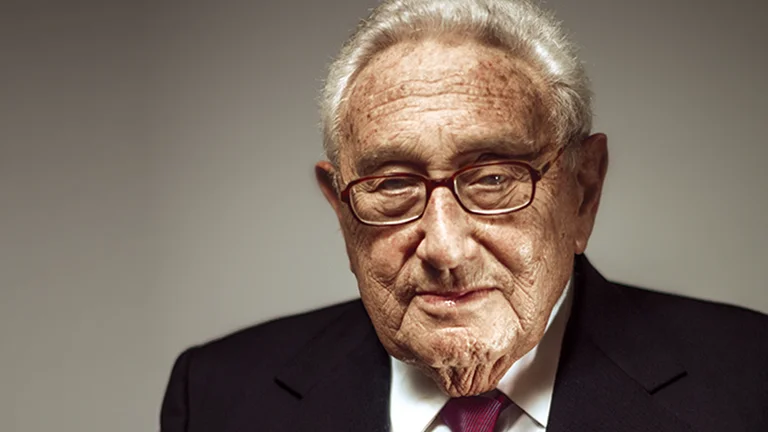
Henry Kissinger, former US Secretary of State, and National Security Adviser. /“The Economist” /Bota.al