5 hours ago
What happened to Donald Trump?
Periskopi(5 years ago)
(5 years ago)He was very persistent while leaving the White House:” I'm staying in politics! It was a turbulent end of the presidency of impeachment, scandalous forgiveness, but also a strong debate over the outcome of the presidential election, but Trump knew it was behind devoted followers, so he aimed at [...]
He was very persistent while leaving the White House:” I'm staying in politics! It was a turbulent end of the presidency of ʹ impeachment, scandalous forgiveness, but also a strong debate over the outcome of the presidential election, but Trump knew there was a committed follower, so he intended to remain a strong voice in American politics.
And not only he: his family was eager to benefit from his electoral success. Usually a former president holds a low profile after leaving office. He wouldn't do that. But the dominant figure would remain in his party. But his plans went wrong.
The president settled in his new home, urging friends to raise their voices on the unfair way he was treated and to appeal to prosecutors who were more than zealous against him. He gets tired of ever listening to these things! ”- confessed a friend.
It was 2001, and the former president was Bill Clinton. When a president leaves office, we expect him to disappear from the scene for a while, to release the scene to the new president, and to give us some time to forget why we didn't regret letting him go” wrote “Time”.
There's no way Donald Trump called Bill Clinton to see you. And not because Clinton would refuse the invitation. But because if they sat down to talk, both men could discover that they had something in common to discuss. Trump has suddenly remained far removed from duty.
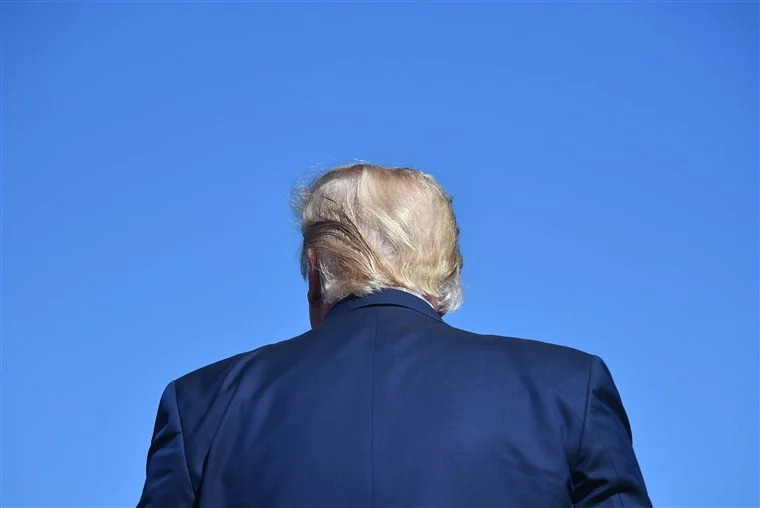
Very few people could have imagined that. Philip Bump of the “Washington Post”croci recently that if you Google the latest images of Trump, you get to a lot of those times before he ran for president.
The most popular theory of Trump's disappearance from the scene is that the ban on Twitter (and other social media sites) has greatly damaged his ability to reach a broad audience. With his Twitter account on his fingertips, he could vent his hands on everyone and everything, and he would be liked and commented on by millions of followers.
The media would surely report on his final position. Trump's eclipse appears to begin about 8 January, when Twitter announced its account ban. Clearly, Trump lacks short postings on Twitter, and receiving immediate reactions from the audience.
He e-mails his statements to reporters sometimes some days in hopes they'll post on Twitter, but it's not the same. But even Twitter theory is flawed. Trump's posts could cause trembling among government officials, but they had begun to lose their strength since 2019.
Fewer people had begun to react to them, and Trump's attempts to compensate for that fall simply by posting more frequently weakened the effect further. Americans seemed to be getting more fed up with the President's harsh statements.
In addition, someone with Trump's reputation does need to have an account on Twitter. As a rebel presidential candidate in 2015, Trump found that the account on that platform provided a useful way to guide the discours, even though few journalists or politicians at first took his candidacy seriously.
But when he was president, Trump had many other ways to detect media attention: press conferences, official interviews, and the addresses of the Oval Office. Although he sometimes avoided these methods as president he did not provide an Oval Office address until nearly 2 years after his mandate was launched he is now using the tools that remain available.
For some time after the coup effort on January 6, 2001, Trump remained surprisingly silent, apparently listening to the counsel of helpers who suggested that he keep his head down while the Senate was still considering his impeachment. But since the Senate failed to condemn him, Trump has been more loud.
He has continued to make public statements, including those at the Republican National Committee meeting last weekend, and has conducted interviews at some of his favorite television stations. He has also given at least a dozen interviews on books written about his presidency.
Trump could get more attention if he gave an interview for a more controversial journalist. Trump can be the victim of his former success in detection of the news cycle. First of all, maybe the media has finally started to understand the lecture about the coverage of its <x0->cars, which were increasingly empty statements.
Second, Trump's ability to dictate the news depended, in part, on his increasingly intense provocations. And once you've tried to reverse a presidential election, you don't have much space to scale further. Trump succeeded in becoming a spokesman for complaints of his base of supporters.
But his complaints about the elections even though he has tried to describe them as election thefts are basically only about what he sees as a personal insult to him, and not as a national cause.
Polls show that many Republicans believe that the 2020 elections were manipulated, and the damage this belief will bring to democracy in the long-term plan is dangerous. In the nearest future, however, no one will remain so angry about this as Trump himself.
Some followers who saw him as a man who could challenge the estability will now see his loss as proof that politics is unchanged, and would sink into apathy or break away from him. For others, the loss of Trump makes him a loser. So they're going to search out other “herony”.
Despite losing influence on the media, Trump remains in control of the Republican Party. A significant minority of the population still supports it. He leads in polls on Republican Party voters for the official candidate of the 2024 presidential candidate. Republicans known as Kevin Mccarthy and Steve Scalise make constant pilgrimage to Trump Mar-a-Lago's residence to strengthen their positions. The campaign committee for the Senate Republicans seems to have invented a special prize for Trump.
Even such figures as Mitch McConnell and Nikki Haley, who severely criticised Trump for the events of January 6th, have claimed to support him if he was nominated for the 2024 elections. But what Trump possesses is the negative power to silhouette any republic that disagrees with him. He has lost most of his positive power to make things happen, to forgive, and to advance the causes.
Trump's fundamental problem is that despite his best efforts, even the lowest, he is no longer president. He just doesn't matter much now in the United States. This happens to every president as soon as he leaves duty, even those like Bill Clinton, who leave the relatively popular position, while Trump has never been such.
During his political career, Trump has acted as if he were immune not only to the legal consequences of his actions but also to all traditional policy rules, and has managed to convince many analysts that this is true. So far, he has been successful in avoiding the law, but the rules have already taken a measure. / Translate: Alket Goce-abcnews. al