7 hours ago
What does Russia want in the Balkans?
Periskopi(5 years ago)
(5 years ago)Popular Narratites on Russia's geopolitical interests in the Balkans are channeled into two very different directions. One of them, inherited from the strategic idea of the 19th century, says Russia, as an unbound empire, must expand to the Balkans in order to have access to the Mediterranean Sea. According to this [...]
Popular Narratites on Russia's geopolitical interests in the Balkans are channeled into two very different directions. One of them, inherited from the strategic idea of the 19th century, says Russia, as an unbound empire, must expand to the Balkans in order to have access to the Mediterranean Sea.
According to this concern, the Balkans are treated as an empty space, despite the ethno-religious identity of the population there. The second horror, which can be traced from the time of the romantic pan-Slavism of the XIX century, but which has been popularised in its current form after the publication of Samuel Huntington's theory on “the clash of civilisations”, says Russia conceives its influence in the Balkans by cultivating brotherly relations with the Orthodox Christians of the region, using common religious identity to protect its geopolitical ambitions.
However, the facts on the ground do not support either of these Narratoria. Russia's influence in the region, from the beginning of the 19th century to the present day, could never compete with the influence of the Anglo-French axis, exerted through Serbian and Greek nationalism channels, built on anti-anti-anti-Islamic and anti-Habsburg/anti-Catolic foundations, in line with the strategic interests of two Western European powers to destroy the smaller empires, and transform them into a number of weak international states.
Although these nationalist movements used Orthodox Christianity, and the popular folklore of the brotherhood with Orthodox Russia, as effective means for mobilizing populations targeted on anti-Islamic and anti-Catholic bases, their elites remain permanently disconnected from Russia, constantly heading towards their real clients in London and Paris.
The Russian motive in mobilising Serbian nationalism in the 1990s was certainly quite appropriate for London and Paris, as they had concealed their continued support for the Bosnian Serb and Croatian military invasion, which produced a huge campaign of ethnic cleansing of non-Serbs in occupied areas, with more than 100,000 dead and over 1 million outcasts.
Another reason, why the Serbian campaign of genocide and ethnic cleansing was backed by London and Paris, was the global promotion of Hungtington's theory on “the collapse of civilisations” as the next “model of conflict”. According to this model, future geopolitical blocks would be formed on the basis of religious identities, acting as “civilization” in conflicts that never end.
However, contrary to the principles of ethnic diversity applied on its territory and in the wider area of the former Soviet Union, Russia's stay in the Balkans has shown open support for Serbia's Great programme for uniting all Serbs into a single, ethnically homogenous state.
Russian foreign policy and open support for Serbian efforts to annex the rebel province of Bosnia, mostly populated by Serbs, is at least self-contract. It is also self-destructive, if taken seriously and applied to Russia itself and neighbouring countries that have an ethnic Russian minority.
Can anyone imagine today's Russia in a permanent effort to annex parts of all post-Soviet republics populated with Russians in order to unite them in Great Russia? Or is Moscow trying to ethnically cleanse its territory, in order to expel or eradicate over 190 ethnic communities, in the name of an ethnically homogenous Russian nation?
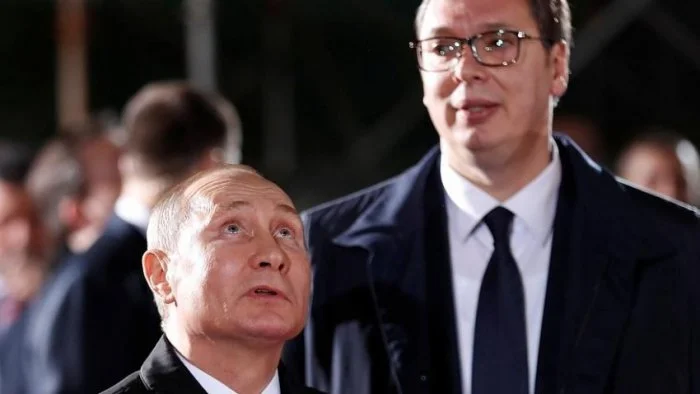
Of course not. However, it is precisely what Russia is supporting in bringing Serbia to its neighbours. Therefore, it should rightly be asked: what does Russia want in the Balkans? For one thing, despite its public support for him, it is highly questionable how much influence Moscow has in Belgrade.
From its existence Serbia, from a semi-autonomous principle within Ottoman territory in 1830 to the establishment of the Kingdom of Serbia in 1882 to its expansion in other territories in the form of the Kingdom of Serbs, Croats and Slovenians (later, the Kingdom of Yugoslavia) at the Summer Conference in 1919, has always had clear support from London and Paris.
The breakup of communist Yugoslavia, which Serbia used as an appropriate opportunity to implement the Greater Serbia programme, was also clearly supported by London and Paris, without any participation in Moscow. Under these conditions, it is difficult to imagine a strategic shift from the Anglo-French secular influence to Russia's.
It is also difficult to identify Russian strategic interests in the Balkans, given the fact that Russia's foreign policy was not designed to exercise control in areas outside former Soviet Union territory. However, if Russia does not have a real impact in Serbia, then current Russian support for Serbia's continued hostile policy towards its neighbours could be a simulation of influence.
But for what purpose? If the Balkan region is of strategic importance to the United States, not only as a link between the West and the Middle East, but also in terms of its natural resources (for example Kosovo), then the simulated Russian influence in the Balkans could serve as a barrier against American influence in areas of real strategic importance to Russia.
On the other hand, not many analysts, diplomats or politicians are aware of the silent strategic alliance between Russia and Turkey, which has raised Turkey to the status of a major power. This alliance has already been tested in Libya, Syria and Nagorno-Karabakh.
Could Russia and Turkey play a similar game in the Balkans? Is there any possibility that Russia and Turkey will create an illusion between the nationalist Serbian elites, that Russia would undoubtedly back their efforts to give part of Bosnia and Kosovo, and at the same time leave Turkey free to extend its military support in Bosnia and Kosovo's efforts to prevent Serbia from questioning their sovereignty? /♪ Alket Goce-abcnews. al