11 hours ago
Governments are using pandemic as an excuse to deny the right to protest
Periskopi(5 years ago)
(5 years ago)The year 2020 tested democracy and civil liberties in many ways. After the World Health Organization proclaims the pandemic of the new coronary in March, governments took unprecedented action, such as establishing curfew, limiting human movement, and restricting or preventing gatherings. Under international law, some of these measures went beyond the allowed borders [...]
The year 2020 tested democracy and civil liberties in many ways. After the World Health Organization proclaims the pandemic of the new coronary in March, governments took unprecedented action, such as establishing curfew, limiting human movement, and restricting or preventing gatherings.
According to international law, some of these measures went beyond the allowed limits for limiting the rights during public health emergencies, borders intended to ensure that such measures are <x0-probutal, necessary and not discriminatory”
In his latest report, the CIVICUS Monitor, a website that traces the space of civil society across the globe, shows that the governments of EU states, Norway and Britain deliberately restricted civic freedoms, often under the guise of fighting pandemic.
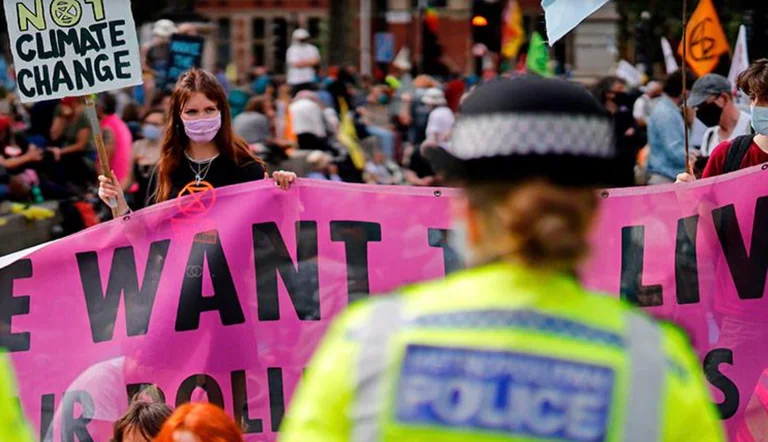
More specifically, they attacked the democratic right to the peaceful rally.
It is not surprising that authoritarian and extreme right governments, such as Hungary, Poland and Slovenia, made good use of the pandemic, though in various ways driven by various political motives and local political contexts. However, even in countries where people were able to exercise their civic freedoms without major obstacles, such as Sweden, there were violations. At the same time, civil society intensified its response and often intervened when governments were going far beyond what was necessary and proportional to fight the pandemic.
The main violations in EU countries that the monitors recorded included bans, censorship, restrictive laws, excessive use of force, intimidation and harassment. The data presents a clear and disturbing view: the right to peaceful gatherings in Europe is threatened.
Pandemia has complicated the situation more, as governments are using it as an excuse to further limit civic space. While governments have claimed that they were imposing measures to fight pandemics, they have often been contradictory, and they have severely restricted the right to peaceful gatherings.
Two examples testify to this contradiction. First, when the restrictions due to the coronary were eased in the summer of 2020, governments in some lands allowed people to gather at a larger number in religious places, shopping centers, or restaurants, but continued to limit the number of people allowed to meet to protest.
This happened in Sweden, where, at the start of the second wave of pandemic, the government banned the public meetings of more than 8 people, even when it allowed collective groups to meet in restaurants, sports events, and other similar locations.
In France, protests remained banned, and the government implemented this ban with amazing severity even when gatherings were possible in cultural environments. Second, law enforcement authorities used an excessive force to disperse protests for violating restrictive measures due to pandemic.
This was seen in Poland during protests that began in October 2020 against an almost complete abortion ban, when protesters faced police violence and ban. Meanwhile, in the United Kingdom, police used various severe tactics during the “Black Livings Matter” protests in May 2020, including removing the face masks of protesters to identify them.
In Berlin many protesters were arrested when 15,000 people gathered to protest police brutality. Similarly, French police used tear gas and excessive force during a feminist march on International Women's Day.
Several other similar examples appeared elsewhere in Europe. In Greece, police used excessive force against immigrant protesters, who were crying out about poor living conditions within refugee camps.
Police also used excessive force against antigovernmental protests in Slovenia for many months when demonstrators regularly took to the streets every week. Despite the coronary pandemic and unprecedented restrictions, people have continued to take to the streets as they used to.
But they have already organised separate physically, creative, symbolic and online protests. Clementyna Suchanow, who co-founded the social movement “The Polish Women's Strike says that “we became creative and invented new forms of protest after being forced by circumstances”.
Even anti-government protest movements found new ways to demonstrate. In Croatia, the civil society group “Zagreb Po Ju Callret” organised protests on the balcony against the prime minister's weak governance during the pandemic, but also management of the consequences of the March 2020 earthquake.
In neighbouring Slovenia, activists have staged bicycle protests against the government of Prime Minister Janez Jansa. Such examples show that civil society is demonstrating solidarity and stability. It is sending a clear message: even in the midst of a global pandemic that has halted many aspects of life, people will never stop fighting for their fundamental freedoms.