4 hours ago
Conflict in the inevitable Balkans: Where is Kosovo?
Periskopi(5 years ago)
(5 years ago)From Arminka Heliić & Anthony Mangnall “Politico.eu”: From the world.al, today's editorial title throughout the Western Balkans, an alarming echo of the 1990s can be heard. While European Union enlargement talks are stalled in the region, there is a common worrying factor in the crises Bosnia and Herzegovina currently faces, Kosovo [...]
From Arminka Heliić & Anthony Mangnall
Today, throughout the Western Balkans, the alarming echo of the 1990s can be heard. While the European Union enlargement talks in the region are stalled, there is a common worrying factor in the crises facing Bosnia and Herzegovina, Kosovo and Montenegro currently: the Serbian government is actively supporting efforts to destabilise them, supporting radicals in these countries, and threatening their sovereignty and territorial integrity.
Combined with Russia's intervention, the division of the EU and NATO weakness, this situation is turning to be a deadly cocktail. The progress achieved in the region in the 2000 ' s in terms of building peaceful, prosperous and multiethnic states is rapidly going down, and the region is open to intervention of all potential perpetrators.
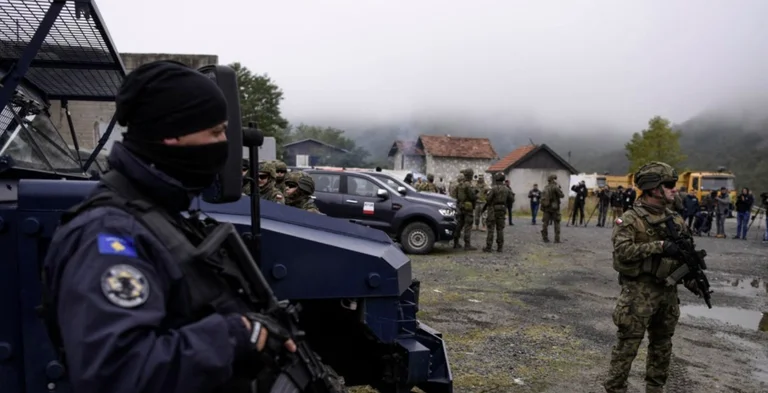
Therefore, the time has come for NATO and the European Union to co-operate, taking concrete action to stop the fall of standards, and to protect the progress that has been made so far. In September of this year, Serbia decided near its border with Kosovo, armoured vehicles and fighter aircraft, openly challenging the post-1999 demilitarisation.
In Bosnia and Herzegovina, separatist Serb politicians, who are politically and financially dependent on Serbia, are withdrawing unilaterally and unconstitutionally from federal-level institutions established as a result of the Dayton Peace Agreement, while conducting special police exercises on an open display of force.
In Montenegro, Belgrade is promoting religious divisions, contributing to an increasingly toxic political climate that has rekindled debates on orientation that should have foreign policy, on ethnic affiliation and religious faith. These destabilising actions are all supported by the concept of the Serbian “world” a similar and equally alarming idea with former President Slobodan Milosevic's “Great Serbia”, currently backed openly by Serbian Interior Minister Aleksandar Vulin.
This can be clearly seen in the 1990s, during which the Milosevic regime caused a series of wars that culminated in ethnic cleansing and genocide. However, this time the situation is escalating by further factors. The main one among them is Russia's active intervention.
The Kremlin supported a coup effort in Montenegro in 2016, and continues to prevent Kosovo from being fully recognised by the UN Security Council. Also, Moscow has supported paramilitaries, and has made open threats in response to any suggestion for Bosnia's NATO membership.
It has also been aiming to undermine the work of the high representative, who is responsible for overseeing the progress of the Dayton Accords, and is supporting scesionists and nationalists throughout the region. Then there is the problem of a divided EU.
While Bulgaria remains the only veto against the launch of membership talks for northern Macedonia and Albania, Hungarian Prime Minister Viktor Orbán has offered a platform based on a dangerous Islamist and anti-Bosnian rhetoric, as well as a historical revision that distorts the confirmed facts about the 1990s wars in the former Yugoslavia.
With such widely circulated ideas, the EU is unable to face the challenge of preserving peace and stability in the Balkans. Meanwhile encouraged by the chaotic withdrawal from Afghanistan, the perception that NATO is powerless has taken a lot of momentum, and that now is the right time to challenge its influence in the region.
Under these conditions, it is essential that we take certain collective actions. Firstly, the region should be treated as a whole of coherent: Western policy should take into account the fact that crises and tensions in Bosnia and Herzegovina, Kosovo and Montenegro are all connected, and that Serbia's support as a pillar of stability in the Western Balkans is unfortunately a wrong policy.
Serbia is no longer an assistant ally in resolving Balkan political problems. Rather, it is their main cause. Therefore, our approach should be to control the situation, accounting for President Aleksandar Vucic and the Serbian government for provoking instability.
Second, NATO must ensure that its presence in the region is large enough to act as an obstacle to violence. That would mean an increase in the number of troops there. EUFOR's stabilising force in Bosnia and Herzegovina has about 700 members, a very low contingent, which is unlikely to prevent any instability of considerable size.
Meanwhile, Kosovo must be admitted into NATO's Partnership for Peace programme together with Bosnia, as well as become a member of the alliance as soon as possible. Third, the EU must be aware of the threat existing at its borders.
Kind words won't take us anywhere. A strong response supported by the threat of sanctions is the only message that will be applied in the region. Threats of violence, ethnic nationalism and denial of genocide must be faced with a clear and swift punishment, instead of the EU's usual and embarrassing silence.
Meanwhile, official statements should not continue to address “both sides”. Some European politicians may worry that such a strong response will only serve to make things worse in the Western Balkans, but that fear is groundless. Russia will not replace the EU in the Balkans. Young people in the region are not emigrating to Russia, but to the EU. When European leaders declared in 2003 that the Balkan “future is within the European Union”, they were right. The question is how much conflict the region will have to experience before reaching that point.
If European leaders such as Hungary's Orbán or Slovenia's Janez Jansa block this turn towards principled policy, then progressive governments must co-ordinate between them, along with the US and Britain, and move forward based on short-term strategies.
In the long-term plan, European countries will have to build a strategy and policy that the 27 member states, something the US should work on. If EU membership for Western Balkan countries is not yet planned, then temporary steps must be taken into account, such as membership in the common market and in the customs union, as well as increased financing.
There is no more doubt that the conflict in the region is no longer unimaginable. In case we don't act, it's just a matter of time. Russia knows that, so it is deliberately testing NATO's determination and skills.
If NATO and the EU are unable to protect stability in the Balkans, then they are unlikely to do so elsewhere. And in the absence of a reliable Euro-Atlantic commitment, the one suffering is not just the Balkans.
Note: Arminka Heliić, member of the Chamber of British Lords, former special adviser to Foreign Secretary William Hague in 2010-2014. Anthony Mangnall, British deputy of the Conservative Party.