17 hours ago
A Gebelsian Defare

Periskopi(6 years ago)
(6 years ago)A response to those who used me, to their political struggle; to those who arranged to lynch me, to hide their moral loss and to shift public focus to me. And, an apology for those who understood as true the resuscitation and manipulation of fine gebelsian. Baton Haxhiu by some [...]
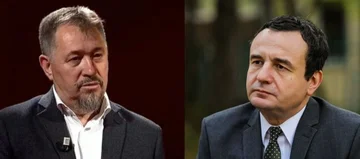
Baton Haxhiu
From some reactions that I hear and read, whose authors are appearing on the task of being human and political are unrecognisable in what they say, primarily because of the positions they represent.
I, simply, know nothing of possible final agreement between Kosovo and Serbia. I don't even know what to talk about. That's the truth.
But I know that some of those who write and have high public positions long for a portion of the KLA General Staff to be punished by the Special Court.
They don't hide it, they do good to hide it.
They speak of righteousness with hysteria in an insolent way, in the name of personal vengeance against a proper name. In reality, though, they are only insulting all who still experience the pain of war crimes.
An answer to these links: I am to be sentenced to anyone who committed crimes. Period.
I'm sorry that to overcome a serious political situation within the Kurti Government, individuals and groups are signed up to cover up their own mistakes, so gebelsian, they build the political cause of peace and the cause of public lynching to me. Putting out of context my sentences.
This group of people, which acts organized in social networking, has distributed unuttered sentences from me and put numbers on the points of non-existing agreement, without me knowing any of its letters.
They've cut parts of the debate, a practice of their already known manipulation, and to make their lie more credible, they've invented points of agreement, putting out of context my sentences for amnesty and the Special Court.
Apologising the damaged families, subject to this terror, and who may have taken it as a favor to my resuscitated opinion by the authors of informed messages, I want to make once again my stand for the Special Court and amnesty, but not by any means amnesty for war crimes.
War crimes cannot be adopted with any political agreement, because they are defined with international treaty, and their amnesty is simply impossible.
Below, I am bringing back the examples I have mentioned in an earlier scripture.
...
Crime must be condemned to strengthen justice and judicial systems. And I'm not having political decisions solved the problems of justice.
After all that was possible publicly and when it was seen that it was impossible to endure longer, because the goal had been achieved, and that the Court was kept and not abolished, I had decided to say my opinion by maintaining absolute incompatibility with what is happening and now being spoken.
Neither the writings with the the thesis of unjust justice nor the reactions to leave Kosovo's ruling guilty of the Special Court, nor the unprecedented response of some public characters, avoiding the large photograph of a historical injustice, which international institutions are doing to Kosovo, do not help justice.
Not even poor Europe, powerless Europe, is no reason to dominate with brutal discours and to carry that discurs of a handful of people in Kosovo to justify the Court in a historically unstable situation.
That's why I'm against Judge.
...
About the amnesty I spoke of
The amnesty I talked about is amnesty as defined by justice, and not amnesty as defined by gebelsian manipulators. These individuals and these groups did not bother to read what amnesty meant, but they rushed to listen to things that I had not said or thought. They stretched “to” and worse the definition of the term I used.
I did not speak of amnesty of criminals who killed my family, nor of criminals who killed thousands of vulnerable children, elders and civilians, nor of amnesty of soldiers and paramilitaries who violated over 20 thousand women, expelled about 1 million Albanians and burned and robbed Kosovo. I didn't talk about this amnesty. Because this would not be amnesty, but the second murder of victims and loved ones.
I spoke of political amnesty, former KLA soldier being imprisoned, tortured and accused of suspected evidence of terrorism and war crimes by Serbian organs, every time it passes through Serbia's territory.
But amnesty for the gebelsians took on greater meaning than definition and its legal meaning, since only as such can it turn into a weapon to attack me.
And if amnesty excludes war crimes, according to all international rules, how is it possible that when it is said by me to mean more than is meant within its legal definition?
Anyone who's taken up as superficially with transitional justice knows that amnesty for war crimes is impossible, and every experiment and attempt to confirm as a regime has failed. Even in Argentina, when it was tried to free the officers of the military dictatorship who had tortured and eliminated citizens from their responsibilities. He has also failed in Chile, following the barbarous regime of Pinocheti. It has also failed in Africa. This has just happened because the amnesty for war crimes does not exist.
So I felt compelled, in the face of families and victims of war, to be humble and to apologize for the turmoil I may have done, as a result of the context of what I said, to explain that the amnesty term used by me is the one that is provided by laws, amnesty that frees peoples of themselves, but not amnesty that pardons the monstrous crimes of individuals and the Serbian state.
For memory
It all started with placing apartheid in Kosovo. This had to be denounced at that time. Therefore, it is clear that the Serbian terror campaign had not started on March 24, 1999, the day NATO marched to bomb Serbia, nor on February 28, 1998 When the Serb massacres were committed in Drenica, not even in 1989.
It was a period of hatred, a time of cultivating racism, of stimulating the false idea that Serbs are superior to Albanians, which lasted at least from 1912 onward.
Of course, in the face of this storm of physical and psychic terror almost a century, Albanians too had in themselves maintained a great hatred of Serbs.
But, that was the submissive's hatred, it was the victim's contempt for the host of arbitrary, the Serbian state.
That's the difference, perhaps the central, in the hatred between Serbs and Albanians.
The victim's hatred of invaders is never the same as that of the conqueror.
Representatives of the international community, who were large numbers in Kosovo, had recently begun the serious process of reconciliation. It was clear that after all that had happened, it was not easy and could not be passed on to daily normality, as if nothing had happened.
After a long time, living together was possible, though difficult.
After the war, Kosovo has looked terrible. And there might have been revenge.
A small part of the people in Kosovo who by barbarous violence had lost their loved ones and relatives, calls and prayers for co-existence with their neighbours in the first place understood them as a welcome from the past.
But how could the common people who returned from refugee camps find black holes instead of rich property? It was almost natural that the sense of vengeance was boiling in everyone's chest. Therefore, the here and there acts of revenge against neighbours had said so too, Bill Clinton, the President of the United States, and repeated it, Joschka Fischer, German Foreign Minister, they were not surprising at all.
But are these crimes for a Tribunal for Kosovo?
The idea of Tribunal
Following charges by Dick Marty, Swiss politician and close friend Carla del Ponte, various international circles called for the establishment of Tribunal for Kosovo. Not for Serbia as a aggressor, but for Kosovo as a victim. Some Kosovo Albanian analysts also adopted this with writing. It was their opinion that they represented. But why was I against the Tribunal?
Jurydically, morally and historically, the idea has no concrete basis, rather it is counterproductive and more than biased. Especially due to the fact that Kosovars -- most of them -- are pro-co-operation with international bodies in dealing with charges of potential criminal acts that may have occurred during the defence fight.
Kosovars have demonstrated this readiness from the beginning, even going without any resistance to The Hague. Having no competencies in law, they have not been able to act themselves in search of “The Verde House”, which falls not in the jurisdiction of Kosovo but Albania. U n NMIC and EULEX have done the job. Or they didn't.
They didn't do it right, because others think so.
Just because of the inability, the inefficiency and failure of this international institution of law, now the tribute and history that will be signed to the coming generations, Kosovo must pay. And, him, being sealed by the country as the victim of genocide instead of eventual crimes.
This is the greatest injustice her allies can commit to Kosovo, the country they freed along with those who are again accused of war crimes today.
Intervention to save Kosovars from genocide was not precedent, but its freedom and the idea of a tribunal has become so.
I don't want with that I am imposing many political and social failures, which Kosovars give the impression that they are counting.
It's about the international report to this country, which, by the actions they do, would seem to have forgotten whether they conquered or liberated Kosovo.
Why these dilemmas?
Why do I think that our freedom is a precedent mosaic that undermines every historical practice, desecrates the logic of every law, that question the morale of any right of human being to protect against evil, aggression?
Viewing the history of problems, the idea of a special tribunal for Kosovo seems meaningless.
A Few Tribunal History
It's written before, but it's worth remembering why every aspect of the idea about the Tribunal comes out absurd. This is just my look, and I may be wrong, but I have my conviction that by experiencing both personal and family experience, all that happened in Kosovo, I have the right to strongly oppose the idea of the Tribunal. Even though it is already firm and is an international contract with the EU. Still, I take a firm stand.
In the “Declaration on German Crimes in occupied Europe” of October 30, 1943, anti-Nazi allies decided that even after the war, mass perpetrators follow. On August 8, 1945, the Nuremberg Charter was signed, the agreement between the world's major countries. The central pillar of this agreement was “Germans who committed serious crimes in other countries will be handed over to the justice organs of those countries. Those who have been high-profile perpetrators of serious crimes but cannot be determined concrete responsibility at the scene will be punished with a later decision in their country - Germany”.
The famous Nuremberg Process, the Eichmann and the similar, opened as the conspiracy of this agreement, which condemned most of the planners and executions of war and genocide of Jews.
Based on this experience and on these practices of the historic agreement, the Tribunal for Rwanda was established, which because of lack of infrastructure and governments that refused co-operation, forced the internationals not to become in the place where the crimes were committed but abroad.
The same situation was presented in the former Yugoslavia, with particular focus in Serbia, as the perpetrators of genocide against Kosovars, Bosniaks, Croats were considered heroes, not aggressors.
In the founding documents of The Hague Tribunal, this was also the reasoning why the judgments would not be held in Belgrade, Zagreb, Sarajevo or Pristina where mass crimes had been committed, but in The Hague.
This historical practice changed with the approach of Carla del Ponte (naturally, in agreement with Zoran Djindjic, as a condition to hand over Slobodan Milosevic and others), which from now on would not persecute only strategists, promoters and executions of genocide, but also their victims.
Not only Slobodan Milosevic and his guard who started war and exercised genocide in the regions of the former Yugoslavia were taken to The Hague, but local army commanders who fought for the protection of the population and resistance to the aggressors.
Some of the KLA commanders ended in The Hague and were released. Meanwhile, the respective countries -- both the aggressor Serbia and the Kosovo victims -- were conditioned to investigate files in case the need is eventually presented.
Serbia, from the judiciary positions, certainly had to act and has not yielded results in this direction. Kosovars were not given this direct opportunity, due to EULEX's presence, which was tasked with clarifying the dilemmas of criminal nature.
However, before I go out to EULEX and Tribunali, it is important to analyse the break-up of the current philosophy of Western law, or criminalisation of the victim who has had the chance to survive.
The most surprising in this process of Tribunal seems to be American, of those who come or live in those more than 30 US states that in their legal system have the so-called “Stand-our-round Lw”, which gives the American the right to protect the threshold and the family from unjust and external aggression and kill.
The principle is the same when he's more massive. Never before the war in the former Yugoslavia, and prior to personalising the legal philosophy by Carla del Ponte, have either the degolantics of French resistance or even the savages of the Red Army who violated thousands of Polish, Czech, Hungarian, and German women, or any militia who protected by Rwanda's Tutsi.
The other that complicates even more the evolution of those who want tribunaals and defenders is the so-called “murder progress in defense of victim”. Westerners also bombed and killed him in defense. Even some army defense commander, even some Albanian civilian, because of the rage after seeing the entire family dead, may have committed murder.
For such cases, even isolated, the law has a duty to accuse, suppose, and condemn such ones.
This, however, does not justify setting up a Tribunal on a country that has fought for freedom because it in this way fabricates the principle that any country can become tribunal.
Thus, it becomes absurd and legally and morally banalized the mission of war crimes tribulals.
Under the EU chapter 23 Action Plan, Serbia has adopted the National Strategy for War Crimes Persecution for 2016-2020. Despite this publicly assessed move, the performance of the War Crimes Department (under the Supreme Court and the Court of Appeals Belgrade remains controversial. The Centre for Humanitarian Law's legal team report, among other things, notes political pressure in cases, lack of transparency and continued procedural violations. Moreover, the report raises concern that for more than three years, the Serbian judiciary has not had results in addressing crimes committed in Kosovo. The last concluded case is that of Lubenik (Prill 2014), expanded later due to other findings for three other indictees involved in the Sik case. However, there are nine other unfinished cases (convincing denial) of crimes in Kosovo related to cases in Pec, Krusha Minor, Savinovoda, Vushtrri, Goden, Kralan, Landovica, Poklek and Rezalla.
In Kosovo, meanwhile, despite investigations by The Hague Tribunal, UNMIK and EULEX are today initiated by the Special Court as additional measures for investigating war crimes committed by the Albanian side.
Furthermore, the EU has never strongly addressed the phenomenon of political recovery of condemned figures involved in war crimes in Kosovo. General Vladimir Lazarevic, sentenced by The Hague Tribunal for War Crimes in Kosovo, currently works as a professor at the Serbian Military Academy training young officers. It has been hosted and recognised by the highest institutional authorities in Serbia on its return in 2015.
At the same time, two other war crimes convicts in The Hague's Interior and Tribunal courts -- Veselin Sljivancanin and Momcilo Kraisnik respectively -- have appeared as public speakers at the events of the Serbian Progressive Party and the Youth Centre in Belgrade. Another convicted war crimes against Albanian civilians in Kosovo, Nikola Sainovic, continues to have regular public presentations as a member of the central board of the Socialist Party of Serbia.
Also, Danica Marinkovic, former investigative judge in Kosovo and witness in favour of Slobodan Milosevic, Sreten Lukiqi and Vlastimir Gjorgevic in The Hague, has become part of the Anticorruption Board.
For crime tracks and amnesty
I'm mentioning village names, not people and families. And no thrilling descriptions.
Meya, Poklek, Obria, Licoshan, Gjakova, Peja, Rogova, Malisha, Skenderaj, Prekazi, Kijeva, Decani, Glogojni...
Who has handled these cases and violations in postwar history?
Who has conditioned them, and who will condemn these cases? Some will fade, some will die and some will not be treated. And where are we? Can we seek justice with the power of the State? These cases must remain until dawn.
But can there be amnesty for other things?
Not running from justice
KLA commanders from all areas have been sentenced by Kosovo courts. Compared to Serbia as the aggressor, Kosovo and international justice institutions have brought these people into the process:
Sabit Geci with his group 30 years in prison.
The Llap Group (ten years in prison).
The Dukagjini group was sentenced to 40 years in prison.
The judgments of Fatmir Limaj and others.
The verdicts of two Drenica groups (centen years in prison).
Over 50 names of war commanders who have been convicted of banal fact.
Repitulation
UNMIK and EULEX have failed because they have had transitional justice in their hands.
Personally, I believe in European idealism for life and order and law, but this has failed.
This behavior has left false impressions of its commitment to order and law.
The impression in countries with unfinished conflict is stronger than prolonged and detailed rational ideas in drafts never used.
You have lacked the political, social and vision of the future of this country's justice.
Is that why Kosovo is sanctioned? For us, its citizens, who have fought for freedom and against genocide.
Therefore, the Tribunal has no historical, no legal or moral basis, that defeats Kosovo.
The headquarters of this mixed commission at any cost should be in Kosovo and nowhere else.
Kosovars -- whether commanders or others who killed -- must be punished in Kosovo.
There can't be Tribunal for a people you protected and fought for freedom.
The peace agreement, on the other hand, should also have an apology within but not an apology for those who committed war crimes and a release from the responsibility of the state that designed these crimes.