7 minutes ago
FH: The lack of leadership in the battle for democracy
Periskopi(6 years ago)
(6 years ago)Democracy is under attack across the globe, and the effects are evident not only in authoritarian states such as China, Russia and Iran, but also in countries with a longer experience in protecting fundamental rights and freedoms. So says the report “Freedom Worldwide 2020”, published Wednesday by Freedom House [...]
So says the report “Freedom in the World 2020”, published on Wednesday by Freedom House ʹ the nongovernmental group, headquartered in Washington.
The report also raised the alarm for a minimising the commitment of governments to plurality a determining feature of liberal democracy.
“Ethnic, religious and other groups have carried the burden of state abuses, both in democratic and authoritarian countries. Lack of control causes such violations to threaten the freedom of all societies”, the report says.
The two most outstanding examples in the report are China and India.
In China, the report highlights the multiyear-old regime campaign for cultural annihilation against the watery minority and other groups, mainly Muslims.
As for India, it is noted that there is the biggest decline among the world's 25 most populated democracies.
India has long been seen as a potential democratic counterweight against authoritarian China in the Indo-Peace region, but the current government's alarming avoidance from democratic norms cloud the value-based difference between Beijing and New Delhi.
Examples of this are taken by surprise revocation of the autonomy of the predominantly Muslim Kashmir region, the adoption of the discriminatory Law for citizenship, as well as the subsequent crackdown on protesters who opposed it.
The report stresses that democratic processes in the United States are also under threat.
“Concerns during 2019 include changes in rules that weakened asylum seekers' rights, new election intervention evidence, and escalating clashes between executive bodies and Congress on their respective competencies”, the report noted.
“India and the United States are the largest and perhaps the most influential democracies in the world and their departure from liberal democratic ideals is sending exactly the wrong message”, says Mike Abramowitz, president of Freedom House.
“If major democratic powers fail to provide strong examples and provide constructive guidance, it will be impossible to reverse global trends that threaten freedom for all societies”, Abramowitz says.
Kosovo, partly free
Freedom House's report even this year lists Kosovo among the partially free countries, along with Albania, Northern Macedonia, Montenegro, Serbia and Bosnia and Herzegovina.
In the play for Kosovo, the report stresses that <x0 elections have brought the nationalist Vetevendosje party to power, where it has an opportunity to change culture and corruption in the country”.
As for Serbia and Montenegro, the report says that independent journalists, opposition figures and those perceived as enemies of the government have faced harassment, threats and sometimes even violence.
“The public's disappointment with ruling parties has sparked major protests in both countries, but they failed to bring about any significant changes”, the organisation says.
Part of the report is also dedicated to northern Macedonia, where the “country held competitive presidential elections, helping repair former Prime Minister Nikola Gruevski”'s undemocratic heritage.
Regarding the overall situation in Europe, the report says that the “progress of liberal democracy in Europe has come under serious pressure in recent years”.
“Directors and populist parties in Central Europe maintained the pace of attacks on independent institutions this year”, the report said.
Protesters worldwide call for change
Freedom House says protesters worldwide call for change.
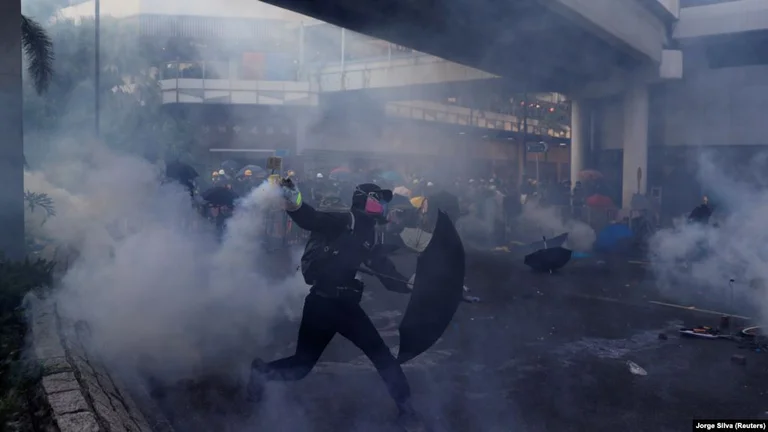
“The outbreak of mass protests through a series of political environments over the past year stressed the universal human desire for fundamental freedoms and good governance. In free, partially free and unfree countries, people came out on the road to express dissatisfaction with existing political systems and to seek changes that would lead to better, more democratic”, the report said.
Here, protests in Hong Kong, Algeria, Bolivia, Chile, Ethiopia, Indonesia, Iraq, Lebanon, and Sudan are mentioned.
However, the report says that these movements were often raised against deeply entrenched interests in these countries, and so far they have not brought about a major improvement in global freedom.
Without greater support and solidarity from consolidated democracies, protest movements requiring freedom and reform are most likely to undergo authoritarian reactions”, said Freedom House Research Vice President Sarah Repusci.
Data from the world report “Freedom 2020”
Of the 195 estimated countries, 83 (43 percent) were valued as free countries, 63 (32 percent) in part cheap, and 49 25 percent are not valued free.
The report notes that people in 64 countries suffered a deterioration of their political rights and civic freedoms in 2019, while improvements took place in only 37 countries.
While democratic countries are showing reluctance in supporting democracy and freedom at the international level, authoritarian powers have expanded their global influence through wars with groups controlling them, election intervention and censorship beyond their borders, the report points to.
“Raport once again shows clearly that democracy is declining”, Abramowitz said.
Political rights and civic freedoms are threatened in free societies and oppressive ones. It is possible to change the direction of this course, but this will require co-ordinated efforts by governments, pressure from people and partnership with the business community”, he said. /rel/