15 hours ago
Europe's Weak Heart
Periskopi(6 years ago)
(6 years ago)Many languages are spoken in Europe, but none of them are the language of global power. More than bad luck, it's a historical disregard, just to predict the osca Wilde. It says: George Pagoulatos ) University of Athens, the new European Commission under the direction of President Ursula von der Leyen, has set up [...]
Many languages are spoken in Europe, but none of them are the language of global power. More than bad luck, it's a historical disregard, just to predict the osca Wilde.
It says: George Pagoulatos University of Athens
The new European Commission, under the direction of President Ursula von der Leyen, has established the scope of global ambition, identifying itself as “geopolitical”.
The previous commission, under the direction of Jean Claude Juncker, traded itself as <x0-political>”, meaning a smarter management of the EU- particularly Greek crisis crises. “Political Commission” Juncker's was successful in the fact that the worst was avoided. Will this commission be just as successful?
The departure was far from ideal. Since one day, Europe had to deal with the consequences of US President Donald Trump's unilateral initiatives: abandoning Kurds and the Turkish invasion of Syria; the Libyan crisis where Turkey is sending troops as well, and certainly the arrogant murder of General Qasem Solejman by an American fears, which did the least of what was left of the deal for the Iranian nuclear programme dealt with by one of the most important joint achievements of the EU and the administration Obama.
Iran is now moving faster towards completion of its nuclear programme, and the Middle East is slipping towards a new cycle of escalation. So all these European reactions, if any, were in subjection. In the absence of joint decision-making, the EU has been replaced by tributary formations E3HBritania, France, Germany) trying to save a glimpse from common European politics.
This is a shame, because Europe remains a force of good on the planet. On key issues, such as dealing with climate change, the EU is world leaders. The European Green Agreement is the most ambitious programme formulated for this purpose, includes a wide range of policies, mobilization markets and answers to the concerns of European citizens.
It's a plan Europe should be proud of. But in many ways, as is often the case, Brussels' noble ambitions stem and are based on other European capitals.
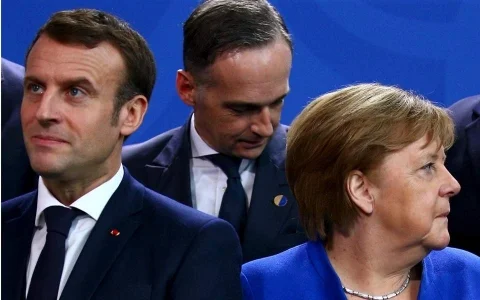
The main factor of paralysis is the already dysfunctional relationship between Paris and Berlin. Strong Franco-German co-operation has always been the heart of European integration. No step has been possible without the co-operation of both countries.
President Emmanuel Macro, the only leader with a European vision, has no one to talk to. Berlin accuses him of irrational behavior in seeking attention, but the responsibility actually lies mainly in Berlin. Macron continued with reforms in France, but Germany suspended him in the Eurozone. The Eurozone's “Budget” was said for a name. Banking integration and joint deposit management schemes are advancing at a glacier rate. The selection of the “s of the common security” is deeply frozen.
Without further integration into the euro, Europe will not be able to convert trade weight into political influence and its unified currency into symbol of its strength. It will remain vulnerable to the global powers that choose to use their own financial superiority and global currency.
At the root of the problem lies the weakness of the German government.
First because after a long period of growth, its economy is slowing down.
Second, because the once dominant Chancellor, Angella Merkel, is at the end of her career, and as in these cases she has the status of the one to replace.
Third, because the weakness of the smaller partner standing in the coalition for fear of a withdrawal will lead to an even worse performance in the election.
Even deeper, German weakness is rooted in the German competitive pattern. An economic growth led by the dynamism of its exports exposes Germany to external pressures and fluctuations in global trade. Its extraordinary commercial surplus, a symbol of German dynamism, is paradoxically the source of weakness. And of Europe as well.
German exports and car factories in China make Germany sensitive to Chinese pressure for 5G. Beijing has threatened that if Berlin calls it a 5G security threat, then China will retaliate, considering German cars dangerous. Massive German exports to the U.S. make Berlin weak to blackmail Trump, as long as it is Germany that loses most of a trade struggle. And the volume of exports and investments in Turkey makes Germany hesitate to impose stricter sanctions on Ankara, even when these are necessary to neutralise Turkish militarism in the region. Economic power is likely to foster political excitement.