21 hours ago
Pilgrims at Amos Oz's grave

Periskopi(7 years ago)
(7 years ago)It says: Brian Latife from the first day we arrived in Israel, I let my companion know that I would not leave without visiting the tomb of Amos Oz, the great Jewish writer who died December of last year. I wanted to make a pilgrimage to the last resting place of this [...]
From the first day we arrived in Israel, I told my companion that I would not leave there until I visited the tomb of Amos Oz, the great Hebrew writer who died last December. I wanted to make a pilgrimage to the last resting place of this great man, in whose books, in addition to great aesthetic pleasure, I have always found the constant commitment of a great human intellectual to remind him of nothing less than Volterin. If there is a book that, by the power of argument and explanation, can be compared to “Volter'sTolerance Treaty”, it's the book “How to cure a fanatic” Amos Oz.
My companion promised me that we would find time to make this pilgrimage, and on the last day of the visit, after leaving Tel Aviv, we made our way to Kibucci Huldah, where Amos Oz's home and his grave are located.
Huldah is one of Israel's best-known guitars, as far as the painful history of it, as well as the fact that it became known by Oz himself and his novels, particularly from his autobiographical book “a tale of love and darkness”.
Oz has come to live in Huldah since his early youth, never left her, and his last wish was to be buried there.
After leaving behind the highway linking the large cities of Israel, we set out on secondary roads that passed through a large field in which the evergreen could be seen. Early in Israel's State, this vast field had been half a desert and now gave you the impression that you are passing through some Italian Mediterranean field.
After 45 minutes of road, we took a different turn, and here comes Huldah. The man who wouldn't know it was a kid would think it was a tourist village. Everything there was to cause that feeling. Huldah is made up of a number of houses of different sizes, of those in the form of small cottages that look like homes of poor people to those that look like villages of rich people at first sight. The first is the kid's property. The second are private homes of its members. Homes are surrounded by beautiful gardens, which give the country a sense of tranquillity. Their fields are open, without clearly defined limits. This is certainly done to prevent privacy from overshadowing the social character of the kickback.
My companion, who knows the country well, leads us to the house that David and Rusty Chinast, husband and wife, the first neighbor of Amos Oz.
Ruty and David are very happy to know the reason for the visit. We walk into their house and cool water, which brings us Ruty, we start the shoot. David tells us how he and his wife got acquainted right here in Huldah about their first life as parents in a small house located a little farther away and the feeling of loneliness they now have because their two children have moved to the United States.
After we rest from the heat of the road, David invites us to go out to see Amos Oz's house. It is a small two - story house that leaves the impression of a house that they have built without too much minding the architectural and aesthetic tastes. It seems incredible that a writer like Amos Oz, who had achieved the highest peaks of aesthetic speech, spent much of his life in that house. Unbelievable, but completely true; and there are two reasons to explain that fact. First, the home is the property of the kinucus, in whose vital philosophy we find the spirit of modest life, to a degree similar to life in the religious communities of the Franciscans. The second, agrees with the first: Amos Oz himself did not want life in luxury. He believed in modesty, and this is one of the basic reasons for his love of life in the bush. Ruty tells us we can't go inside the house, because she's now inhabited by another family. There is an iron chair in front of the house, completely rusty. Rusty tells me Amos Oz sat on it a lot. I sit down, trying to show the pilgrim's gesture that will touch the footsteps of his saint.
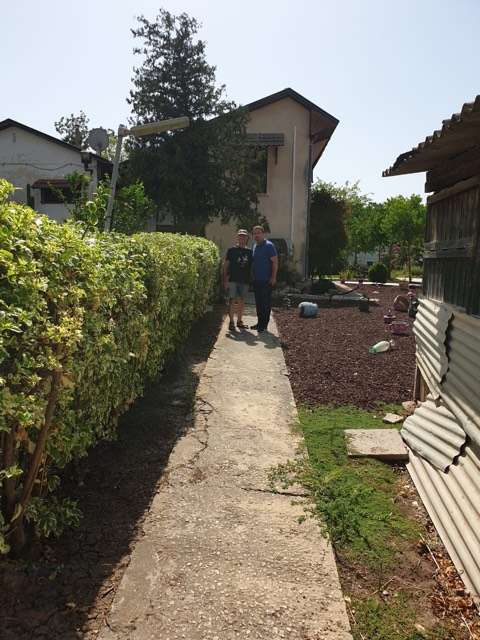
No more than 100 yards away was another old cottage, and so was the rubber property. Someone who has no information about the nature of life in the bush and the man who lived in that house would certainly think that that house was built by some poor family, just to have a roof over his head. The house is divided into two parts, one of which, with the permission of Kibucci Huldah administration, Amos Oz had adopted it as a working room while writing. There he had written some of his most important literary and essayistic works. In front of it is the cottage in which David and Ruty had begun their married life as members of the kibuk. Pointing to the two houses' common courtyard, David tells us: “Here we met with Amos every day, we drank coffee together and talked about big and small matters, then he went back to his room and kept on writing for hours. Now that he's gone, every time I walk by, I feel kind of upset. The door to the room that Amos wrote is locked, and all that's left is memories of”.
I want to feel the frustration, which contains David's story about the neighbor who doesn't have it anymore, and near the door of Amos's room. I pull the handle, but it won't open. I knock once, twice, but no one on the inside answers me. Meanwhile, David's response, which is a few steps behind me: “Amos is not there”! David's words cause us to laugh at the situation that we both acted spontaneously, but those laughter do not take away the sad feeling of the eternal absence of the resident living inside that room. David adds: “Should have come earlier, death was faster than you”
I light a cigarette, and I sit on a large stone in the shade of trees between the writer's house and that of David. Over the course of many years, seated on that stone, both friends had enjoyed morning and evening coffees together during their many long discussions. This part of David's confession reminded me of some of the description that Amos Oz gave to the social life of Kibucci Hulda, in the years he came in: “In Huldah I realized that even the most farmer's farmer, read books at night and discussed them all day. As they had olives, they argued fervently about Tolstoy, Plehanov, and Bacon, about the permanent revolution against revolution in one place, about Gustav Landauer's Social Democracy and the eternal tension between the values of equality and freedom, and, between these two, the search for the brotherhood of mankind. As they arranged their eggs in a jumble, they discussed how to revive ancient Jewish festivals for celebration in a village environment. As they cut down rows of vines, they ran for modern art”. That spirit still continues in Huldah, and we can take David's son as an example. He's grown up working on the kidbuci fields and has now gone to the U.S. to finish a dissertation study on nuclear physics.
Not only Huldah, but also other guitars throughout Israel, were established by Jews coming from European cultural elites. They joined the dream of the ancient homeland of the ancestors, with their Western outlook, and this union took the lives of Israeli democracy, which, in fact, today is the only real democracy in the Middle East.

We leave the courtyard of the great writer and David - directed to the building that serves as Huldah's administrative center but also as a museum in its history. David tells us all that story: how Huldah was founded, what were the initial difficulties, then the enmity of the surrounding Arab tribes, the attack on it by these tribes in 1929, and where the commander who organized the protection of the quiboc was killed, then the reactions of the British who controlled the entire area and the difficult years after the establishment of Israel's State. Ruty is with us all the time and occasionally intervenes to fulfill David's confession with any details forgotten by him. David realizes that the heat is again beating us, so he suggests that we go to the nearby market for refreshments. After we do this, we return to David's house, pick up cars, and head toward Huldah's cemetery. Many of its citizens, dead in time and under different circumstances, including those killed in Israel's struggle for independence, are slaughtered there. The youngest tomb there is Amos Oz's tomb: a simple concrete plaque, a simple sign showing the man lying there and some flower vases, which the heat has dried up. David says that the tomb will not be left in this state, even though it completely agrees with the demands of Amos Oz's vital modesty. The great writer who spent his entire life in modesty materially would surely not want to have a tomb that reflects the opposite of this life. David tells us that in Jewish tradition the one who visits someone's grave in honor of him would do well to place a stone on his grave. I respect this tradition, and in a few minutes I remain silent on pilgrimages near the grave. There lies a man who, with his stories and ideas, has greatly influenced the way I see the world, and today I have come to thank him for that. To my friends who are with me, I tell them not to spoil my moment of meditation. They disperse through the cemetery as Ruty goes to open the water source that is there and begins to water the grass on the tombs of Israel's martyrs.
At the end of meditation, I leave the cemetery to see the view of it. On the east side lies the vast field of Huldah, planted with grapes, and on the west side is the wine factory. Between the field of vines there is a way, on which are lofty palm trees. Ruty tells us that the street is called the “Washington Street”, because that's where a lot of Hollywood film scenes were shot. Among the renowned actors and producers, there was Natalie Poortman, while working in the film “A tale of love and darkness”, based on the autobiography of Amos Oz, with the same title.

On the other hand, beyond the field of vines, lies Theodor Herzl's Forest, founder of the Zionist Movement and the idea of creating the state of Israel. The brilliant recognition of dramatic developments in Europe, Herzegovina and the premonition that Jews could no longer exist without having their national state. He worked for years on the idea of restoring Jews to the ancient homeland, from being forcibly expelled from the Romans two thousand years ago. Herzl died in 1904 without seeing his dream come true, but his many friends and associates raised funds to buy the land in which the forest is now located, to which he was named. It also houses the Herzl Museum and monuments in memory of people who lost their lives in the war to make his dream come true. When others scoffed at her plans, Hertzl said: "The dreams and the works are not as different as many people think. All the works are dreams at first and are made of dreams at the end of” Such is Israel today - a dream come true, inspiring the dreams of people around the world. Such was Amos Oz, a writer who, as a rare person, managed to find and live the harmony between love for his country and universal ethical appeal to respect another's dignity. I look at his grave for the last time and return to greet and thank Ruty and David for giving meaning to my intellectual pilgrimage to the tomb of Amos Oz, which, of course, remains one of the greatest writers and intellectuals of our time.