4 days ago
Russia is about to invade a state in Europe

Periskopi(7 years ago)
(7 years ago)At first, he brought Georgia's land back to Ukraine. Vladimir Putin's next goal will likely be a country in Europe that is not part of NATO. Not many observers would view the coldest seaway as the hottest geopolitical point. But this can [...]
Not many observers would view the coldest seaway as the hottest geopolitical point. But that can change. Last week reports were released that Kremlin's new policy will require all international naval ships to alert Russia 45 days ago so that they can enter the North Sea Road that connects the Pacific Ocean to the Atlantic through Arctic waters in northern Siberia. Any ship on this road, where Russia has invested too much in sophisticated military infrastructure, will have to have a Russian naval pilot aboard. Ships that violate these regulations will be prohibited by force, or ) under undesigned circumstances étrextremé é will be eliminated “x1>.
The last of the Kremlin's threats has already gone unnoticed, perhaps because it is no surprise. Russian officials justify new maritime resources with thought-intelligating explanations, claiming that the multi-x0 sea operations in the Arctic of various foreign states” require such an answer.
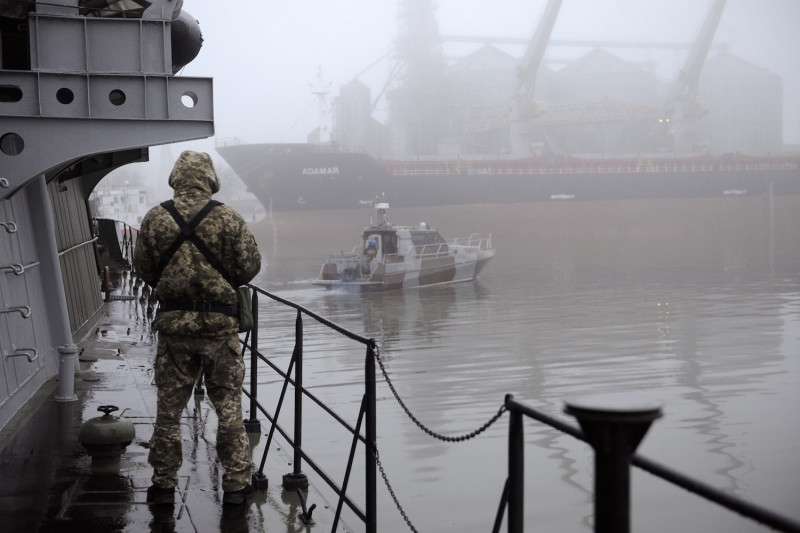
Ukrainianoldier stands a giant military boat called “Dondas” moreed in Mariupol, Sea of Azov port on November 27, 2018. Three Ukrainians were observed off the case of Creia by Russia forces, which figured on and executed Kyev's ship after several years of defense. Here's what is known about Sunday's incident. (Photo by Sega V O LSKII / AFP) (Photo Credit should read SEGA VOLSCII/AFP/Getty Images)
This is the same tactic that Russian President Vladimir Putin has used to justify his military adventures for years ago: From Georgia in 2008, Ukraine in 2014, to Syria in 2015, Putin has always blamed Russian aggression on the West. Media supported by the Kremlin amplification this message, fearing the audience by NATO and labeling the West's denouncing to Putin's actions as evidence of “rusophobia. ”
A lot of people wonder what Putin gets from the delay ahead of this gear. In violation of international norms, it has become global link. American and European sanctions have made it even worse for the declining Russian economy to add questions about why Putin would pay such an expensive price to receive even small portions of territory.
Those who have tried to answer that question have missed the point. In Crime, Eastern Ukraine, South Ossetia, or others, Putin considers them Russia's courtyards, gaining territories has never been a goal in itself. Putin's goal today is the same as when he invaded my country in 2008: to tighten power levers in Russia. Whenever Putin's inner popularity decreases, it either escalates an existing conflict or launches another campaign of aggression.
And obviously that works. Putin has ruled the largest country in the world for nearly two decades, consolidating power after every international crisis he has caused. Common Russian voters may find it hard to survive on pensions from $200 a month, but Putin's base feels proud to be living in a superpower.
Putin is also predictable and logical: By occupying a weak neighbour, he gives him a boost to popularity, rather than the disstopic improvement of the healthcare system in Russia. It is not coincidence that his popularity peaked in 2015, after the Crimea annexed. Later that year, as the Russian economy was declining, the intervention in Syria served to promote patriotism. Moreover, Russia's actions in Syria marked Putin's dance from military adventure to former Soviet states in empowering projections beyond Russia's (U.S.) citizens.
To know these steps, Putin took sharp criticism from Washington and Brussels. But accusations from outside Russia only enhance its inner popularity. With every foreign choice the Kremlin mixs, every violation of human rights in occupied crime, and every time Russian soldiers push their thornloaf wire to Georgia, the standard answers to the U.S. and Europe diplomatic expressions of deep concern
From Georgia's invasion to the hybrid offensive in Ukraine, Western leaders have marked red lines after red lines Putin violated without conviction. The weakness of international norms, of liberal order that many in Washington and Brussels implement for little protection, makes Moscow appear stronger. In the eyes of his supporters, Putin is bluffing the West.
But the status quo cannot hold any longer. If we have learned something from the last two decades, a new crisis appears on the horizon. According to a March 7th survey by Russia's Public Opinion Research Centre, Russian voters' confidence in Putin has dropped by 32 percent to the lowest level since 2006.
Putin has escalated provocations in recent months until his popularity has marked a decline. In November, Russian forces shot and stopped three Ukrainian naval ships trying to cross from the Krich Strait to the Azov Sea. More than 100 days have passed, and the international community's condemnation has been forgotten. But 25 Ukrainian sailors who were arrested during the incident remain in illegal custody by the Russian state.
The violations of Putin's law and standards at Russia's dealt with no longer seem to shock the world. He has already revised Europe's borders by force and has thrown it away. Now, to provoke the wrath of the West, I have to do something even more scandalous.
The question is not whether he will attack, but who. Some point to Belarus, but Putin would earn little by showing force in a country most Russians already consider an integral part of Russia. Some predict it could be one of the Baltic states, Estonia, Latvia or Lithuania. Putin certainly sees the small Baltic countries as threats; after all, they are functional democracies on the border with Russia. But for now, Baltic is safe for two reasons.
First, the new front of Russian aggression is unlikely to be a NATO ally. Inconsistent Western responses to taking territories from Moscow have only strengthened Putin, but he is not brave enough to risk facing NATO's Article 5 that could lead to a conventional fight against the US-led coalition. Putin knows where the heels are not. If he did not understand it, he would not survive that long.
Second, Putin's new adventure will most likely be outside the former Soviet Union. The West has eagerly acknowledged its neoimperialist ambitions in the region. Further incidents in Ukraine, Georgia or other non-NATO member states that were in the USSR would sound like deja vuAnd that would not strengthen Putin's position.
I've had the disaster of getting to know Putin better than most people. Having this good knowledge of him, I predict that escalation will occur in another direction.
Russia's most likely goal in the near future is either Finland or Sweden; even though both parts of the EU, none is a NATO member. Attacking a country that is a member of NATO, Putin does not risk a proportional response, as Nathan 5 of Natos predicts. But by attacking a European country, he can expect a great reward from public opinion in Russia. This is a simple analysis Putin has undertaken, open, many times in the past. Any Russian forces investment has paid for the respective divisions. Finland and Sweden meet these requirements.
I don't expect Russian tanks to step foot on Helsinki or Stockhol. But it would be too easy for Moscow to take up a piece of land in any Arctic enclaves or any small island, such as Gotham, Sweden, considering the strategic skills Russia has built in its northern part. After all, who would go to war for a frozen island in Baltic or for part of Finland's tundra? NATO would not, but Putin would because the profit is great for him.
Russian aggression on Scandinavian territory... countries that everyone in the West sees as part of the West... may seem to be overblown. However, it wasn't far from the prosecution of the Crime that I predicted, it caught everyone as a scenario for the end of the world. Years ago, Russia's invasion of Georgia, despite my warnings, also caught the world by surprise.
Former Soviet states, even if they are NATO members such as Estonia, are widely perceived as non-Western. This perception may be incorrect, but in politics, perception is often worth more than reality. For Finland and Sweden, however, perception and reality are linked. They are not former Soviet republics; they are definitely parts of the West.
From Georgia to Ukraine, Syria and beyond, Putin's trajectory has been clear. By challenging the norms imposed by the West, he has progressively taken greater steps towards self-emanciating. But he will achieve full liberation only by confronting the West directly.
That may sound shocking, but Putin has shocked the world in many cases. The West cannot allow itself to be caught unawares again.
* Saakashville is former president of Georgia from 2004 to 2013. /Periscopi