a day ago
What did the young man asking “do with speech, do you want to talk?”

Periskopi(7 years ago)
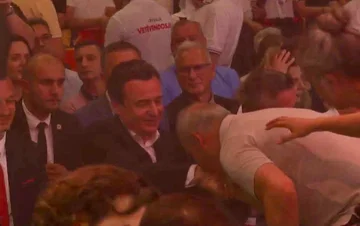
(7 years ago)The 2014 central election had won the Democratic Party of Kosovo [ PDK. Renowned national television “KTV” had gone to this party's raid to record the fan's party. In one village, this television had caught some drunken people dancing cheerfully. The clothing can judge their status. [...]
The 2014 central election had won the Democratic Party of Kosovo [ PDK. Renowned national television “KTV” had gone to this party's raid to record the fan's party. In one village, this television had caught some drunken people dancing cheerfully. The clothing could judge their economic status - poor people. In that same election, the same television set up another chronic, featuring two young people at the party, one saying <x2... Congratulations Malisheva, Drenas, Kosovo! ” while the other requesting permission to speak.
These videos became viral in our digital space, as many as five years later people in question become the target of scorn.
But what makes these two videos significant? Two things. First, it is the motive of the holiday, while the second is the emphasis reflecting the region where it came from, Drenica.
KTV reporting on both cases can easily be observed by the racist tendency to humiliate a group of people with specific regional affiliations. This television, however, is the most professional in the country, without the thread of hesitation, identifies drunk people in inappropriate positions. In fact, the camera is seen asking for more gestures and more words to satisfy society's racist diversity toward these people.
The other chronicleric, which today is even more viral than the first, presents a young person who repeatedly asks: “ABBA swears, do you talk to me?” What's so terrible about this video? Let's make the new citizen of Pristina, who the voice '%a' has replaced with that '%o [a language evolution that can be seen with the naked eye, within the last four decades]: “A bon me talk, a bon me talk?” Would such viral videos be made? Never. Rather, it would be viewed as a civilized act.
So we know very clearly that in the case we are laughing [in fact, when laughter hurts the other person, it can be scoffed out] through provincial and racial prejudices [not having to deal with another race, but with the perspective that it says there are elements of elliatic, genetic that make it worse, weak, and disparaging one member of another group of people].
In our case, because racism is known to us and unsavory in the public realm, it appears through stuttering, cynicism, and money, which we refuse to undo. In other words, we keep them out of our minds.
But the strength of such predators is remarkable within a society that has no meal and no thinking tradition. Inside a well-mannered society. Haygars are discurs elements that are widely allowed as indestructible and unexaminated, corrupt and eliminate values we claim to believe in. Ask most of the people who keep making fun of these people in the video would rarely be found to be racist. In the past, he has learned that it is bad to declare yourself a racist and naturally denies such a label. But trends are in circulation and racism even indirectly can be entered into the public realm and done in fashion, and the same will be listed within such political groups.
Since racism and fascism in the political history of the Kosovo Albanians was unstated, we can imagine that all of this originated in international racism. A Drenica citizen is not despised because he supports him PDK, but because it's from Drenica. And in part, The PDK is not despised because it has made bad governance, but because its leader is from Drenica. Now, this party has made reforms in its image, bringing increasingly urban people to the fore, and election results despite any failure of its scandal can again be surprising!
Why? Because there's a mass of mostly poor voters who can't change their accent within a decade according to market demands. There is a mass of voters who feel overwhelmed by social prejudice. And that they find rest within a party that explodes these profound prejudices. On the other hand, even the mentioned provision that operates with such taunts would change the thought of The most urban PDK.
It produces pressure and power. It produces oppression and powers. And from this angle, he who is oppressed is not the scoffer, but the ridiculer. The one who's ruling, isn't the new one who asked the irresolute “a does with the verb?
Haygars and abusive speech have tremendous strength in maintaining our provincial, sexist, and generally in scheme of printing and privileges. They are not unpolitical and subject. Rather, they are political and degrading knowledge.