4 days ago
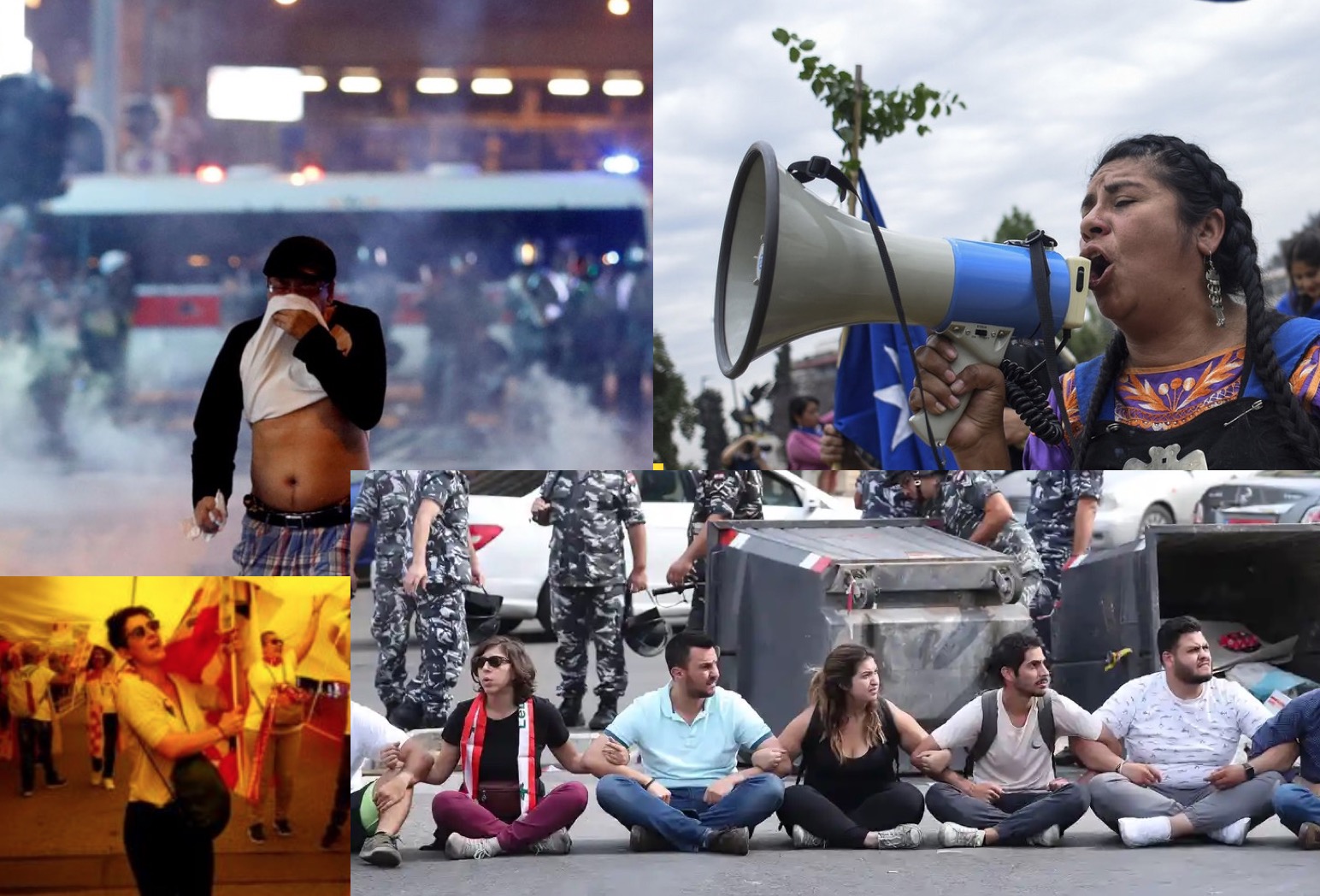
Barcelona. Santiago. Beirut. Hong Kong. Why did the world go out on the street to protest?

Periskopi(7 years ago)
(7 years ago)The army on the streets of Santiago in Chile, Barcelona's Urquinaona Square, barricades on the streets of Beirut: The world seems to be on fire. These images of the violent riots of the last days are not isolated. They were preceded by similar scenes in Ecuador, Haiti (where the popular uprising continues), Iraq, [...]
The army on the streets of Santiago in Chile, Barcelona's Urquinaona Square, barricades on the streets of Beirut: The world seems to be on fire. These images of the violent riots of the last days are not isolated. They were preceded by similar scenes in Ecuador, Haiti (where the popular uprising continues), Iraq, Egypt, Indonesia, Hong Kong and Colombia, not to mention last year's movements in Zimbabwe, Nicaragua, France, Romania and Serbia.
Of course, these events can be seen as a result of local movements, born of specific situations: poverty in Haiti, Chilean right militarism, economic dollarisation in Ecuador and Lebanon, the Spanish government's refusal to accept the existence of a Catalan issue, or democratic aspirations of young people in Hong Kong. It's an accurate reading, but maybe it's not enough. Local movements fighting for democracy and for a more just society have always existed. But the situation is special, because the protests are all erupting simultaneously, and it is inevitable to imagine that they are related.
The link between them could be detected in the economic crisis that hit the world between 2007 and 2008. This crisis began with the bankruptcy of the American bank Lehman Brothers on September 15, 2008, had deeper consequences than experts tend to admit, and its effects still feel. It is not a simple financial crisis: it is a crisis of neoliberalism, a model of capitalism management, which is based on the state's submission to capital, economic financing and commercialisation of society.
Like the crises of the past thirty - seventyth century, the current crisis challenges the functioning of capitalism. These stages are often very long and are accompanied by period of revolt. In the book “Overwhelming”, historian Adam Tooze explains that the events in 1929 were the culmination of a capitalism crisis that had actually begun during World War I but that had emerged only after the conflict. Similarly, neoliberalism was imposed only in the 1990s, twenty years after the decline of the old economic paradigm.
Deep crisis.
Today we are facing a long crisis, which has become even more serious and deep, because the neoliberal system is struggling to survive. And this war is leading the world to the abyss. It is true that neoliberalism has survived the shock of 2008 and has been returned by proposing solutions for the world, such as austerity measures of saving and <x0 structural reforms” designed to destroy the workers' protection systems and weaker categories. In an effort to remain dominant, however, he made his fall even more evident.
This tendency was first manifested in the form of a forward, towards economic growth, promoted above all by China, and its anxiety about continuing to promote Western demand, which is essential to its economic system. This outlook ahead has caused an industrial overproduction that has dramatically exacerbated the climate crisis. Some data is enough to create an idea: in two years, China produces more steel than it produced in 150 years by the United Kingdom, and more cement than that produced by the United States throughout the 20th century. This strategy has failed because it has ended up damaging developing countries that supply China, such as Brazil, Argentina, Ecuador and Venezuela. The governments of these countries could no longer rely on the export of raw materials, and had to adjust their policies.
The other factor that has saved neoliberalism has been a monetary policy that has blocked any form of fiscal incentive in Western countries, and that in reality has only helped the financial sector and large multinational companies. This rescue plan for neoliberalism has failed. The world economy has not returned to growth and productivity is at a low historical level, despite the technological revolution. The private sector invests very little, and often makes it worse. For several months, the global economy has entered a new phase of slowdown.
Internal Inequities
Again, governments are trying to avoid recession by helping rich people and businesses, and this further increases in inequality. According to this logic, in fact, every time an adjustment is needed, more and more effort is required and adaptive by those already living in difficult conditions: a tax is imposed on the use of hatsapp for Internet calls to Lebanon; fuel subsidies are abolished in Ecuador or Haiti; the price of public transportation increases, as happened in Chile. All these measures make it harder for citizens to work and earn a salary.
In all countries, inequality gets deeper. This is the conclusion reached by economist Branko Milanevic, who in the book “Global Injustice” (Louss University Press 2017) predicted a return to class warfare. Now we know he was right.
For a long time, we thought that criticism of neoliberalism was a “privilege of rich”, reserved for the most industrialized countries that did not understand the advantages this system brought to the rest of the world. From a point of view, increasing inequality was the price to be paid for economic growth and development, and it had to be accepted so that the populations of developing countries could escape poverty.
But now this thesis is no longer functioning, for the protest begins right from developing countries. The first signs came in 2013 to Brazil, shortly after the first - class market had collapsed, with unprecedented mobilization against Dilma Roussef's attempt to increase the cost of public transportation. That wave has spread and today affects countries that, as in Chile's case, have long been presented by international institutions as examples of success and stability.
In these countries, prodigation from neoliberalism has been exacerbated; with its need for continued economic growth and competition, this model ended on a dead end: if economic growth slows down, inequalities emerge, while improvements in living standards achieved in the past reduces competition, all in the context of the global trade crisis. The measures previously required have already made us realize that approaching living standards between rich and developing countries, the great promise of neoliberalism, is a benefit. A single solution is proposed to the people of those countries: a new poverty.
But all of this doesn't matter to neoliberalism. Blocked by its logic of growth, it is caught up in theories such as the Coase Theorem and the Kurba Laffer ʹ, under which the problem of distributing wealth must be separated from economic reality. And I can do it, thanks to another of its fundamental features: “definition” of democracy, that is, the idea that economic issues cannot depend on democratic elections and have to be protected from citizens' humor or, if we quote French President Emmanuel Macron, from the sad “passions”. But today, in the face of increasing inequality and problems posed by global warming, this division has no meaning. After 50 years of supervised democracy, people seek to consider their needs, not those of markets or investors.
The Only Solution Left
The current crisis of neoliberalism has three faces: ecological, social and democratic. The current economic system is unable to address them. It proposes responding to climate urgency through markets and reducing the consumption of the weaker. The social and democratic crisis reacts with apathy, knowing that to devote yourself to these problems, it would be necessary to change economic paradigm at the bottom.
Climate investment would require investment to be directed differently. The economy should no longer rely on growth driven by real estate and financial bubbles, and the entire monetary system should be questioned. It is precisely what stands out in the new climate agreement proposed by the left in the United States and which scares so many neoliberal economists. If resources could be reselled at the expense of the richest, the poorest classes would be given the means to live better without destroying the planet. Moreover, by approaching decision-making processes, citizens can check that politicians do not bring advantages only to the rich and capital, but to act in collective interest. It's what neoliberalism has always rejected: democracy's ability to “change the economic situation”. And that's what we need today.
In other words, putting the social issue at the center of the debate today means that a democratic and ecological issue should be presented necessarily. But since this change has been strongly rejected by neoliberalism and by states that have humbled themselves to its logic, the only option remaining is road mobilization. Priorities may vary according to countries, but everywhere the neoliberal system is questioned.
In a video published on social networks on October 19th, Spanish police officers are seen following Catalan hopefuls on the streets of Barcelona. A wall reads the inscription “Aix) és llutta de classe”, “this is a class war”. After the national issue of the Catalans, there has always been a demand for a more just and uneven society. When depression strikes, these cases come first. The desire to regain democratic control in Catalonia is reflected in social and ecological priorities (Raül Romeva, one of the politicians convicted by the Spanish Supreme Court, was an ecologist, before entering the movement of independence).
In France the movement of yellow vests was not just a “fiscal revolts”. The government's decision to lift the fuel tax has not eased the movement, which has already questioned the functioning of democracy and policies against revenue redealing, promoted by the government. Yeleks have even joined ecological movements.
Something similar has happened in Ecuador: the fight against ending fuel subsidies has highlighted the size of inequalities affecting the local population, which for years has been in revolt against resource exploitation. In Lebanon, where seven persons have a quarter of GDP's fortune, rejection of a reform plan involving taxes for the poorest and privatisations went parallel to the anti-government protest, an expression of the main parties in the country. This connection between social movement and democratisation is evident in Chile. In Hong Kong, democratic protests against the Chinese regime, which in every way tries to conceal the crisis of its economic model, has taken on a clear social dimension.
And we're only first. There is no reason to imagine that the neoliberalism crisis will be resolved soon. Social pressures will be associated with climate disasters, such as those that have hit the Caribbean for several years, which in turn will further exacerbate social conditions. The countries seem fully unable to find solutions different from those offered by the neoliberal manual. True, in Ecuador or Lebanon, protesters managed to withdraw the legal proposals they rejected. But these victories are fragile and, as we have seen, they do not solve fundamental problems, and they do not respond to the need for more democracy.
Ecological and Democratic
In the face of this permanent conflict, neoliberalism can become more difficult and hide behind the state's “legal violence”. Like Macron in France, who justified all kinds of police violence, or Pedro Sánchez in Spain, who visited injured police in Barcelona on 21 October but not protesters. Or like Chilean President Sebastián Piñera, who spoke to the nation in the eyes of the military, just as dictator Augusto Pinochet once did. For protesters he said: “We are at war”. Social war thus becomes a global war and includes neoliberalism and its supporters against its opponents.
In the face of the aggression of this war and the inability of politicians to move beyond dominant economic thinking, we will see a convergence between neoliberalism, which is the protection of state capital interests, and neo-fascist and nationalist movements, as it is already taking place in Eastern European countries, in English - speaking countries and in India or China. The need for stability can only be met with a militarism of society that will accompany its commercialisation. Neoliberalism has proved that it is not compatible with such an evolution: Its laboratory was Chile of Pinochet, a land closed to freedoms but open to foreign capital. This return to history could be a bad omen that requires an urgent reflection on building a social, ecological and democratic alternative.
Romanic Godin is a French journalist, author of the book “Social War in France” / Mediapart ʹworld.al