2 days ago
Political Correcting of Kosovo-Albania Relations

Periskopi(8 years ago)
(8 years ago)In his recent interview in Opinion, Sali Berisha unveiled political views about the idea of “correction of borders”. According to him, this idea does not amount to geopolitical changes at a global level, respectively, to the development of US Western Balkans policies under Trump administration, but exclusively by political authorities in Serbia and the “archies of Belgrade” in [...]
Editing territorial lines in the Balkans, according to Berisha, is also a project of Serbian origin and will necessarily result in “Greater Serbia”. He continued by stating that neither the national union of Kosovo nor Albania should be supported if approved formally by Serbia. Its discussion in opinion, as usual, was characterized by an empty nationalist rhetoric and aggressive language, but both rarely this time and consistently, by a completely non - Christian and full of political defects.
First, Berisha fully interpreted that the correction of the border lines is the result of the Thaci-Vuchic personal relations. Throughout the interview, he referred only to Kostunica's statements, Tadicic, Daciqi or Vuciqi, neglecting overall international integrity to evolve that has enabled alternative options such as the axis for normalisation of relations. He completely ignored the fact that the United States currently does not decoupled the idea of correcting borders, so he accepts this scenario as a key to closing Kosovo-Serbia bilateral disputes. Likewise, a similar movement in the geostrategic stance is quite surprising even to a large part of European exhibitors, including Federica Moghrin. In this sense, Sali Berisha appeared not only as a timelyly spent leader but totally out of time with political judgment: he operates with last century's nationalist rhetoric, without any reference to political transformations on the globe in the Trump period. Thus, any discussion about the idea of territorial corrections cannot only be presented at the level of daily nationalist legalisations, but should be sufficiently attentive to the more general global circumstances.
Second, Sali Berisha, with the aim of minimising the importance of eventual border correction benefits, found that Kosovo does not need recognition from Serbia at all. According to him, Kosovo is only about US recognition: others, like recognition by the Faroe Islands, as recognition from Serbia, for political weight is the same. With this level of political judgment, not only does it not reflect at all the maturity of a former statesman, but it is not even at the level of an average political opinionist.
US recognitions and other European powers are irreplaceable for Kosovo. However, from Juncker's strategy where Kosovo figures in a marginal position for EU integration to failure for membership in U NESTO and the lack of seating in the UN are indicators that Kosovo's universal non-recognition of citizenship is producing serious political effects on its international representation.
If once UN evasion has been a condition for Kosovo's declaration of independence, membership in the UN today is a condition for the crowning of citizenship.
In this version, Russia's support to the UN is necessary. So, accepting this fact is not about philosophy-Russian policies, but just approval of a situation given on the ground and recognition of the new political reality. Although he intended to present himself with the position of responsible statesman in opinion, ignoring all this complexity of circumstances, Berisha only chose the easy way to address the public rather than the serious version of the issue.
Third, Berisha said any touch of borders is the precedent to build
Serbia the Great, conceived by Vuciki's predecessors. Here he failed to conceive the necessity of completing Kosovo's citizenship from his permanent obsession to deal with political opponents. The way he elaborated his idea is completely contrary to his promoted Pan-Albanian spirit. Berisha alludes that the most valuable portion of Kosovo assets is located in northern Kosovo (which wrongly identified him with the northern Mitrovica municipality throughout the interview) from the Lake of Weyman to the Panchiqi Maya in Leposavic.
The habit of comparing lakes and hills with the rights of Albanians in the Presevo Valley is still valid. On behalf of a hill, field and lake, Berisha is able to deny the possibility of saving 80,000 Albanians in Serbia. Thus, behind his declarative concerns with the fate of the Albanian nation, it falls into the trap of preserving the existing status of Albanians there.
For more, in his interview together with Albin Kurti, he insisted that Kosovo and Albania should advance with the level of financial assistance in Presevo, Bujanoc and Medvedja. This promise shows that their position is highly amended: no international donation can be transferred to Serbia without prior approval of the Ministry of Finance and the People's Bank of Serbia. Their proposal is technically unobservable, but only demagoxically functional.
It is noteworthy here that in that interview Albin Kurti degraded his request for a union of the Presevo Valley with Kosovo in demand for Kosovo's financial assistance to the Presevo Valley. Their opposing political position involved only empty geopolitical and nationalist rhetoric shortcomings.
In this context, it remains of particular importance to say something about the recent meetings of political representatives from Kosovo and Albania regarding the possibility of border correction.
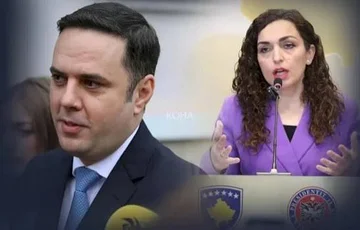
Kurti-Berisha meeting, for example, is nothing more than extending a political culture deprived of any stable public rating and any defined political principle. In other words, the meeting was the product of a policy based on present-day non-progressal rock and affirmation of aggressive nationalist naturists in public. This meeting can only be understood differently through a complete suspension of Kurti's pledges that do not build political co-operation without programmatic reconciliation.
While Berisha equates Albania's current left as political remnants of the communist regime, Kurti considers it to be covered by the very possibility of developing a native left. While Kurti late has been pro-nouncing Rama's declarations of independence in Belgrade, Berisha believed they are only a powerful intervention in Kosovo's independent policy. While Kurti believes the national union is the main solution for Albanian development in general, Berisha believes it was a “pro-ruse formula” and “pro-Serbian” that promotes Serbian claims in the region. While Kurti insists that Kosovo's independence should happen through the right to unilateral self-rule, Berisha's government had also accepted the concept of conditional “independence” on behalf of multilatheralism. Albin Kurti and Sali Berisha are mutually exclusive figures in politics.
In the latest interview, Berisha rejected the invulnerability of Kosovo's territorial integrity just by being summoned to the Ahtisaari Pakon, while Kurt's entire political existence owes its opposition to this political platform. The irony is that Kurti himself, who has opposed the territorial integrity of Kosovo coded according to Ahtisaari and the Constitution of Kosovo, has today become its main advocate in practice. Despite conceptual dynamics, Kurti and Berisha, however, have eventually joined, first of all, out of fear of losing their historic causes if the border correction scenario is implemented successfully and eventually opens the objective potential for national union; second, by their personal outrage towards President Thaci and, third, by faith in the same methodology of political action.
Berisha and Kurti have warned of a return to radical non-institution methods, mainly due to their electoral defeats. Berisha declared that the Rama government never falls by vote, but by popular uprisings and the government's revolutionary fall. Spended on politics, he does not think of Albania's long-term prospects, but his short-term personal perspective. Kurti, likewise, has warned popular revolutionary companies against the dialogue team, even though he has not publicly exhausted democratic means for this topic in the Parliament. With split parties and declining electoral confidence, Kurti is exploiting any popular initiative to be personally re-torted on the political scene in Kosovo. Thus, Kurt and Berisha's common denominator is the prioritisation of personal electoral profits in delicate political circumstances without adequate selection of tools and without a profound view of the effects of their actions. Therefore, despite political differences, unifying them is not difficult at all. Concern remains, however, whether the eventual escalation of public security will contribute to a climate of no favourable public judgment.
Whether such an option is implemented or not, the question is that any opposition to this idea should provide the answer to how to unblock the European agenda of Kosovo, how it will secure Kosovo's seat at the UN, and how I will avoid the permanent conflict of Kosovo citizenship.
The discussion on this issue should also be presented at the level of positive contributions and eventual benefits from this process overall. Aprior opposition and identification of the risks posed by this process are the easiest form of commitment to this debate.
For this will be written a day longer, but the essence of benefits from this process can be rounded up as follows: the first one, Kosovo will eventually be set free from an integral part of the territory of Kosovo; the second, Kosovo will eventually take the active role in protecting Albanian citizens in the Presheva Valley; in whatever circumstances the Lake of Weyman and the North Mitrovica municipality will eventually be set free from the integral parts of Kosovo; the second, Kosovo will eventually take the role of Albanian citizens; in any area of Vojmanic population of northern Mitrovica; the majority of Kosovo's third, the Serb territory; and in any other minority, Kosovo's primary or fourth minority interests; and the predominantly, Kosovo's primary capacity (rector) and the predominantly speaking, the majority of the province's primary capacity (rectory) and the majority of Kosovo are not allowed by the province's ability; and the majority of parliament; and the majority of Kosovo are eventuallys, the majority of Kosovo, the majority, the majority, the majority of Kosovo, the majority, and the majority of Kosovo, the latter.
In this sense, balancing the priorities and shortcomings of this process is a markedly more complicated form than rejection in the way Berisha has revealed it in Opinion. In whatever circumstances, the idea of redressing borders is more precedent for empowering Kosovo's citizenship and affirmation of national interests in general than for the great Serbia. In a word, the implications of this process are quite contrary to Berisha's promotions in the interview.
This is a very historic moment to operate with electoral accounts and to be judged in short-term political terms. Kurti and Berisha are not only spreading the climate of opposition without alternatives but also non-progressive co-operation without restraint and vision. In this situation, at least Kosovo society must prove its maturity by going through daily political tensions and rationally thought in favour of common good.
Sali Berisha and Albin Kurti seem alarmed, as if wanting to stop a story on behalf of which they have entered politics and have survived to this day.
They're afraid it'll become reality, but not their stories.