4 days ago
Balkans now filled with Milosevic monuments

Periskopi(8 years ago)
(8 years ago)Memorials can serve many different purposes in any society of social dialogue, social reconstruction, democratisation, symbolic repair, reconciliation and peace-building processes, to mention only a few. On the other hand, they also serve as tools that help define national identity, create social cohesion about politics and social issues. They can also [...]
Memorials can serve many different purposes in any society of social dialogue, social reconstruction, democratisation, symbolic repair, reconciliation and peace-building processes, to mention only a few.
On the other hand, they also serve as tools that help define national identity, create social cohesion about politics and social issues.
They can also be counterfeiting historical facts written on stones, disparaging acts that harm public interest, offend victims of cruelty, and so forth.
The question of who, what and how any society should decide to memorialise is of a cruise importance, especially in societies like Serbia, which is still in charge of the wartime past.
Moreover, the current political elite in Serbia is the same as the one that was born politically and actually in the wars of the 1990s.
It was founded with Milosevic's ideology for Greater Serbia that brought fire and rage, despair and death to all, non-Serbs and Serbs, though in a non-reciprocative manner during the time of Milosevic's Serb aggression.
Who and what, as a society, we choose to forgive is perhaps more dependent on politics than on what we choose to remember.
Remembering is a passive, often French process. Remembering is a far more compelling process both for individuals and for society than simply “remembering”.
Separate cases of trauma, people must make conscious efforts not to forget someone and something, while remembering as such remains in the realm of individual or group practices that may be sporadic, scattered, or transitional.
By making the decision about who and what the state, and what society as a whole, decides not to forget, through many forms of memitative practices, government institutions try to push something or someone of great social importance into public memory, which is, before it is a psychological act, political act as well.
By sharing a place for public memory, the state wants it to be a docking place, a stone from which to look back into the past for orientation, inspiration, or for what simply serves as historical truth.
The new monuments have such significance because they represent us at this moment in time. They tell us how we perceive our past, but they also provide important data of what we should look for in the future.
Let us turn back and consider the initiative to build a monument in memory of Milosevic in Belgrade.
It may seem surprising, but I'm here to make it happen. A monument erected in Belgrade, bringing in his image, his face and forcing us not to forget his ideology, the consequences of his murders, monstrous and devilish policies, in my opinion, must be placed by his followers in a more frequent place of the city as possible.
This painful reminder of what we are must receive immediate approval from the city government, which truly faces the political and social realities in which we live.
It's that kind of iceberg of “monments”, which already exist throughout Serbia and other Western Balkan countries.
Let's mention some of them, because Milosevic's monuments, like the effects of his policies on Serbian society and its future, but also for the future of the entire region, are still very much alive, although he himself has been dead for years.
Toma Fila, Milosevic's afokat and close friend, recently said on a television note that one of Milosevic's strongest and most stable monuments is the existence of the entity led by Serbs in Bosnia, Republika Srpska, and the leadership there.
Establishing this proto-state on genocide and ethnic cleansing of Bosniaks and other non-Serbs during the 90s, Milosevic succeeded in at least one thing he left enough ideological ammunition in his followers to continue implementing his grand plan, dating back to the early 90s of all Serbs in one state, a Nazi-style state of Serbia.
Belgrade already has an unofficial monument built in memory of Milosevic a mass cemetery in Bayatnica, just ten kilometers from the city centre, where hundreds of Kosovo Albanians were brought dead from Kosovo and buried in the middle of the night.
If you look around Serbia, you will find Milosevic's monuments in the face you will recognize him in people, in their attitude and in their political choices.
See all the violence and discrimination that govern Serbian society, another set of monuments, see President Aleksandar Vuqiq, Minister of Milosevic's Propagand, see Foreign Minister Ivica Dakiqiqi, if you want more vivid examples of Milosevic's monuments around us.
Take a look at the media, the public speeches of our politicians, the intellectual elite, and the growing fascist and right movements that are flourishing in our society.
If you look south, you will see, for example, Trepca, one of the countries where Milosevic's forces had burned bodies of many Albanians during the so-called Kosovo war to cover their blood trails.
If you look north, you will find another monument, the place where former Serbian President Ivan Stambolic, Milosevic's close ally who was later rivaled, was killed by bandits from state service in 2000.
If you look east, you will see the picturesque towns and villages of once multiethnic Bosnia and Herzegovina that turned into large graveyards.
Srebrenica is Milosevic's most famous monument, with more than 8732 souls buried in a cold land.
Tuzla, Gorazde, Zvornik, Foca and other towns east of Bosnia have at least one monument of Milosevic's death camp, a rape camp, a mass-identified cemetery, a burnt house, a family that has lost its members.
Look beyond them, and you will find Sarajevo as it now stands surrounded by great hills where Milosevic has erected many monuments to himself uncountable graves and tombstones of Bosniaks killed during the 45-day siege of the city by the forces of the Serbs.
Even farther east, you see Prijedor, Bihacin and many other Milosevic monuments built by his cursed hands.
Return to Belgrade and see better, where a new Milosevic monument will reportedly be erected, and pay attention to the heart of the city where you will find a memorial site for Milosevic's well-known victims.
This place is on Nemanja 21, behind the government building of Serbia.
There lies an invisible and clear monument of Milosevic. He shows him standing on Zoran Djindjic's dead body that was killed by people serving Milosevic's forces and with the support of the politics and media of his successor.
Let's look at Milosevic's monuments in the form of paper, too. For example, the declaration of reconciliation between Djindjic's followers and Milosevic, who shamelessly equated these two people and declared <x0-> national reconciliation”, which in fact only rehabilitated Milosevic and his war dogs.
Now take a look at the text of the state constitution. This too is a monument to Milosevic, with its harmful projections and its effects on the future of our society, especially what they consider the Republic of Kosovo now independent, as part of Serbia.
Take a look at the sad state of our public life, the collapse of public institutions, our propaganda and controlled media, our corrupt parties in power and opposition, the nationalist system of values that has been embraced by most citizens and that was insisted by Milosevic, do you see them now? Milosevic's monuments stand around us, killing us, even from his grave.
Have we surpassed Milosevic's time? If we just remember who's leading our country, then we'll know the answer.
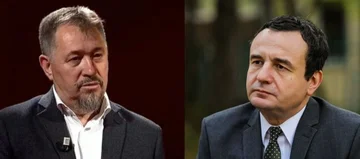
True, Aleksandar Vuqiqi [only in appearance] is not Milosevic, but what about Milosevic's support from the citizens of the world? How do they feel about setting up a monument to him in Belgrade?
Based on a survey in a television show on which Toma Fila explained why Milosevic should have a monument in Belgrade, the audience of this television voted pro/against that idea.
At the end of the show, more than 55 per cent of the audience voted in favour of building its monument.
The survey is not reliable, of course, but it says something; it is 2018, and the result of a common television survey was not that close.
Let's forget about that survey, and believe it doesn't reflect public opinion, except to feel a little better about ourselves.
Let's get back to the issue ? Should we need another monument of Milosevic, in addition to this time, proudly standing in the center of town?
Absolutely. Let them freeze Milosevic's monument. Only then will we have the historic opportunity to at least destroy one of these monuments.
Subtitles by Leapin