4 days ago
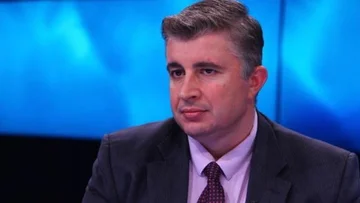
Skenderbeu and Fuga

Periskopi(8 years ago)
(8 years ago)Artan Fuga, known for the Albanian letters, invites us to talk about Skenderbee's figure and not only that; from this invitation comes another invitation that is the revision of history, which brings us back to the reason why we should have or have long had reform for scientific research [...]
Artan Fuga, the name known in Albanian letters, invites us to talk about Skenderbee's figure and not only that; from this invitation comes another invitation that is the revision of history which brings us back to the reason why we should have dealt with or have long been in scientific research reform in Albania.
The need to have a new figure of Skenderbeu, cut off from ideological designs, makes Fuga ask us to join for a “idealistic historyo” against ideological. This invitation comes when Tirana's policy (at the direction of the prime minister) is trying to provide Skenderbeu's “Years of Skender” as a way to promote the cultural and historical model. The odds are to bring this debate back to the public arena, heated debates on Skenderbeu. The wine we left behind was accompanied by a debate on Skenderbeu as hot as this season itself. But, as we well know, post-Social seasons for Skenderbe have been dynamic; those seasons are only two, summer and winter passing in the summer-to-winter and vice versa. Thus, again this time the fury is likely to continue long because Skenderbeu leads all the political lives that the authors give in their ideological or identifying views of current policies. The skenderbe becomes the limit, the mastar, the value of itself and the other.
However, let's focus a little bit on the term “idealistic historyologist”. Many would love the word “idealist”. In any case, I would be fearful of the meaning that Fuga used, but as far as I can bring to light from the argument's explanation, it turns out that it is required that Skenderbe's figure be seen as that of a visionary who had captured the moment of the historic future in Europe. In this case, the term “idealistic historyist” first serves to give us the idea that we lack idealistic history, and what exists on Skenderbe is ideological. The second meaning that takes on “idealistic history” is that of a field of knowledge that doesn't give weight to “, but instead gives priority to the idea or ideal that orders the arm to lift a sword rather than an opposite. So here it seems like it's about the demand for a transition from an ideological history, to one. History of Ideas So the term “idealistic historyo” doesn't sound like it's hit hard.
One of the examples Fuga uses to support the argument of an idealistic historyography is this: “ ... when the priest Paul Angel said in English the baptism formula in Durres, it is not a purely linguistic issue as they have treated it. It's the biggest record of Cultural Anthropology Arbeer. Do you know what it means when a community of believers will hear their faith in church in their mother tongue? ...”. For the Baptism Form and the Factive Arberean Culture has given a complete answer Scholar Ardian Vehbiu. When Fuga follows the idea of what the Arberical cultural context was like, it looks like it's already inviting us to a well-thought platform of how it should be, and not what the cultural history of that period might have been. However, let us take a step to the picture by asking another question: Is there really a recorded history of which and under the Soviet or Stalinist lens that rejects this idea? Actually, no. Stalinist history does not provide that much historical landscape with MountainsHow much longer? Work class or Village class etc. Of course, idealistic and ideological landscapes. A life of Skenderbeu for the sake of Stalinism in Albania. The movie about Skenderbe is full of images of this nature, but not history.
Out of concern for reviewing history, Fuga invites us to do an analysis of Skenderbe's wishes, ideas, and visions. Among other things, he says: “No, it's not just my father's fiud. It's not a sadness to the career, nor a betrayal of the Sultan's Father. Nor flash of child vision! No kidding!”. It's not clear here who's referring to, who's making fun of who, but the odds are that there's a lot of attitudes here that still aren't found in ideological history, that's this one. We don't have any Stalinist in the time of communism in Albania that the argument about Skenderbe's war brings either a betrayal of father or a childish game or a return for father's property. These are the thesis, of course not that of the childhood game, articulated in various forms by historians, mostly of the post-Socialist period. They do it once under the garment of deconstrutism, once of deorientism, sometimes of a kind Kitsch- History. The fact is, many Fuga invitations coincide with ideas promoted by the history that Fuga himself criticizes. As a result, history is required for a role, a role to be proud of what we are today.
Fuga follows: “He [understanding Skenderbeun] He looked away because if he saw that he could not win, he would not put himself and his family, clan and tribe, people, on an adventure. Who launches a battle without hope of winning it?” A quick answer would be that there is even a fatal option. A battle without hope to win. This can be done by someone who has no choice but to live or die. Well, that interpreting space may allow us to find a personal cause, as has been the invitation of <x1Werging” (which I do not find based), under which it leads to receiving a war not visionary but completely conditioned by luck. We may come to the logic of adventurers and so forth, but someone may ask us to stop perhaps by making serious criticism of who can consider such an opportunity especially when we are talking about the national hero...
Skenderbeu is set as a presumption or part of a cultural context, with co-ordination like Ian Hus (1370-1415), Gutenberg, (14341444), Makiavelin (1469)1527), Dekartin (1596 c. 1650), Galileo Galilein (1564-1642). However, as can be seen from birthdays, two of them - the first - have a closer time relationship with Skenderbe, but others are about a century later. And when it comes to the idea, ideas, ideologies, intercalated cosmology for/and modern states, or the concept and existence of the nation, these researchers have little or no connection between what would be politically, philosophically or anthropologically the idea of nation and nation state. As far as I know, we only have a phrase in Italy from Skenderbe's mouth when he was helping his son, Alfonso of Naples, during his time. It would be very difficult to build a historical building for Skenderbe's visions or excitement, but if a historian succeeds in doing so, then we should consider what historyical text he has followed. I usually read these historical interpretations with pleasure, and I don't care when they don't raise a hero to my taste.
Neologymin “Albanistics” used by Fuga I haven't understood yet, but this argument is hard to load after Fuga has apparently written at the rate that requires virtual communication. I'm curious to know if the term “abanisticists” means researcher Albanians, animalsor Animals of Albanians. The tone likely refers to this second, but sometimes it would be good to stop itself from interpretations, as they are both constant and endless. After all, this is the game of history and the game history makes with our minds.
In another moment Funga's writing takes the form of an invitation for a historyographer to sell several issues simultaneously: “...why should you do your best without opportunism to remove the cover of iron that has locked up in a cave of truths and that prevents us from being proud of what we should know where we came from. We've become a nation without a project, so boys and girls go. That's why it takes a re-enhancing of the Albanian academy, not only with new people, but with new hypotheses and intellectual energy.”.
According to this invitation, Skenderbeu will have to Update in contemporary context. So he should be viewed as a personal or simply national project, but i n as a pan European and European project, and above all, make us proud of what we are. The task must be completed by a new academy, which has the courage and knowledge. I know that there are publications by Albanian authors who consider Skenderbe as the predecessor or one of the visionaries of United Europe, but such books can only be read for discurs analysis of post-talinistic literature in Albania. The point is how you get invited to do science when you determine what you're going to build? That's what I'm convinced Fuga knows not to walk. Of course, if it's a therapeutic history that aims to make people feel good, maybe we can take a certain consideration of Fuga's invitation, but this approach has been captured by many leading researchers -- in the condition of collective trauma, the identities of the fall of communism, and they are not inclined towards critical thinking but to that shamanic.
How do we do it? Let's go to an idealistic history storytelling about fiction, about research; about therapy, making people feel good; or going to an investigative story that makes people think critically? In any case, if we want to be a little bit critical, we can have a platform predestinating conclusions, but it's going to take a platform that opens paths of critical consideration, and the best, most prosperous soil for this is that of image, body, soul and the work of the National Hero. Otherwise, we'll encourage one Kitsch-historic or gently put a pop-historic. And the film bath, used in humor by Fuga: “Do you want to fight the brains? I don't know. will be able to return “A wants you to take a story toso that I may be satisfied with what you were involved in,Are you? I want that point..“
Peaches. com