11 minutes ago
Parties Calculate Coalitions in Silence

Periskopi(9 years ago)
(9 years ago)Political parties in Kosovo, now and several days, are silent about coalition possibilities for forming the new Kosovo government, following early parliamentary elections held on June 11th. After the voting ended, as well as the publication of preliminary results by the Central Election Commission, political parties had given a verse [...]
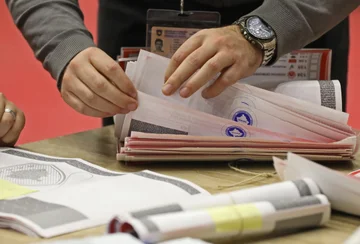
Following the outcome of the vote, as well as the publication of preliminary results by the Central Election Commission, political parties had issued a series of statements concerning the possibilities of creating coalitions, which would create the country's new executive.
But the current silence, in the opinion, is also seen as a lack of options by political parties following the election outcome, which does not guarantee them the formation of the government, without the link of new post-election coalitions.
Politologist Ramush Tahiri, speaking of Radio Free Europe, expresses the opinion that the silence of political parties regarding the possible coalitions is their own accounting, separately, that will last until election results are certified, as verifying the mandate.
According to him, the moment the results are certified and each party will know how many MPs it has, then talks and coalition-making agreements will begin.
What is now seen is that there are three large groups. Neither has more than 35 percent of the vote, and the coalition is forced to become one of the three groups, plus minorities. After verifying the mandates, it is understandable that the first coalition will aim to do the numbers and will seek negotiations, first with the coalition, and then, it is tactical, will also seek with parties within the coalition. Recently, even with individual individuals”, Tahiri said.
Politologist Belul Beqaj, professor of Political Sciences, tells Radio Free Europe that the actual phase is one of the potential possibilities for concreteising public statements of individual subjects and potential leaders. Currently, according to politician Beqaj, a new phase for political subjects is expected.
“They will face reality, bitter or in the hope that they can eventually make coalitions, depending on party calculations, but also with certain individuals. But one matter, in my opinion, would be wrong to be part of the calculations. This is related to forming the government, which would depend more on the Serbian List than on MPs and other political subjects”, Beqaj says.
But is there any potential possibility of blocking the process of creating the new government, of the fact that none of the political subjects have the percentage of votes guaranteeing the formation of the government alone?
Politologist Tahiri suggests there will not be any blockades for forming the new executive, for his claim that constitutional and legal opportunities exist that such a thing will not happen.
“If the first mandate fails to make Government and has 61 deputies' votes, then hand it over (mandatin). Then the next termant from the other coalition will have numbers, because 50 percent is either the first time or the second time. There's no third time. And it depends on how they share power, that is, ministerial posts and prime minister. Also, the second part, but which is no less important, is what the governing programme will harmonise and which deputies will face, Tahiri says.
Even politician Beqaj does not believe there may be any blockades for the formation of the executive. According to him, political parties have learned from previous experience, when after the 2014 parliamentary elections, the formation of the new government was blocked for six months. However, according to him, if a similar situation is repeated, then political parties should seek solutions to the situation.
However, it can very often be thought, under one that in my opinion is not wrong, for forming a technical government, with a mandate of six or 12 months, which will serve as a transitional phase for reform of the electoral system; for reform of political parties that need to be reformed; for reaching some decisions that address no concrete responsibilities to anyone, but in all, such as Demark and Association. Then, a new phase of awareness of the electorate and parties, with a new quality of policy making”, Beqaj said.
The Central Election Commission has warned that the Certificate of results of early parliamentary elections on June 11th will take place this week.