7 minutes ago
What is behind the record strengthening of Albanian lek?
Periskopi(an hour ago)
(an hour ago)One euro was returned this week with only 93.62 leks - the lowest historical level against the Albanian currency.
In theory, a stronger money would have to make imported goods cheaper, lower costs for businesses, and increase citizens' purchasing power.
In Albania, however, the opposite occurs.
Food prices continue to remain among the highest in the region, exporters complain they are losing competitiveness, while economists question whether official explanations are enough to understand why the money is so strengthened.
The debate has turned into a clash between government, opposition and economic experts.
The government argues that strengthening the money is the result of entering large amounts of currency into the economy, driven by tourism, foreign investment and remittances. The opposition, on the other hand, claims that the exchange rate is also influenced by informal economy and money laundering. While part of economists say official data does not fully explain this phenomenon and require a deeper analysis of currency sources entering the country.
For Prime Minister Edi Rama, it is not the euro that has weakened, but the money that has been strengthened.
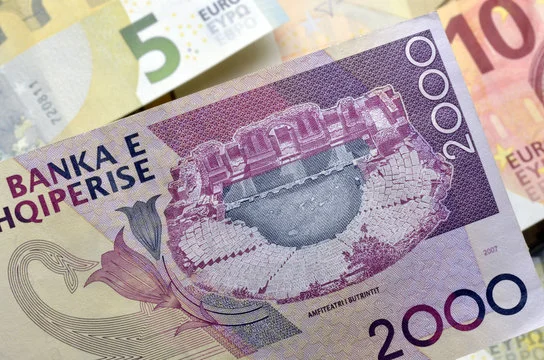
A 200-dollar bill.
The production of money is a success for the Albanian economy. It is a stubborn indicator of economic growth”, he said in recent days, linking this development mainly to increased tourism revenues.
Official figures support this argument.
According to the Bank of Albania, foreign visitors spent about 5.7 billion euros in Albania during 2025 - about 15 percent more than a year ago.
Albania's Finance Ministry also reported 1.6 billion euros in foreign direct investment and over 2 billion euros in remittances, which, according to the Government, have significantly increased the euro's market bid and have led to strengthening the money.
But, the opposition says a stronger currency is necessarily a sign of a stronger economy, arguing that this development has not been associated with increased production, productivity or exports.
According to her, strengthening the money does not reflect the real state of the Albanian economy.
Is tourism, investments, and remittances enough to explain it?
For Government, the answer is yes.
Prime Minister Rama rejects claims that after strengthening the money, money of dubious origin is mostly hidden.
According to him, large currency entry into the economy is the result of legitimate developments, above all tourism boom.
We discuss that there is a dirty money washing machine here, but who would let us continue to close chapters with the European Union?
The opposition sees the situation differently.
The leader of the Democratic Party, Sali Berisha, claims that overestimating the money cannot be explained only to tourism or investments, but also relates to the introduction of money from criminal activities.
Although it does not present concrete evidence for this claim, he argues that major euro flows have affected the exchange course, without bringing about improved citizens' welfare or the productive economy.
The debate is not new.
For years, the informal economy and the risk of money laundering have been part of discussions on the Albanian economy.
The latest report by the Special Prosecutor against Corruption and Organised Crime (SPAK) shows that during 2025 alone, some 45.4m euros of assets have been seized, while the construction and real estate sector is identified as among the areas with the highest exposure to money laundering.
However, such information itself does not prove that the exchange rate has been influenced by criminal activities.
For this very reason, some economists argue that the debate should rely not only on political statements, but on analysis of economic indicators.
According to them, the main question is not whether tourism has brought more euros to Albania - that is indisputable - but whether it is enough to explain such a large strengthening of the money.
Economists: Figures do not fully explain lek strengthening
Irena Beciraj, Albania's former deputy finance minister, argues that the government's analysis relies only on the money entering the country, but does not take into account what comes out.
According to her, about 5.7 billion euros in tourism revenues during 2025 should be lowered by about 3.06 billion euros that Albanians spent abroad.
Even in foreign investments, she sees an important difference.
A large part of them, Beqiray says, does not represent new capital that has entered Albania, but profits that foreign companies have chosen to reinvest in the country.
While remittances, according to her, have increased but not on levels that would explain such a big change in the exchange rate.
For me, 25 to 40 percent of the lek overload remains unexplained by tourism, foreign investment and remittances”, Beqiray says.
Economist Pano Soko has a similar attitude.
He argues that if strengthening the money was the result of the real economy, it would be reflected primarily in the trade balance.
“... But data shows that the balance is in deficit and the difference remains almost the same since 2013, when the euro was exchanged for $140. If this ratio between import and export has not changed, even the exchange rate would remain the same”, Soko tells Radio Free Europe, Periscopi broadcasts.
A $500 card.
According to him, even foreign investments do not explain this development.
If we were to see only this indicator, the euro would even have to be strengthened, because foreign investments between 2015 and today have dropped”, he says.
So where does the rest of the currency that pressures the exchange course come from?
Beqiraj says official economic data does not fully explain the strengthening of the money and that this could mean the existence of other currency flows that are not reflected in official statistics.
Soko takes a step further, arguing that the informal economy and money of criminal origin have an important impact on the currency market, since the exchange rate is important in the amount of the euro in circulation, regardless of its source.
The money grows stronger, but why doesn't it feel in the citizens' pocket?
In theory, a stronger currency must bring tangible benefits to the economy.
Imports become cheaper, business costs decrease, and this, over time, should be reflected in the prices consumers pay.
But economists say this did not happen in Albania.
A recent price study shows that in 2024 prices of food and nonalcohol beverages in Albania reached 100 percent of the European Union average, up from 68 percent in 2012.
According to the authors of the study, Albania has registered the largest increase in food prices in the region, although the income of Albanian families remains much lower than in EU countries.
Azmi Stringa, one of the authors of the study, says strengthening the money is not translated into price reductions for consumers.
A stronger lek was to bring benefits to citizens and the productive economy, but this did not happen”, Stringa says.
He adds that the structural problems of the Albanian economy, such as poor competition, lack of transparency in the market, and limited supervision, have prevented the positive effect of the exchange rate from reaching the consumer.
Beqiraj also refers to the same study to illustrate the paradox.
According to it, food prices in Albania are already comparable, even in some cases higher than in countries such as the Netherlands or Spain, although these countries have markedly higher incomes and living standards.
“The results of the study show that food prices in Albania have increased earlier, faster and more frequently than in the countries of the region, even though the money has been estimated by about 30% over the last decade”, Beqiray says.
Meanwhile, a stronger money does not affect everyone equally.
Economists say that among the hardest hit are exporters, who earn their income in euros, while salaries, energy, rents and most of the costs are paid in cash.
With euro depreciation, their profits shrink, and Albanian products become less competitive in international markets.
According to Soko, the same pressure is felt by the tourism sector.
<x) But a higher price does not make it competitive with other countries. If this drop of the euro follows, many tourist operators will be forced out of the market”, Soko says.
The beneficiaries, on the other hand, are those who buy goods abroad or have financial obligations in euros.
Importive businesses pay less for products they bring from abroad, while citizens who have loans in euros repay them less than a few years ago.
Even the state benefits, as part of the public debt is taken in euros and is now compensated with a more favourable exchange rate.