5 hours ago
Zeka: Kosovo risking relations with US by rejecting US gas project
Periskopi(21 hours ago)
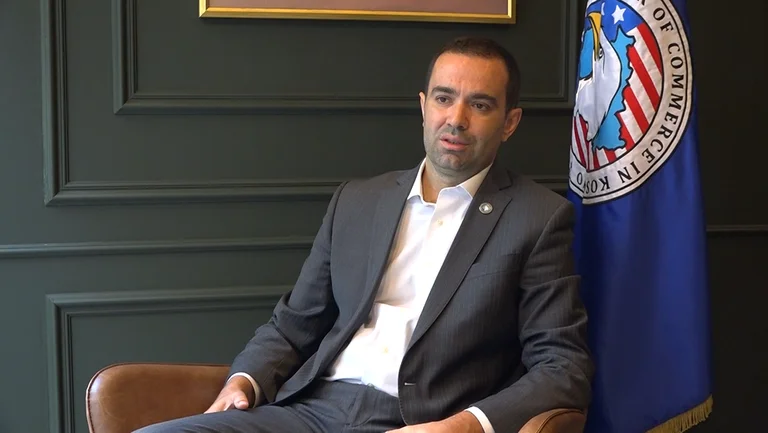
(21 hours ago)Kosovo is sending negative signals to the United States of America (SHBA) by failing to join regional projects for liquid natural gas (LNG), the executive director of the American Economic Ode in Kosovo, Arian Zeka, has praised in an interview for Online Economics.
According to him, involvement in US LNG projects does not only matter energy, but also strategic and geopolitical, while warning that Kosovo's lack of will could negatively affect reports with the country's main ally.
Zeka said that expanding the American natural gas network in Europe and the Western Balkans has been an American administration priority for more than a decade.
The extension of the United States' liquid natural gas network in the states of Europe, including Kosovo and other Western Balkan states, remains one of the most important aspects of the current American administration. But anyway, it has kept some consistency in the preliminary administration, and maybe it's been 13 years since I remember that this topic has been a priority topic for the American administration across some administrations. And it's a pity that the Government of the Republic of Kosovo is in office, but, of course, it means before it had a full mandate even from 2021 onward, they fail to understand this important aspect, this strategic aspect to the American administration. Confirmed in a statement that the State Department had made, which the issue probably remains among the main pillars of establishing economic co-operation between the United States of America and all the states of the continent of Europe”, Zeka told EO.
He said that after the start of the war in Ukraine, European countries have reduced dependence on Russian gas and are oriented towards American gas.
The initial start of the conflict in Ukraine, or the launch of Russian aggression against Ukraine, the countries of Europe in large measure, have soon made the transition from dependence on Russian gas they had until then to an ever greater presence of liquid natural gas. What has happened in the meantime is that the United States has also increased its production capacities, which is also about 65% of Europe's total supply comes from the United States. Which means that the states of Europe have come to understand that beyond supply with an energy source, that is, the question of liquid natural gas is a strategic aspect of the establishment of their relationship with the United States”, he said.
Commenting on Kosovo's interest in this project, Zeka said the country is delivering a wrong message to Washington.
Bad message. Even in an opinion that means that one in charge of work at the U.S. Embassy, Kosovo is being delayed. And it was said, repeated on the part of another U.S. Embassy official. We've said that as Ode American, we believe that the quality of relations between Kosovo and the United States will suffer, will have a negative effect on this case. This absence of Kosovo's will to join this, this initiative of the region. That we already have all states of the Western Balkans, states that have had bad relations with the United States, which have pledged to develop the infrastructure necessary for importing liquid natural gas, while Kosovo is the only country in the Balkans to tell APUyo this start”, he said.
Zeka said Kosovo had the opportunity to express readiness to join this initiative even at meetings held in Washington.
It's not even a secret, in February there was a meeting of what is known as the Energy Emination Council, which was founded under the White House, the most important institution in the United States. Our government cabinet has been represented there, even subsequently, Kosovo has not pledged, has not pledged the necessary vow along with other Western Balkan states. That is strange, no one understands in full why the Kosovo government refuses to take such a step. I believe that in the future we will have an interest in joining such a initiative, much more knowing that we have great dependence on energy imports from states that may not have diplomatic or interstate relations with the Republic of Kosovo, nor do they know. At the same time, we encourage that we say “po” importing important energy sources from the state, from the most important ally we have, which is the United States”, he said.
He warned that the biggest damage could be strategically and in relation to Kosovo's Euro-Atlantic goals.
And beyond what we fail to complete is our energy supply resources, since liquid natural gas is involved as one of the most important sources of energy, that is, in terms of empowering our state entity, I believe here would be the biggest loss. We would lose the support of the United States of America in our journey towards Euro-Atlantic integration, and of course, we would also endanger the other state priorities we have, as I mentioned membership in Euro-Atlantic institutions. Since it is said that more and more, even from other social life exhibits in Kosovo, as well as political life, not those related to power, that this may be the possible danger”, he said.
Kosovo is the only country in the Western Balkans that is not involved in projects that expand the energy impact of the United States in the region through liquid natural gas projects (LNG).
Kosovo's incumbent government, led by Albin Kurti, has expressed more interest in “gasing local coal”.
This [charging coal] we can do with an American company, for example,”, Kurti stated earlier.
The American Embassy in Pristina has repeatedly called for Kosovo's involvement in the US LNG project. Jobwork in this embassy, Annu Prattipati, has declared in early June that Kosovo is failing to meet increased energy supply requirements, citing Kosovo Customs data, under which the country has spent 735m euros on importing electricity from neighbouring countries in the past four years.
According to these data, energy imports increased from 142m euros in 2024 to 259m euros in 2025.
Prattipati has estimated that if prices and energy demand continue to rise, Kosovo will increasingly depend on the energy supply of neighbouring countries.
Meanwhile, Albania, Croatia and Bosnia and Herzegovina have entered important initiatives with American companies and with the US on expanding the gas network, including projects aimed at reducing dependence on Russian supplies. / EO