8 hours ago
“kinetic Extractors”: The unusual shipment of Russian Oresnik nuclear missile
Periskopi(a month ago)
(a month ago)When Russian ballistic missiles flew at night near Kiev on May 24, some videos recorded an unusual detail. Despite a series of visible shocks and collision objects, there were no explosive flares that normally accompany a missile attack, writes Radio Free Europe.
The video, which does not offer clear images recorded during the two initial attacks on this weapon, in Dnipro in November 2024, and in Lviv in January 2026, showed a similar lack of initial explosions.
“It seems that they do not carry explosives”, Pavel Podvig, senior researcher at the United Nations Institute of Disarmament, told Radio Free Europe. The hypersonic shells released by Oresnik, glistening from the heat of re-entry into the atmosphere, “are probably heavy objects, with the idea that the destructive force comes from kinetic energy”, he added.
Konrad Muzyka, defence analyst at Rochan Consulting, said the attacks with Oresnic appear to be carried out with about 36 “kinetic detector”, which comes out of six means of returns issued by the rocket during the last arch of its flight. These missiles, he said, are supported at extremely high speed of hitting to destroy or penetrate targets, instead of carrying huge explosive loads”.
But at a cost estimated tens of millions of dollars for each missile, many commentators including Russians have questioned the benefit of throwing hypersonic pieces of metal or concrete into the grip of Ukraine.
“simply, extremely expensive equipment crashed on earth”, Russian blogger Vladimir Romanov wrote in Telegram, whose post attached the latest to Oresnic attacks. The “all of this for the sake of a beautiful view that nobody believes [but pensioners]”, he added.
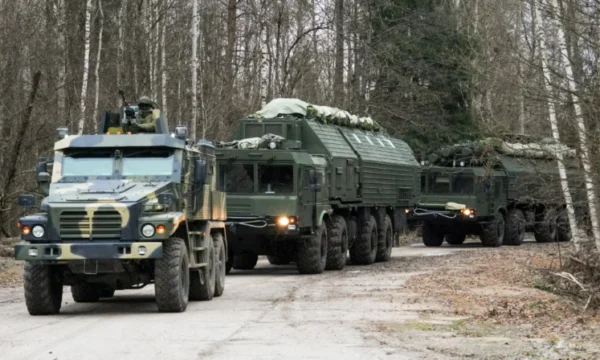
Oresnik (or, in Albanian, nuts tree) is a medium-range ballistic missile, estimated to be about 12m long. There is an action ray of some 5,000 miles [5,000 km] and with a reported load of more than one tonne. This weapon is transported with a relatively small tool and assigned for its ability to disappear from sight, like a tree in the forest.
Ballistic missiles, such as Oresnic, that launch nuclear heads from high altitude, are known for their exact difficulty. This aspect is largely insignificant in the case of a nuclear strike with a large ray of destruction, but kinetic missiles may not even be able to damage large targets.
An investigation, with open sources related to the impact of the 2024 Oressnik attack on Dnipro, which targeted a Soviet-era missile plant, found that Orshnik shells may not have hit the factory at all.
Photos taken in Dnipro several hours after the 2024 attack showed great damage on the roof of an unidentified building, but the rest of the building seemed intact.
Muzyka told Radio Free Europe that in the case of the May 24th attack, images “appear to show striking elements over a relatively broad area”. Military analyst said he believes this “can show a deliberate distribution at some points of target or potentially major restrictions on accuracy” of this weapon.
Residents of the eastern city of Dnipro watch the damage caused after the first use of the Oresnik missile against Ukraine in November 2024.
Following the attack on Bila Tserkva, a Ukrainian military blogger identified what he claimed was the site of one of the shells. He compared the crater, the size of a swimming pool, to the destructive power of an artillery shell.
Earlier, Ukraine's emergency services had published images showing damaged garages and a small fire in Bila Tserkva. It is not clear what was targeted in the city, but Bila Tserkva is home to a Soviet-era airport.
Experts believe the aim of the Oressnik attacks in Ukraine is largely psychological. “The attacks seem more like a strategic signal than attempts to mark significant successes [on the ground]”, Muzyka told Radio Free Europe.
Podvig expressed similar appreciation. “Technically, there may be a lot of missile damage against vulnerable targets, but in my opinion this has more to do with sending the signal”.
Shortly before the attack with Oressnik on May 24th, the Kremlin had called on the army to prepare “proposals for the manner of revenge against what it described as a Ukrainian attack fearing a student dorm, where at least 18 people were killed.
Oressnik has become a key point of Kremlin propaganda, which has promoted his speed and range of action across the European continent as well as the ability of the weapon to carry nuclear heads. Russian state media have published the supposed flight times the Oresnik heads need to achieve targets across Europe 20 minutes to London and Paris, 12 minutes to Warsaw.
This nuclear capacity, and a number of similar concessions to long-range intercccectal ballistic missiles, seem to have led to the use of the missile. On November 20th, 2024, the day before Oresnik's first launch to Ukraine, the US and several other Western embassies were unexpectedly closed due to the <x0-> risk increase from air attacks”.
A day before the attack on Oressnik on 24 May, Ukrainian President Volodymyr Zelensky, calling for intelligence information from the US and Europe, said Russia was preparing to hit Ukraine with this advanced missile.
An Oressnik missile unit promoted to an unidentified location in Russia in January 2023.
Russia claims to give “automatically” U.S.A. a 30-minute warning to Oresnic missile concessions. The Pentagon has confirmed that it was reported “short-term” before the November 2024 attack, but Podvig said it is likely that communication on Russian intentions was shared with the American side hours earlier.
The “is an agreement for launching ballistic missiles dating back to 1988, which the two countries continue to respect and the pact requires 24 hours notice before”, the arms expert said. “Technitically, it only covers interccontinent ballistic missiles, but I can imagine that to be on the safe side, Russia sends out reports so that these concessions are not interpreted as transcentinal ballistic missile concessions”.
Currently, America has the nuclear doctrine called “reduction following warning”, which means that the US can carry out “bacterious attacks” as soon as missiles issued by another party, before they hit the territory. / REL/