a few seconds ago
Blockades in the Parliament Risk the Fate of 121m International Agreements
Periskopi(4 months ago)
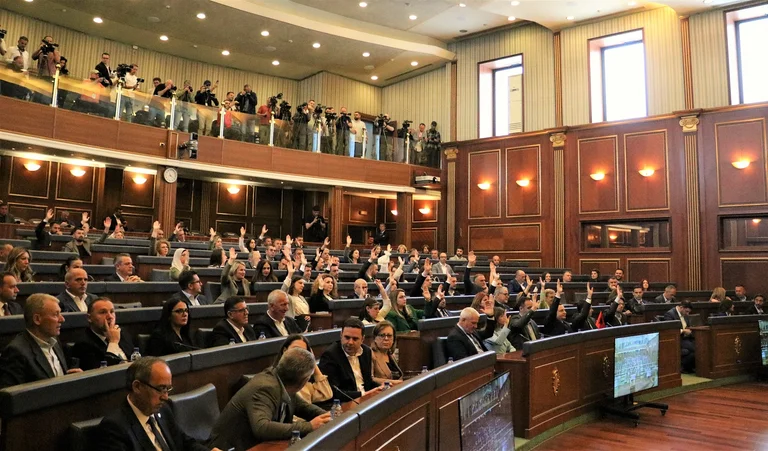
(4 months ago)The Kosovo Assembly has until 31 March to ratify the loan agreement between Kosovo and the European Investment Bank for the “Energy Photovoltaic Energy Corporation”, worth 33m euros. But all the work of the Parliament is frozen to this date by the Constitutional Court, [...]
But, all the work of the Parliament is frozen to this date by the Constitutional Court, through the provisional move imposed following President Vjosa Osmani's decree on the distribution of the tenth legislature.
Agreement on Touching Project KEK, it's one of eight Sosh's current legislatures in her drawers.
These include:
Kosovo membership agreement on Peace Board
Agreement on access to higher education and acceptance for studies in the Western Balkans
Two amendments to financial agreement between Kosovo, European Union for IPA Programme
Two loan agreements with the European Bank for Reconstruction and Development (BERZH): one for the power efficiency project in public buildings and for equipment to treat sewage in Podujevo and
The loan agreement with the Saudi Development Fund for the Pristina-Mitrovica road project.
The value of four of these agreements, including those with the European Investment Bank, amounts to 121m euros.
Kosovo Government spokesman Arlind Manjuka has told Radio Free Europe that deadlines for the adoption of these agreements are tight, and “require quick proceedings on the part of the Parliament”.
From the European Investment Bank said ratification of the “agreement is necessary for providing proposed financing”.
The ratification of the agreement would enable Kosovo to move forward with the construction of one of its largest photovoltaic solar plants, with a capacity of up to 100 megawatts. The project is expected to strengthen the country's energy security by increasing the share of renewable energy produced in the country and by reducing dependence on coal-based generation. It would also support the broader goals of Kosovo's green transition, as the plant is expected to generate about 169 gigavaves of electricity per year and would significantly reduce carbon dioxide emissions as soon as” is operational.
The Value of Agreements
Recognisors of the Parliament's work consider the agreements directly impact on improving the quality of citizens' lives and on strengthening Kosovo's international position.
“In essence, ratification of these agreements implies speeding up public investments, increasing institutional stability and concrete medium- and long-term benefits for citizens”, Kosovo Free Europe Radio Melos Kolshi, researcher at the Kosovo Institute for Justice (IKD).
But, according to Kosovo Democratic Institute researcher (KDI) Violet Hajolli, the current situation “creates an institutional uncertainty”.
“Since international agreements should be ratified by the two-thirds-highly qualified Assembly, any impasse in its operation automatically postpones the ratification process. This means that, until there is a clarity for the full functioning of the legislature, it is difficult to predict when these agreements for adoption can be processed”, she said.
From the ruling Vetevendosje Movement, the ruling party said these agreements are scheduled to approve Friday, March 6th, a day after failing to elect the new president. The hearing was not held after Osman issued the decree to distribute the Assembly on the morning of that day.
The head of the Vetevendosje Movement Parliamentary Group, Arberie Nagavci, told Radio Free Europe that these four agreements “have particular significance for economic development, infrastructure improvement, environmental protection and increased energy efficiency in the country”.
Therefore, their adoption as quickly as it is in the direct interest of Kosovo citizens and sustainable development. Under such circumstances, it is important that these strategic projects do not remain hostage to political developments, but advance as soon as possible to bring concrete benefits to the country and citizens”.
The Consequences of Agreements
Violeta Hajolli says failure to break international agreements affects delays in implementing projects and in the image of the state in the international arena.
“Although international partners usually understand internal political situations, continuing institutional blockades can affect the pace of co-operation and confidence in implementing joint projects”, she said.
Kolshi sees multiple consequences, even outside Kosovo.
“In a global context of geopolitical changes and reconfiguration of the foreign policy priorities of major international actors, including the American administration, it is vital that Kosovo prove institutional seriousness and decision-making capacity to preserve and strengthen strategic partnerships”.
Radio Free Europe has asked other institutions that sponsor these agreements the EU, the BERZH and the Saudi Development Fund what eventual consequences Kosovo may face from its inability to ratify documents, but has not received an answer.
Need of Political Understanding
Taking into account the fact that two-thirds of the votes of all Kosovo Assembly deputies are needed for approval of international agreements, political consensus is key.
KDI researcher Hajoll mentions that it is very important that the agreements be handled “beyond the interests of political momentum”.
“in most cases, these agreements relate to the country's development, international co-operation and improved services for citizens. Therefore, it is important that the political debate focuses on their content and benefits, ensuring that the ratification process is conducted transparently and at times”, she stressed.
And Kolshi from the IKD says the Assembly has already faced significant “delays”.
The particular “responsibility falls to the current government, which in addition to the negotiating role in the international agreement, should show political leadership and capacity to build institutional consensus and stability with the Parliament and other political actors”.
This is not the first time Kosovo risks losing funds from international agreements, due to internal problems.
The current legislature barely reached the deadline needed to take advantage of agreements with the World Bank and with the EU under the Development Plan. The amount of three total agreements affects the value of around 1 billion euros. / REL