16 minutes ago
Macedonia: Enormous detection of Serbian brigades bordering Kosovo, risk for entire Balkans
Periskopi(2 years ago)
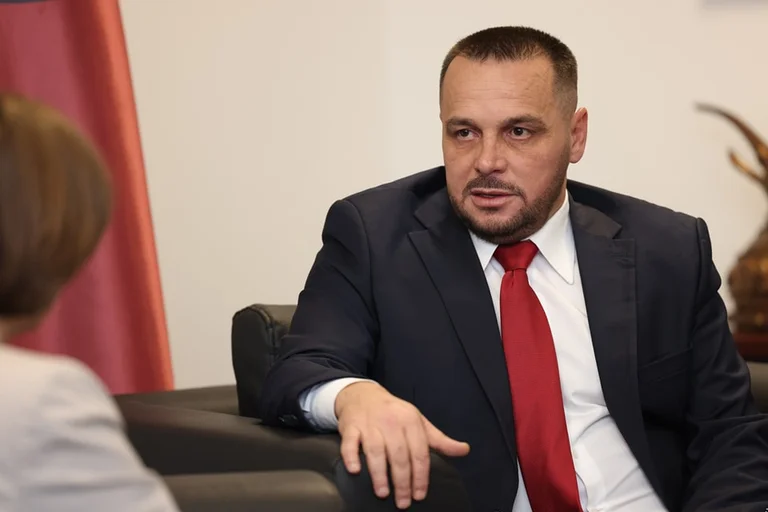
(2 years ago)Kosovo is facing an endlocation of the Serbian army, police and gendarmerie in southern Serbia, mainly along the border line, Defence Minister Ejup Macedonia declares in an interview for The Geopost. In addition to the brigades, it says Serbia has located on the border with Kosovo other capacities that were purchased from China and [...]
Kosovo is facing an endlocation of the Serbian army, police and gendarmerie in southern Serbia, mainly along the border line, Defence Minister Ejup Macedonia declares in an interview for The Geopost.
In addition to the brigades, it says Serbia has located at the border with Kosovo other capacities that were purchased from China and Russia, and that it poses a threat not only to Kosovo, but to all Western Balkan countries. According to him, such danger is too high.
Macedonia also speaks of Russian influence in the Balkans, which says information is the weapon Russia uses to bring down a state. And that, he says, is finding extensions with Serbia's intelligence structures, supported by Russian intelligence structures as foundation.
In an interview with The Geopost, Macedonia also speaks of the capacities of the Kosovo Security Force, which it says is strengthening and is in the second phase of the transition to co-ordination with the United States.
Total interview:
The Geopost: Mr. Minister, can you tell us about the capabilities of the Kosovo Security Force and how you see the US's approval of the Javelin missile supply, what does that mean for Kosovo?
Macedonia: The Kosovo Security Force, the Ministry of Defence, supports the development of the Kosovo Security Force based on the comprehensive transition plan, which has thus been compiled in co-operation with the United States and other NATO partners. This plan has been under way since 2019. We are currently in the second phase of the comprehensive transition plan.
This plan is divided into three main stages. The first phase was completed in 2022 and has largely had to do with preparing the aspect of legislation, doctrine, documents and training for members of the Kosovo Security Force. And we are currently in the second phase of the sweeping transition plan, which will continue until 2025, so the completion of this phase will be 2025, which means that by that time, the Kosovo Security Force will have three valid infantry regiments ready to carry out the duty of protecting the territory, namely, combat duty for the protection of the territory, and ready to be part of joint missions with our partners and allies.
Normally over the past year, you are informed that we've waved a infantry regiment, this regiment has been waved under the exercise “Defeder Europe 23” and are currently in preparation for the wave of the second infantry regiment. The supply, that is, acceptance of the State Department's request for the anti-tank Yavelin system that took place on January 11th of this year, is very significant for us, especially in the fact that with this system we further develop our combat capacities for supporting Kosovo Security Force operations.
These capacities are planned and co-ordinated along with the United States of America and will be built over the years according to plan.
The third phase will begin in 2025 and ends in 2028. This will be the final phase of the transition of the Kosovo Security Force, where we will build other capacities, such as air support capacities and artillery capacities.
Part of them are in place from this stage, and thanks to the continued support we have had from Prime Minister Kurti and the Government of the Republic of Kosovo with an additional budget. So the budget that we've received, as in terms of budget growth, also the additional budget we've received over the past three years, has obviously affected us to develop these capacities far before they were planned and currently, we have it as information we have in place the air support capacities through Bayraktar fears, but we plan to build other capacities. We also have other systems that we already have in place.
All these capacities are being built in co-operation with our partners, and all purchases that have been made are in line with NATO standards, so all of Kosovo Security Force equipment is purchased by NATO countries, are according to NATO standards, and are planned in the inventory of Kosovo Security Force equipment.
The Geopost: There are 48 of Serbia's military bases on the border with Kosovo, as well as the supply of weapons Serbia has received from Russia, how much does this endanger Kosovo?
Macedonia: Yes, the 48 operational front bases of the Serbian Army and gendarmerie are a constant threat to our country, even to the fact that these 48 bases are close to the border with our country's territory, so they are about 300m to 5km from the Kosovo border line and are hostilely directed against our country's territory. In addition to these 48 bases, it is also noteworthy that 3 out of 4 Serbian Army brigades are deployed south of Serbia's territory, and those hostilely directed against our country's territory.
We have an enormation of the Serbian Army, police and gendarmerie in southern Serbia, mainly along the border line with the Republic of Kosovo. In addition to these three brigades, there are other combat formations of the Serbian Army that are deployed south of Serbia's territory, and are mainly based in the Rash, Nis and Vranje, so along our country's entire borderline and these 48 bases that you stressed are an operational extension of these three Serbian Army brigades that are currently in the south of Serbia's territory, and only 1 of Serbia's 4 Army brigades has been deployed north of Serbia's territory, more precisely at the border with the Republic of Croatia.
So most of the military capacities, including the capacities that have been acquired from China and Russia, are located south of Serbia's territory, and this poses no threat only to our country, but to the entire region of the Western Balkans and to other countries bordering the Republic of Kosovo. Adding to that the latest actions taken by paramilitary armed groups instructed by Serbia's security structures, this risk is too high.
The Geopost: How secure is the citizen of the Republic of Kosovo?
Macedonia: Serbia against the Republic of Kosovo is implementing various tactics and forms of war, among them are hybrid threats, so, through hybrid attacks that imply engagement of conventional forces in co-operation with the nonconventional forces against the Republic of Kosovo, in this case, information is one of the elements, propaganda, we can say is one of the elements Serbia is using over years to jeopardise stability in our country, but also to influence and control Kosovo Serb citizens, who, unfortunately their part, not all, have been affected by the report on the integration of the Republic and the society of Kosovo. This information is consistently reflected through various forms, 50% of the media in Serbia remains undirected, there are media that are not known where they are based, and these media have extensions in the Republic of Kosovo as well and tend to continue to create a situation where we would question the stability of our country, trying to create social unrest but other trouble for the citizens of our country.
It's to emphasize that one of the key points of the Russian secret service to destabilise a country, so to kneel down a state is information, and information is always aimed at creating a collective depression, a depression that is also seen in our country and that I appreciate that there is a basis for the intelligence structures of Serbia supported by Russian intelligence structures.
The Geopost: We have discussions about Kosovo's entry into NATO, but first the partnership for peace is needed?
Macedonia: The Partnership for Peace is not a required and necessary step to NATO accession, so it is a step shared by NATO membership. Our country is building defence capacities in line with NATO standards. We, within the framework of the Ministry of Defence and the Kosovo Security Force, have a NATO team that is dedicated to consulting and supporting the development of our country's defence capacities. The entire doctrine that we have built in the Kosovo Security Force and all the planning that is being carried out in the Ministry of Defence is in line with NATO standards, all equipment purchases, all the systems we use are NATO systems, and these steps have been made primarily in order to bring our country into NATO's partnership for peace.
The decision to be part of NATO, but even the partnership for peace is the political decision of NATO members, and unfortunately we still have countries reluctant to recognise our country's independence and subsequently hesitate to accept Kosovo, however, we've had recent approach, during last autumn, at the KSF partner conference, we have also had non-recognitional countries that have participated in this conference aimed at developing the Kosovo Security Force and the FSK integration with NATO, more precisely we had representatives from Greece and that were part of the conference that was held during last October of last month.