3 minutes ago
Businessmen in Kosovo, Serbia weigh benefits from normalisation of relations
Periskopi(3 years ago)
(3 years ago)Pro-co-operation and agreements. This is the position of some businessmen from Kosovo and Serbia, on the eve of meeting the leaders of the two countries, with the aim of normalising relations. For Radovan Mijatovic, director of the company “Hemotehna” from Subotica in northern Serbia, political stability would enable increased trade exchanges. “... would facilitate [...]
For Radovan Mijatovic, director of the company “Hemotehna” from Subotica in northern Serbia, political stability would enable increased trade exchanges.
“... would facilitate and accelerate the transport of goods as well as payment transactions”, (set REL).
His company deals with the production of plastic chemicals.
Similarly, Fyzullah Mustafa, owner of the company “Fluidi” in Gjilan ʹ the eastern part of Kosovo, which operates in the southern part of Serbia as well.
This company is engaged in juice production.
“Normising political relations between the two countries should lead to improved the situation and to removing the [economic] barriers”, Mustafa says.
The economic talks of Kosovo and Serbia, which represent the interests of businessmen in both countries, also agree that an agreement between Pristina and Belgrade, besides removing trade barriers, would create an environment for foreign investment.
Kosovo Prime Minister Albin Kurti, and Serbia's president, Aleksandar Vuciq, will meet on March 18th in Ohrid, North Macedonia, for a new round of talks mediating the European Union.
The EU expects the two leaders to agree on the annex to implement an EU proposal for normalisation of relations.
The contents of this proposal have been accepted in principle, during a meeting in Brussels on 27 February.
“The agreement would mean easier transport of goods”
The company “Hemothehna” from Subotica has been co-operating with business partners in Kosovo for nearly 30 years.
Kosovo companies are our long-term partners. We've been cooperating with them since 1995. They are mainly buyers of ambalages for pesticides, liquid trash and pharmaceuticals”, says company director Radovan Mijatovic.
But, Mustafa, owner of the company “Fluidi” from Gjilan, says that despite the political agreement, “will take time for consumers in Serbia to accept goods produced in Kosovo”.
However, this is in the will of consumers of both countries”, he says.
Since declaring independence in 2008, Kosovo has had different challenges in terms of economic exchange with Serbia, taking into account that official Belgrade does not recognise Kosovo, documents issued by its institutions respectively.
One of the obstacles producers in Kosovo face is the non-recognition of the product origin certificate issued by Kosovo institutions.
Three years ago, the shoe company “Solid” from Suhareka, near Prizren, has been forced to remove “Made in Kosova”, or “produced in Kosovo”, so that it could export goods to Serbia.
So, in “products Solid” can only be found a seal containing Suhareka, or the city they produce.
They [Serbia] have never accepted the made in Kosova. This has made me withdraw from that market... If we buy products in Serbia, why don't they buy ʹMade in Kosova”, says the owner of this company, Quick Kuci.
Mijatovic, owner of the company from Subotica, also tells of the political impact on Kosovo economic relations- Serbia:
“Politics affects creating an atmosphere that leads to reluctance to buy goods only because they are from the regions of Serbia or Kosovo, regardless of how much better and cheaper those goods are”.
Asked what are the biggest obstacles in trade between Serbia and Kosovo, Mijatovic mentions, among other things, border controls that “generally last longer than is needed”, covering state symbols on vehicle plates and campaigns: “Blem local products”.
All of this has an effect on the price of exported goods, and we, as partners, lose pace with competition, which uses every opportunity to enter the market”, Mijatovic says.
Importing Investments
The European proposal aims to lead to the full normalisation of relations between Kosovo and Serbia.
This document, originally known as the Franco-German plan, also has the support of the United States of America.
Representatives of the Economic Odays of Kosovo and Serbia alike express the conviction that the European proposal will eliminate trade barriers between the two states.
The chairman of the Kosovo Economic Ode, Lulzim Rafuna, says its implementation will increase the motivation of foreign investors to extend their capital to Kosovo.
According to him, the occasional political unrest in Kosovo, especially in the Serb-run inhabited north, has presented the country as uncertain in the eyes of international investors.
“Profession of reports represents a kind of judicial and political security. We had a case of tensions, roadblocks, last year. This is not a good mirror to the potential investors”.
The adviser to the head of Serbia's Economic Ode, Nenad Djurdjevic, says implementation of the EU plan will also increase the joint investments of Kosovo and Serbia and, at the same time, will have a positive effect throughout the Western Balkans.
He says the Economic Odas of Serbia and Kosovo have maintained co-operation even in “challenging times”.
We promote business and economic co-operation. Anything that can produce results that we don't depend on any political level I think we've reached”, Djurdjevic says.
Trade exchange between Kosovo and Serbia
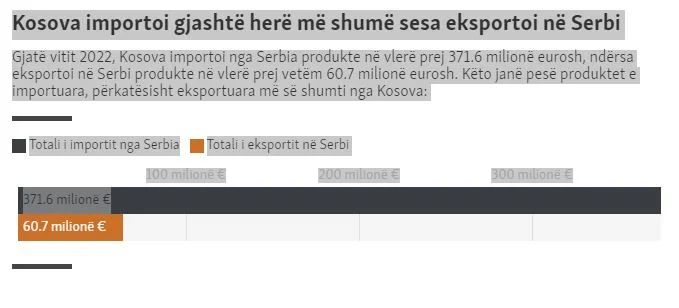
During 2022, Kosovo has imported products from Serbia worth 371.6m euros, while exporting 60.7m euros of products to Serbia, Kosovo Customs data shows.
According to data from Serbia's Republic of Statistics Ent, in 2022, there has been record exchange of goods between Serbia and Kosovo worth about half a billion euros.
Serbia's Economic Ode data shows that Serbia has exported more goods to Kosovo than it imported. The value of exports, according to them, was 467.3m euros, while of imports of 61.7m euros.