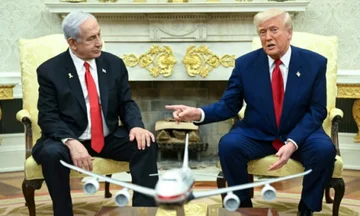
CNN: Netanyahu seeks emergency meeting with Trump amid mounting tensions over negotiations with Iran
 16 minutes ago
 (3 years ago)
Michael Martens in a review-shaped article on „Frankfurter Allgemeine Zeitung FAZ“presents the book of former Kosovo diplomat Blerim Canaj, originally named „Politsischer Scheedwegg. Die Universität Pristina als Brenpunkek ethnonationaler conflicted 1989-1999“ (political twist. Pristina University as the hot spot of the 1989-1999 East Conflict recently published at home [...]
Michael Martens in a review-like article for „Frankfurter Allgemeine Zeitung FAZ“presents the book of former Kosovo diplomat Blerim Canaj, originally entitled „Politischer Scheideweeg. Die Universität Pristina als Brenpunkek ethnonationaler conflicting 1989-1999“ (political twist. Pristina University as the hot spot of national conflicts 1989-1999, recently published in the prestigious German publishing house “Harrasowitz Verlag”
University of Independence
A study shows how Pristina University has played a crucial role in forming a special Kosovo identity, how from a shadow state became a state
By Michael Martens
The conflict for Kosovo remains at the beginning and at the end of Yugoslav wars. When Serbia's President Slobodan Milosevic cancelled the province's autonomy then, the carefully built internal balance of Yugoslavia was destroyed and thus strengthened the existing Croatian and Slovenian trends for partition. Ten years later the attack on NATO on Serbia and Montenegro brought the withdrawal of the Serbian state from Kosovo, which then in 2008 declared its independence.
Blerim Canaj, in his study, investigates the role of the University of Pristina founded in 1970 in the process. “Since its establishment, especially since the 1980s and 1990s the university was met by the media and Serbian politics as the centre of Albanian nationalism”, the author found in the introduction of the book. In fact, the university in the Kosovo capital had become a “through the peaceful struggle of the Albanian people, but also a battlefield of wars and political ambitions” explains further and quotes Southeast European historian Oliver Jens Schmitt, who founded the bilingual university, described as the “emancipative project of Albanians” in which little did become science.
In Serbian nationalist circles, the founding of the University for Serbia's largest minority -- which in Kosovo was the clear majority -- was originally seen as a danger to Belgrade's control of Kosovo. “Albanians were taken away by weapons and given the balls” in a Serbian assessment. The then Serbian calculator was that through an educated teaching staff in Belgrade a pro-Yugoslav Albanian communist “elite in Kosovo, the author estimates. “Bases of Social Markism” and “People's protection” was mandatory in planning university programmes. That a majority of students would later interpret the meaning and purpose of the People's Protection Against Foreign Invasors differently than Serbia had targeted, belongs to the order of the “History” which was not binding in Pristina.
Albanian textbooks and 200 educators from Enver Hoxha's dictatorship
The university's role in strengthening identity was also linked to an event which, when this High School was established, had already been exceeded: Following the Soviet Union's march in Czechoslovakia in 1968, Albania left the Warsaw Pact for what improved relations between Tirana and Belgrade. In the course of an agreement with Albania, Pristina University could introduce textbooks and 200 teachers from Enver Hoxha's dictatorship. And when Yugoslav-Albanian relations deteriorated in the 1980s, teachers sent from Albania were replaced by the first generation of professors from Kosovo. So remained most Albanian - speaking students.
The outside world was first interested in university because of the turmoil started by the university in 1981. The apparent cause was a 2000 protest by 36,000 students against the poor diet of mint. The project spread very quickly. Albanian students, who enjoyed a high prestige and within the Albanian population, were worthy of intellectual elites, joined tens of thousands of Albanians throughout Kosovo, who then officially demonstrated for Kosovo's political establishment and against the poor social situation (...), writes Canaj and features the irredentist element of the protests: “There were no slogans missing which sought a union with Albania and called for the name of Albanian State chief Enver Hoxha<2>. The requirements for uniting Kosovo, which was actually Yugoslavia's most underdeveloped province, but with a living standard higher than with the European country -- the third most poor in the world -- clears up the high degree of then-uniron discontent in most people.
In 1981, Serbia was still on its feet. But the University of Pristina that had earlier become the irreversible factor of forming political will in Kosovo. For example, students supported miners' protests and other social protests. Hundreds of thousands of Pristina protesters and students participated in demonstrations against the removal of autonomy at the end of 1988.
In the eightth years nationalism in Serbia also gained importance as the eho of events in Kosovo until it came to power in Milosevic's figure. Milosevic attempted to return power to Kosovo through the Serbianisation of all key countries. Serbia's “Government Serbizes the entire institutional life in Kosovo and even the University of Pristina by dismissing all Albanian collaborators and students and with the help of state violence by driving them out of building”, Canay writes. Serbian programmes were from now on. Albanian textbooks were banned, teaching language was only Serbian. As a reaction the Albanian elite formed parallel institutions from which they were expelled. The state was created “at Hije”, which the outside world primarily associated with politician and writer Ibrahim Rugova. A shadowed Albanian “Parliament “which met under the open sky declared independence from Serbia but not from Yugoslavia, “University in the Hije” supplied spiritual weapons for political liberation in relation to Serbia. All this Canay is deeply documented by what his book is also a Kosovo story from the 1970s to the 1999 NATO intervention. Development of the University of Pristina is closely related.
Brian Canay: Politischer Scheideweg in Kosovoo. Die Universität Pristina als Brenpunk ethonationaler conflict 1989 1999. Harrasowitz Verlag, Wiesbaden 2023. 249 S., 58.
44 minutes ago