2 hours ago
Albanian police story from 1912, as it started with two Kosovo boys, guards of Isa Boletin
Periskopi(3 years ago)
(3 years ago)By Gjergj Marki that distant November of 1912, while Ismail Kemal asked Isa Boletin to find two faithful Kosovars who had accompanied him to Vlora to guard at the door of the newly formed government office, he never thought that by that act, [...]
That distant November of 1912, as Ismail Kemal asked Isa Boletin to find two faithful boys from Kosovars who had accompanied him to Vlora, to guard at the door of the newly formed government office, he had never thought that by that act, he was unwittingly sanctioning the foundations of the future gun of the Albanian Gendarmerie and her Guard.
So Isa Boletini, while ordering those two young men from Kosovo, named Ahmet Llapi and Haliim Bajgora, to preserve the first prime minister of the newly established government, had never thought of him, that he had given himself the attributes of the commander of Guard, in the first government of the Albanian state. How did the creation of Albanian Gendarmerie and the National Guard continue, and who were the people who commanded it?
Genesis of the Gun of Gendarmery
Genesis's creation of the Albanian Gendarmerie gun, although she left with those young men, mostly Kosovars, who were under the command of Isa Boletin, did not live long. It was dissolved with the government's fall, following the resignation of Albania's first prime minister, Ismail Kemal!
At the end of 1913 until January 1920, when the Loushnje Congress was held, although there was a Gendarmerie's gun, cannot be spoken of as a regular Gendarmerie of the Albanian state, as Albania at that time was occupied by neighbours and held under the administration of the Great Powers, which were appointed by the League of Combes to preserve some of the internal unrest that had swept the entire country and from the risk it faced from abroad, from the Greek armies of the South-Montenegrin Serbs in the north.
In this context, there was the arrival of Dutch Colonel Thompson, who remained in Durres, to Albania in an effort to establish turbulent order, from internal conflicts that had plagued almost the entire country.
The First Schools of Gendarmerie
For the first time in Albania, military schools, or more accurately courses for the preparation of gendarmes opened in 1919, in Vlora and Gjirokastra. These courses were actually beginning to take place in advance, before 1919, when in Tirana, under the auspices of the Austro-Hungarian military, the preparation of soldiers and officers who would be involved in the gendarmerie gun, tasked with maintaining order and quiet, not only in the main cities, but to the villages of the most remote municipalities in the country. These courses were held under the command of Major Ismail Hakki Kuci (born from the village of Kuc of Vlora) and English Colonel Ridolf.
At the time in those courses, considered the first school of Albanian Gendarmerie, a large part of Albanian officers who had studied abroad, such as in Turkey and Austria, who were also the first teachers of that school. Thereafter, in 1921, another school opened in Tirana, which began to be prepared under the officers and soldiers for regular army troops. A year later, in 1922, this school was transferred from Tirana to Vlora, and its destination returned only to prepare the gendarmes. This school in the city of Vlora functioned until June 1924, when the June Rebellion took place that forced down Shefqet Vllac's government, in which Ahmet Zogu held the post of interior minister.
Texting courses for gendars after 1925
With Ahmet Zogu's return to power in 1925, the Zona-Comandas were established and in each of these areas opened by a course in preparing gendarmes. In May 1926 another gendarmerie school opened in the city of Shkodra, which would follow four years later with the school that opened in Durres.
At the order of King Zog, these schools closed on May 1, 1935, and moved to the city of Burrell. The transfer of the gendarmerie school to the city of Burrel was made on the part of King Zog, due to numerous demands to serve in this weapon coming from Matt's provinces, Mirdidita and Debar. From this school, which remained open until 1939, when Italian fascist aggression against Albania was carried out every year, a large number of gendarmes, later distributed throughout the country. In addition to various schools and courses for the preparation of gendarmes, a large number of officers of that arm.e. were sent abroad to both Italy and Austria, where military academys ended.
In 1936, the Albanian Gendarmerie had a colonel, 4 subcolonella, 8 majora, 16 first captains, 32 second captains, 40 lieutenants and 43 subtogersa, having a total of 144 officers in the compound of that arm, with a total budget of 3,250. Thousands of gold francs.
Creation of Special Battalion
Since the Congress of Lusnje, with the re-creating Albanian Gendarmerie's weapon, was established and the creation of a special battalion, which would be of primary duty, the establishment of the peace order in cases of unrest and rebellion against the government.
This battalion, which was put under the command of Major Preng Jakuk (from the village of Prwell of Lezha), who had been educated in a military school in Vienna, was then called the Shute Battalion, for its own nature, from everywhere, by trading operations, in areas where there was unrest and corruption of order and rebellion against the government. Under the command of Major Yaku, this Special Battalion, which was in the composition of Albanian Gendarmerie, managed to impose order and tranquillity and to suppress several anti-government uprisings, such as those Esadists in Durres, Shiyak and Tirana, Bajram Curret at the Tower of Presence (when he attacked Tirana) Gjonmarkaj in Mirdija, Gashi's uprising of Krasniac, etc. Although Major Preng Yaku died. Just by accident in June 1923, by the explosion of a bomb (launching fish in the Valbonne River in Tropoj), the Shitit (special) Battalion continued its activity, confirming its mandate.
Gendarmerie Commanders
Since the Lusnje Congress, at the helm of the Albanian Gendarmaria was appointed major, Meleq Frasher, who held the post until March 1922, when he was killed in Kamez, in attacks by the rebel forces of Halit Llyesh, Dan Canit, Elez Isudf of Colonel Bajram Curri, who from various directions and numerous forces, attacked Tirana with the intention of ousting the government. Following this afternoon attack, there was a rough war that continued all night, through the streets and government buildings of the capital, between rebel forces commanded by Elez Isufi and the government of Gendarmerie who, after the assassination of their commander Meleq Frasher, commanded Interior Minister Ahmet Zogu. After two days and two nights of fighting that terrified the entire capital population, which closed into houses without knowing what was happening, Ahmet Zogu managed to repel the rebel forces of Elez Isufi and Bajram Curri and established peace in Tirana. After that, all ministers and deputies who had been hiding in the forests of Qafe-Kraba returned to Tirana.
With the intervention of British Ambassador Eyres, who was accredited in Tirana, Zogu forgave Elez Isufin and let him go back to Debar, giving him a large quantity of gold. After the assassination of Commander General Meleq Frasher, a year later in June 1924, in an effort with fanolist forces led by Colonel Rexhep Shala, who attacked Shkodra, remained the city's commander of gendarmerie, Captain Ferid Frascher. In 1923, Meleq Frasher, at the helm of Albanian Gendarmerie, was occupied by Major Banu Hamdi, who remained in that post until 1924, when Ahmet Zogu appointed Major Saif Permet. A year later in 1925, Major Permeti left the country with Lieutenant Colonel Ramiz Debar, who stood at the helm of the Gendarmerie gun until 1927, when he left the country undercolonel Kasem Sejdin.
The King's Guard and bodyguard
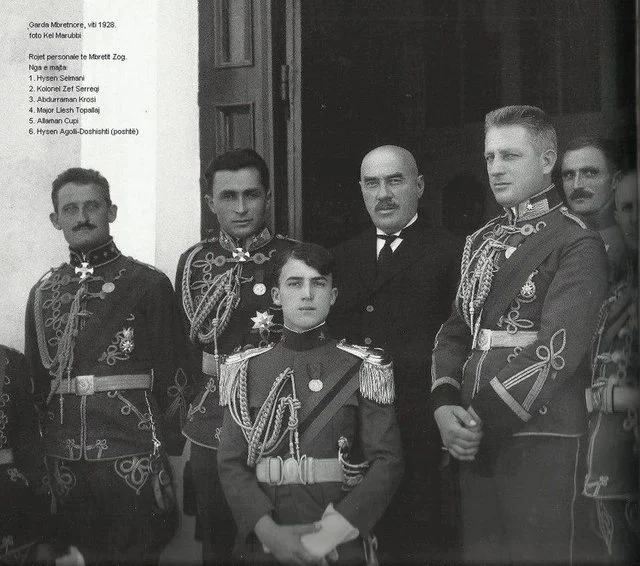
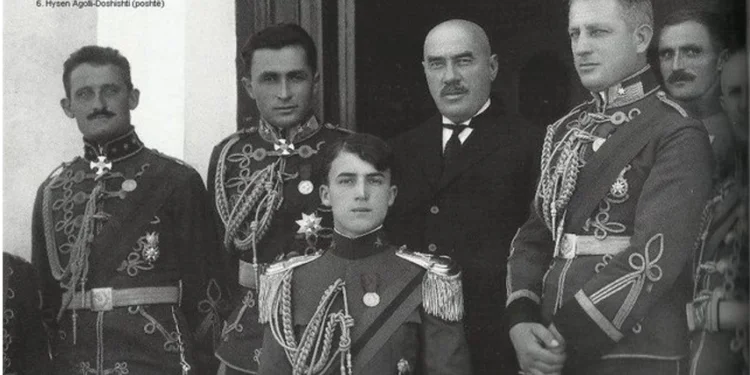
Early in 1925, when Ahmet Zogu returned to power, he devoted special importance and re - creation to the Republic Guard, which was called Royal Guard by the proclamation of Monarchy. At the top of this Guard, consisting mainly of masons coming from northern provinces, such as Matt, Debar, and Mirday, Zogu appointed as commander Major Hysen Selman, a close man known as Bird's grandson. Likewise, the re - creation of the Guard, Zogu chose and his bodyguard, then known as the president of the state's adjutanature. Zogu's first Adjutant was Lieutenant Colonel Zef Serreqi, (Zog considered him the most loyal man), who came from a prominent school family and studied in Austria. As the second adjutant was appointed major, Leesh Topalliaj. After Topallaj, in Zogu's adjutantura, Osman Gazepi, originally from Leskovik, who had been Esat Pasha bodyguard, when he was deputy in the Turkish Parliament and Captain Allaman Chupi, who was from Matti, the birthplace of Zogu. All of these, with the exception of Topallaj who was murdered in 1932 on Vienna assassination, served faithfully to the end of King Zog.
Reorganizing Gendarmerie
With Monarchy's announcement in 1928, the Albanian Gendarmerie was organized into circles, circles, and mailomandash in accordance with the geographical extent of the country's population. After this year, the Gendarmerie's weapon, or King's Redheads, as otherwise known because of red collars, was given great importance and a large number were built to the most remote ends of the country. In this regard, one of the newspapers of the day that echoed her reorganization wrote: “Visset, even the most distant of the homeland, was enriched with a set of buildings in which the military would heave the body and from which he would set out when begging for duties to restore peace and order, where they were vulnerable. The traveler who once feared our mountains passes through today freely and safely, and on the most forsaken of the squirrels, since there is almost no passage in our Eagle, that there may be no vote of gender. It's that in the first few minutes, the post office buildings of this weapon. They didn't even show the most original confort, King Zog's regime, gave you a nice and decent set of buildings for all the military working there”.
In 1938, Albanian Gendarmeria had 3643 effective
In 1928 the total number of gendarmes across Albania totaled about 3,000. That number came up from year to year with nearly 100 gendarmes, and in 1938 their number reached 3643, summing up and the city police, as municipal police were then called. Albanian Gendarmerie from its creation remained faithful to the end the role for which it was created, correctly maintaining the constitutional order. Likewise, in an attempt to overthrow the Monarchic regime, such as the “Vlora” movement in 1931, “Fiter's chairmanship” in 1935, the chairmanship of officers” at the helm of the Toto Brothers, etc., the Albanian Gendarme played a key role in their printing. So loyal she remained to the King that in the fascist aggression of April 7, 1939, in Durres, Zogu appointed the gendarmerie officer, Major Abbas Cup.
British General in Gendarmerie
In 1933, King Zog appointed Lieutenant Colonel Shefki Shatk, one of the most prepared officers of that arms, to head the Albanian Gendarmerie. This same year, King Zog called to the aid of Gendarm.rey, English General Perssie, who made a huge contribution to strengthening and consolidating that weapon. The English general's arrival led to the Royal Gendarmerie's weapon being put on the basis of the relevant new laws and regulations approved by the government. So that year, the Albanian Parliament adopted the new gendarmerie gun law, which was distributed through bulletins in that arm's troops, in all counties and Prefectures. After Monarchy's proclamation in 1928, King Zog ordered the reshuffle of Gendarmerie, relying on a draft law that had been presented on the part of the government. After that, Xandermaria began to be reorganized, changing its forward form into battalions, companies, platoons, and mails. But in 1930, battalions were surprised, and the royal gendarmerie was restored to its old form, which remained unchanged until 1939, when Italian invasion finally destroyed King Zog's Monarchic regime, and with it and the Gendarmerie of the Albanian state...
(Shouting: Next came Italian, German, Communist time, pluralism)